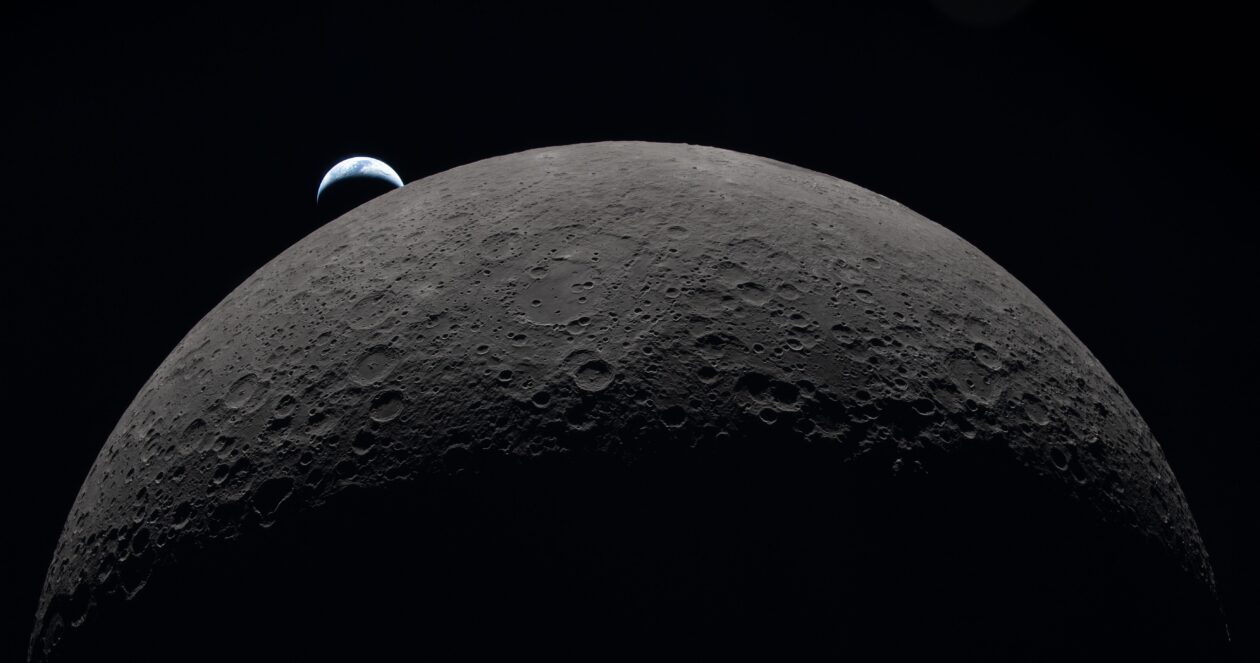
A day after the Artemis 2 mission’s historic lunar flyby, NASA has released a stunning set of high-resolution images documenting Earthset and Earthrise, a solar eclipse that set the moon aglow, and other views of the lunar far side and the astronauts who took the pictures.
The photographs were taken during a seven-hour lunar observation period at the farthest point of the Orion space capsule’s 10-day odyssey. The mission marked the first crewed trip around the moon since Apollo 17 in 1972, and the farthest-ever voyage by space travelers (252,756 miles from Earth, and more than 4,000 miles beyond the moon).
The Earthset photo was captured just as our home planet was sinking beneath the lunar horizon, followed about 40 minutes later by a picture of Earth rising above the horizon on the other side of the moon. The pictures rekindled the spirit of NASA’s original Earthrise photo, taken by astronaut Bill Anders during Apollo 8’s round-the-moon mission in 1968.
As Artemis 2’s astronauts prepared to take their own Earthrise photo, NASA astronaut Christina Koch said she was inspired by the original. “I had the photo up in my room as a kid, and it was part of what inspired me to keep working hard to achieve things I dreamed about,” she said.
The original Earthrise is one of the best-known photos from the Apollo era, but it took decades to confirm who actually took the shot. Anders wasn’t the sort of person to make a fuss over attribution. After a long career at NASA, at the Nuclear Regulatory Commission, in the diplomatic corps and in private industry, he settled down in Western Washington and founded the Heritage Flight Museum in Burlington, Wash. Two years ago, he died in a plane crash in waters off the San Juan Islands at the age of 90.
Anders and the original Earthrise aren’t the only connections linking Artemis 2 with the Pacific Northwest. The success of the mission depends in part on components built in the Seattle area. L3Harris’ Aerojet Rocketdyne facility in Redmond worked on Orion’s main engine and built some of its thrusters, while Karman Space Systems’ Mukilteo facility provided mechanisms for Orion’s parachute deployment system and emergency hatch release system.
Artemis 2’s four astronauts — Koch, NASA mission commander Reid Wiseman, pilot Victor Glover and Canadian astronaut Jeremy Hansen — were scheduled for off-duty periods today as Orion coasted toward Friday’s Pacific Ocean splashdown. The astronauts took questions from the crew of the International Space Station during a ship-to-ship chat.
“Basically, every single thing we learned on ISS is up here,” Koch said. The big difference? “I found myself noticing not only the beauty of the Earth, but how much blackness there was around it,” she said. “It just made it even more special. It truly emphasized how alike we are, how the same thing keeps every single person on planet Earth alive. … We have some shared things about how we love and live that are just universal. The specialness and preciousness of that really is emphasized when you notice how much else there is around it.”
Meanwhile, NASA’s image-processing team put in long hours overnight to work on the pictures taken by Artemis 2’s astronauts during the flyby. Pictures are being posted to NASA’s lunar flyby gallery. Check out these highlights, and click on the images to feast your eyes on higher-resolution views: