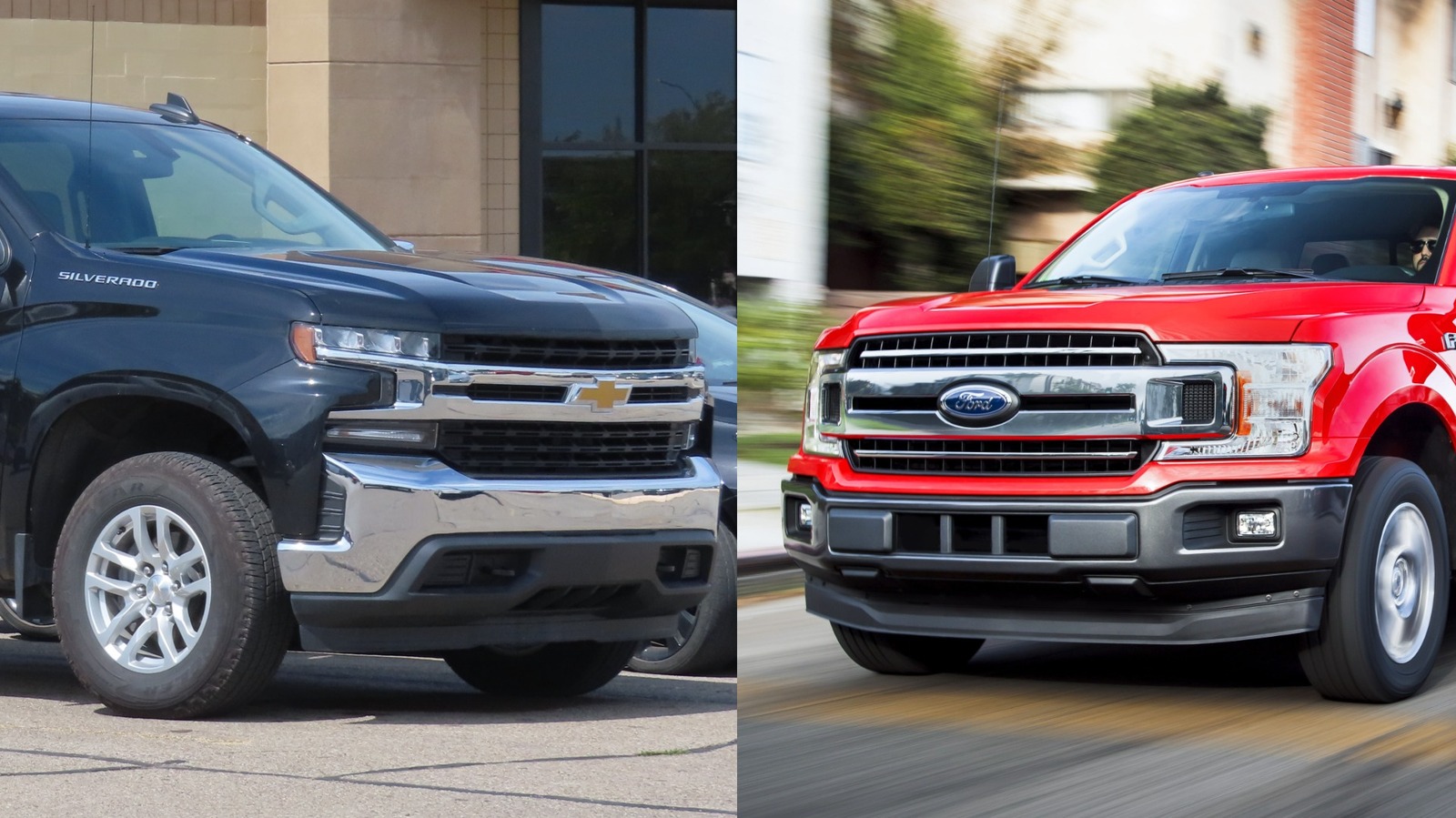
When you think of a turbodiesel-powered pickup truck, at least one that’s sold in the North American market, the first thing that comes to mind is surely a big, heavy duty truck. It is, after all, in these big Chevy Silverado HDs, Ford Super Dutys, and RAM 2500s and 3500s where their respective Duramax, Power Stroke, and Cummins diesel engines are the most popular.
However, at different times over the last decade, smaller versions of these turbodiesel engines have been offered in smaller, half-ton pickup trucks with varying degrees of success and popularity. For example, while it’s less than half the size of the Silverado HD’s Duramax V8, the Duramax 3.0 inline-six is considered one of the best truck engines out there today.
Just before GM debuted the 3.0-liter Duramax for the 2019 Chevy Silverado 1500 and GMC Sierra 1500 trucks, Ford introduced its own 3.0-liter Power Stroke V6 for the 2018 model year as an option for the best-selling F-150 pickup. While these two 3.0-liter engines differ in very substantial ways — different layout, different power outputs, different availability and so on — the goal for both trucks was the same: Bringing the same diesel torque and fuel economy from their heavy-duty siblings into the smaller half-ton package. So let’s take a look at how that worked out and how these two half-ton diesel truck engines compare.
Inline-six vs V6 battle
Before looking at the engines head-to-head, it’s important to point out the elephant in the room — the 3.0 Power Stroke engine is no longer available in a new pickup, and it hasn’t been for a while. Ford discontinued the F-150’s diesel engine option back in 2021, meaning it was only on the market for a few short years. Even so, the short-lived Ford 3.0 Power Stroke makes for an interesting comparison to both the LM2 3.0 Duramax it competed against at the time, and the updated LZ0 version of the engine that GM offers today.
We can start with the biggest difference between the two engines, that being the fact that the Power Stroke 3.0 is a V6 engine while the Duramax is an inline-six. Additionally, while the F-150 might be considered the quintessential all-American pickup truck, the 3.0 Power Stroke actually had its roots in Europe, as it came from the Lion diesel engine family used by both Ford of Europe and other European brands. Likewise, the 3.0 Duramax has a hint of European DNA as well, as GM co-developed the engine with the FEV Group of Germany.
While the Power Stroke’s 250 horsepower rating wasn’t particularly impressive, diesel buyers were likely much more interested in the engine’s 440 lb-ft of torque. The Ford engine, however, was outgunned by the Duramax at the time, with the Chevy engine making 277 horsepower and 460 pound-feet of torque.
Differing priorities
Thanks in large part to the Duramax’s advantage in power and torque, the Silverado got the nod over the F-150 in diesel-powered half-ton truck comparisons at the time. Then, the 3.0 Duramax was made even better with a 2023 update that gave it a substantial power bump to 305 horsepower and 495 pound-feet of torque. However, even if Ford’s 3.0 Power Stroke experiment was short-lived, and diesel F-150s are rare sights on the road, that doesn’t necessarily mean the engine was a failure on its own merits.
Some still praise the 3.0 Power Stroke for its excellent fuel economy and smoothness, with a feeling that Ford pulled the plug before the engine’s potential was fully realized. Ford, however, decided to place its priorities on the F-150’s EcoBoost gasoline engines and hybrid powertrain options rather than sticking with the diesel.
GM’s venture into smaller displacement diesel engine truck engines has proven more successful and longer lasting than Ford’s, with Chevy and GMC not just keeping the Duramax 3.0 on the market after Ford pulled out, but also giving the engine substantial updates as well. Today, when compared against the traditional Chevy 5.3 gasoline V8, the Silverado 1500’s 3.0 Duramax continues to hold its own with its impressive low-end torque delivery and fuel efficiency — albeit at a higher price.