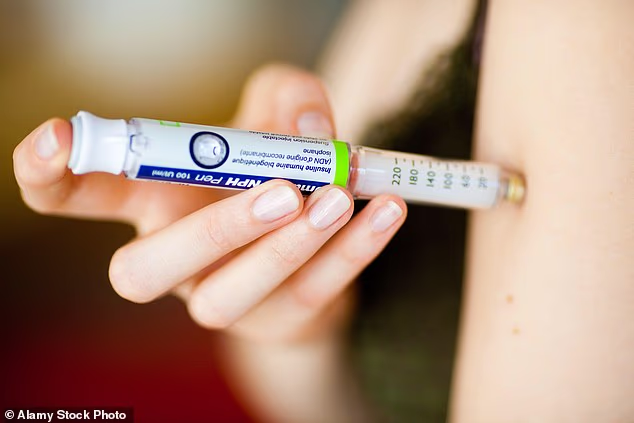
A first-of-its-kind gene therapy trial for type 1 diabetics is set to begin this year, raising hopes that a single jab could transform treatment for millions worldwide.
Adults with the incurable condition will be given a one-time dose of an injection which scientists hope will help the body control blood sugar levels without the need for daily insulin.
Early animal model tests showed the jab – called KRIYA-839 – worked for up to four years without suppressing the immune system.
Unveiled at this year’s International Conference on Advanced Technologies and Treatments for Diabetes, the treatment will now be tested in humans for the first time – and could potentially last a lifetime.
‘In the type 1 community, we’re used to (hearing) this will happen in 10 to 15 years and maybe will come one day,’ announced Jeremy Pettus, an endocrinologist and associate professor of medicine at the University of California, as first reported by Medscape.
‘It’s very exciting to stand here and say that this is actually something that’s in the works and happening now.’
It is hoped that the therapy will work by making thigh muscles – where the injection is given – produce insulin and help regulate blood sugar.
Dr Partha Kar, NHS England’s national speciality adviser for diabetes told the Daily Mail that the development is ‘really exciting’ and has the potential to be a ‘functional cure’ for the condition.
A first-of-its-kind gene therapy trial for type 1 diabetics is set to begin this year, raising hopes that a single jab could transform treatment for millions worldwide
Prof Pettus stressed that the method ‘isn’t gene editing or changing genetic makeup’. Instead it is said to deliver insulin-related genes into muscle cells, where they will stay and keep producing proteins long-term.
He added: ‘This is a proven technology. Now the manufacturing has improved such that we can move away from the (rare) cases to more common diseases like diabetes.’
Around 464,000 people in the UK live with type 1 diabetes, a condition which means the body cannot produce insulin – a hormone needed to convert sugar into energy.
Patients currently rely on daily insulin injections or pumps to manage their blood sugar.
The new therapy could significantly reduce that burden for type 1 diabetics across the world, with Prof Pettus suggesting it could ‘potentially be for the masses.’
Dr Kar said the injection has the potential to ‘help a lot of people if it works’ and that ‘it’s got a potential for being a functional cure’ – even if ‘it’s not a complete one’.
He added: ‘(I see it as really exciting). We’re talking about a lifetime of coming off high doses of insulin or having an artificial system around you because at the end of the day, there’s technology and everything.
Dr Kar believes the two ‘big unknowns’ going into the trials are how much insulin the injection will produce, and how long the effects will last.
But, he said: ‘If you’re saying, ‘hey, listen, we can reproduce 75 per cent of your need of insulin’, and then you probably would be like, ‘wow, that’s a big thing’.
‘I see it as positive. I think I’d be excited if me or if my children had type 1 diabetes. I certainly would be keeping a very close eye on this.’
The treatment is said to involve a short period of ‘immune modulation,’ meaning the immune system is temporarily dampened to help the therapy enter cells effectively.
The injection may be given in both legs during a single outpatient visit lasting up to an hour and could take two to three months to reach full effect.
‘And then, if all goes well, this could last for the entire life of the patient,’ Prof Pettus added.
The initial trial will run for one year and enrol adults with higher blood sugar levels who already use automated insulin delivery systems, allowing researchers to monitor changes.
If successful, future trials could include those who use daily injections.
Tadej Battelino, head of endocrinology at UCH-UMC Ljubljana, told Medscape that he wouldn’t use the word ‘cure’ just yet, adding: ‘I tend to be cautious, so I really can’t give promises. Does this have a potential? Very much so.’
Battelino added that if it can keep blood sugar in a healthy range most of the time, perhaps in combination with technology, then ‘I’m not saying it’s a cure, but a functional cure, for sure.’