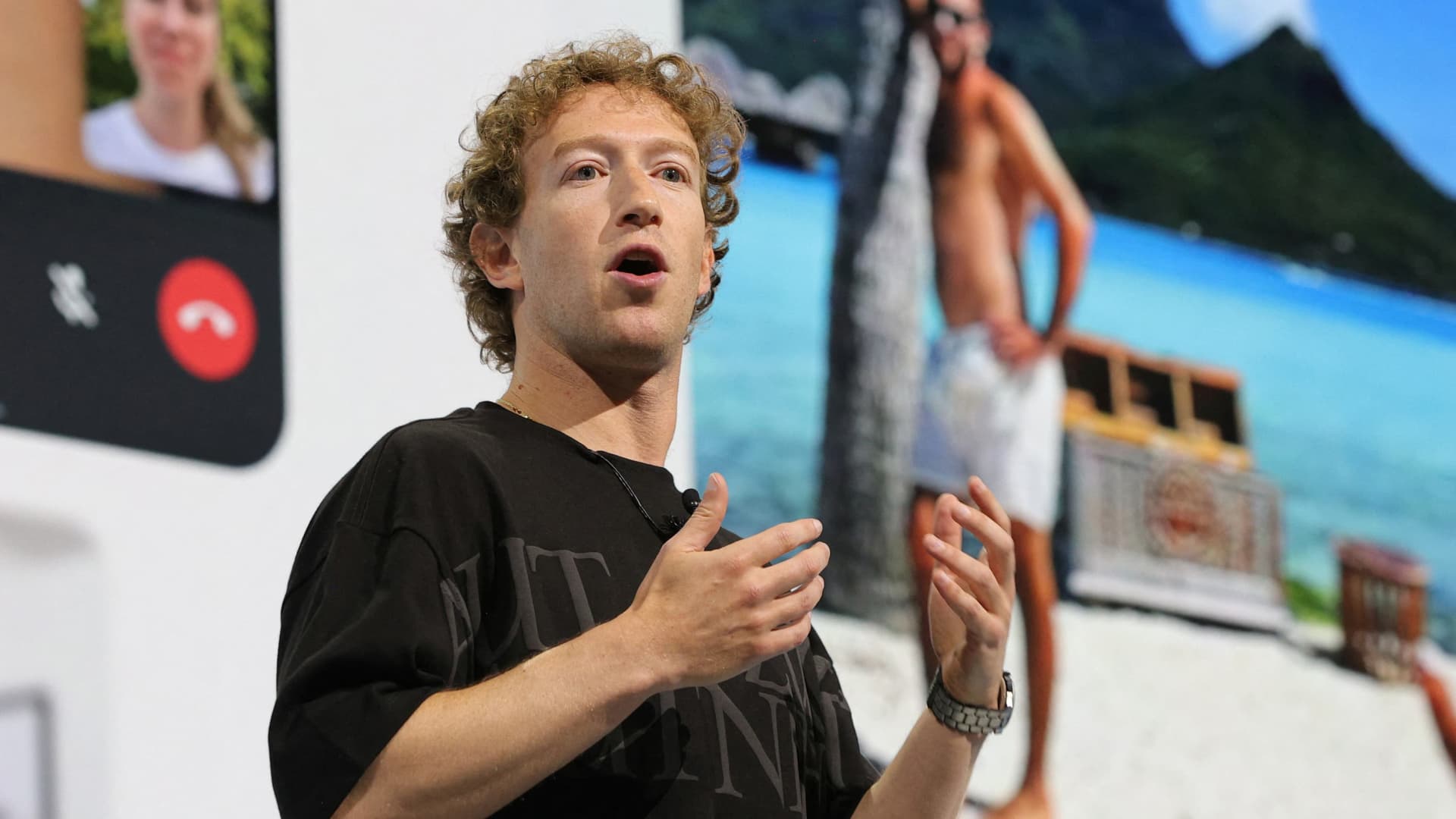
Meta CEO Mark Zuckerberg makes a keynote speech at the Meta Connect annual event at the company’s headquarters in Menlo Park, Calif., on Sept. 25, 2024.
Manuel Orbegozo | Reuters
Meta is debuting its first major artificial intelligence model since the costly hiring of Scale AI’s Alexandr Wang nine months ago, as the Facebook parent aims to carve out a niche in a market that’s being dominated by OpenAI, Anthropic and Google.
Dubbed Muse Spark and originally codenamed Avocado, the AI model announced Wednesday is the first from the company’s new Muse series developed by Meta Superintelligence Labs, the AI unit that Wang oversees. Wang joined Meta in June as part of the company’s $14.3 billion investment in Scale AI, where he was CEO.
Meta is desperate to regain momentum in the fiercely competitive AI market following the disappointing debut of its latest open-source models last April. The release failed to captivate developers, leading CEO Mark Zuckerberg to pivot his strategy.
“Over the last nine months, Meta Superintelligence Labs rebuilt our AI stack from the ground up, moving faster than any development cycle we have run before,” Meta said in a blog post on Wednesday. “This initial model is small and fast by design, yet capable enough to reason through complex questions in science, math, and health. It is a powerful foundation, and the next generation is already in development.”
Meta isn’t positioning Muse Spark as a top-of-the-line model, but is instead highlighting its efficiency and “competitive performance” on various tasks.
The new Muse Spark will be proprietary, instead of open source, with the company saying there is “hope to open-source future versions of the model.” The company had been taking an open-source approach to AI with its Llama family of models.
Meta said in a technical blog about the new model that that improved AI training techniques along with rebuilt technology infrastructure has enabled the company to create smaller AI models that are as capable as its older midsize Llama 4 variant for “an order of magnitude less compute.”
“Muse Spark offers competitive performance in multimodal perception, reasoning, health, and agentic tasks,” Meta said in the post. “We continue to invest in areas with current performance gaps, specifically long-horizon agentic systems and coding workflows.”
Meta is also experimenting with a new AI model revenue stream by offering third-party developers access to Muse Spark’s underlying technology via an API. Currently, only unspecified “select partners” can access the AI model’s “private API preview,” but Meta said that it plans to eventually offer paid API access to a wider audience at a later date.
The new model now powers the company’s digital assistant in the standalone Meta AI app and desktop website. Muse Spark will debut in the coming weeks inside Facebook, Instagram, WhatsApp and Messenger, as well as in the company’s Ray-Ban Meta AI glasses. Meta also plans for Muse Spark to eventually power the company’s Vibes AI video feature in the Meta AI app. That service currently uses AI models from third-parties like Black Forest Labs.
With Muse Spark, users of the standalone Meta AI app and related website will now be able to alternate between certain modes depending on the sophistication of their prompts. Users can get use one mode quick answers to simple questions, and another for more complicated queries related to tasks like analyzing legal documents or gleaning nutritional information from photos of grocery store products.
This is breaking news. Please check back for updates.
WATCH: Alphabet, Meta, Microsoft all down as data center spending rises.