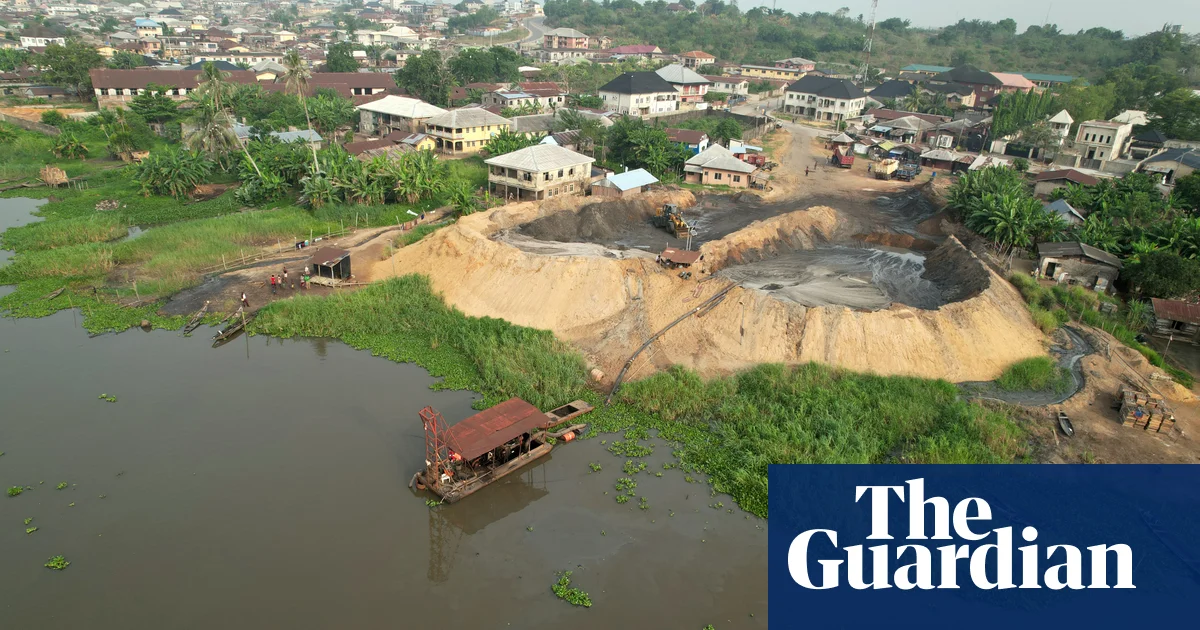
Before dawn, when the noise of Lagos’s danfo buses fills the air and generators rumble to life, the city’s lagoon is already stirring. Not from fish splashing or canoes gliding, but from the long suction pipes of the dredging machines, pulling up the lagoon bed and spitting out wet sand that will be used in the construction of high-rise blocks, housing estates and flyovers.
Sand dredging is regulated by the Lagos state government and the waterways authority but in a city of more than 20 million people, where sharp sand has never been in higher demand, not all dredging is being done by the book.
Unregulated dredging and mining have eroded the seabed by nearly 6 metres between the reclaimed Banana Island and the nearby Third Mainland Bridge, according to a study from the Nigerian Institute for Oceanography and Marine Research (NIOMR). That area is a roughly 5km stretch of central Lagos’s main lagoon channel linking the city’s island districts to the mainland.
“When you dredge sand at that scale without a proper assessment of its environmental impacts, it destroys or wipes out certain species, which harms fisheries and, ultimately, everyone who depends on them,” says Dr Nnimmo Bassey, director of the ecological thinktank, Health of Mother Earth Foundation (Homef).
The effects of dredging extend far beyond the immediate area, causing significant ecological damage and harming local fisheries, marine life, and the coastal communities that depend on them.
This is the reality for Lagos coastal communities such as Epe, Oto-Awori, Era Town, Makoko, and many others.
Fasasi Adekunle pushes his canoe into the dark waters off Epe before daylight. For more than 30 years, this routine has been his life: mend the nets, check the tide, read the wind. Now, the low, grinding hum of dredgers defines his mornings.
“We used to cast our nets at 7pm and return before midday the next day with enough tilapia to earn at least 30,000 naira (£16),” says Adekunle, 55. “Now we go farther, spend more on fuel, and sometimes return almost empty handed.”
The lagoon, once a dependable lifeline, has grown increasingly unpredictable for fishers and fishmongers along the waterfront. “The water is no longer our friend,” says Adekunle.
A number of people the Guardian spoke to said that every rainy season, their homes edge closer to the water.
“As Lagos rises, our land washes away,” says Ogbemi Okuku, 20, who lives in Era Town, a community in Oto-Awori located off the Lagos-Badagry Expressway. “They build estates with sand dredged from our waters. But who is building for us?”
Across Oto-Awori, similar stories abound. Ajoke Orebiyi, a 42-year-old fishmonger, negotiates for a small quantity of tilapia on the boat of a fisher who has just returned from sea. A decade ago, she says, she needed three boatloads to meet demand.
“Before, fishers would return before noon with full nets,” she says. “Now they travel much farther, and spend even more on fuel, only to return with almost nothing.”
Her income has fallen by nearly half in five years. What she earns now must cover food, school fees and rent. When the catch is poor, prices rise, and though customers complain, she can’t control it.
-
Clockwise from top: A fishing boat laid up in Epe bay; Ajoke Orebiyi, a fishmonger, buys fish at the Oto-Awori jetty; Jeremiah, a fisher, sorts his paltry catch and pushes through water hyacinths; and Abay Patrick, 13, a young fisher, displays his catch in Epe
Declining fish populations are a common complaint in coastal areas and are often linked to the climate crisis, affecting water temperature, rainfall and fish distribution. But fishers and fish merchants also say the lagoon floor has changed: deeper dredged channels, murkier water, swirling currents, and nets snagging on an uneven bed.
“When the dredgers operate, the water turns cloudy,” says Jeremiah, a 77-year-old fisher in Oto-Awori. “The fish move away, and sometimes we find them floating dead on the surface.”
Scientists say dredging increases turbidity, muddying the water and destroying breeding grounds, but for those who depend on daily catches, science is secondary to survival.
“What we know is this: the fish are disappearing,” Adekunle says. “And our children still need to eat.”
-
Elizabeth Ayara and Balogun Taiwo, fishmongers in Epe, say they now struggle to make ends meet since their business has dropped off due to the dredging of the lagoon
The crisis in Lagos is part of a larger global story. Sand is the second-most extracted resource after water and a key ingredient in concrete, glass and asphalt. Coastal and marine sands, especially sharp sand, are highly sought after by the construction industry.
But in Lagos, the consequences are especially severe due to its flood-prone, low-lying geography, vulnerable to sea-level rise and sediment disruption.
Dr Joseph Onoja, the director general of the Nigerian Conservation Foundation (NCF), warns that unregulated dredging harms more than fish, endangering sea turtle nesting sites and migratory bird habitats, pushing regional species to extinction.
“We are already seeing early signs of ecosystem collapse in fisheries, migratory birds, and endangered sea turtles that nest on our beaches,” he says. “Sand dredging may not be the only cause, but it intensifies pressures such as sea-level rise and stronger waves, which erode the shoreline and displace long-established fishing communities.”
-
Boatloads of sharp sand, manually extracted from the Oto-Awori Lagoon along the Lagos-Badagry Expressway, are prepared for transport
Mark Ofua, west Africa representative for Wild Africa, a conservation advocacy organisation, says that dredging is driving local species to extinction, with more than 230 fish species in Nigeria’s inland waters already showing population declines, partly due to these activities.
“Dredging causes severe environmental destruction, affecting every level of the food chain, and the entire society ultimately feels the impact,” he says.
Although Lagos has a regulatory framework, in practice, enforcement is weak.
“Most mechanised dredging is usually carried out at night, allowing operators to work under the radar,” says Akan Okiji, another fisher in Epe. “They also change locations to evade being detected.”
There are also claims of complicity among local leaders, which has led to a situation where people are reluctant to speak up.
-
Akan Okiji, a fisher, sits in his boat after returning from a trip with an empty net. He says dredging activities have destroyed the lagoon
“When traditional leaders endorse a dredging company, it becomes very difficult for ordinary people to speak out,” says a community organiser in Oto-Awori. “Many fear the consequences or losing the small benefits they’ve been promised.”
The economic incentives are powerful. Sand mining is highly lucrative, driven by constant demand for land development and turning swamplands into luxury real estate. For local power brokers, covert deals with dredging firms offer a discreet but profitable income stream, while for canoe-based artisanal miners, it is a vital lifeline in a failing economy.
Wasiu Olaniyi, 36, has made a living diving for sand in Oto-Awori for more than three years, bringing up bucket-loads from the lagoon floor bound for construction sites.
He and his colleagues each earn 10,000 naira (£5) a boatload, which they sell to a middleman who supplies bigger buyers. Filling one boat takes three hours. Formerly a bricklayer, Olaniyi now depends on sand dredging to support his family.
Environmental rights activists at Homef and conservationists at NCF continue to advocate full-scale environmental monitoring, habitat restoration, and a dredging moratorium in sensitive areas.
“Development is essential, but it must be sustainable so we don’t destroy the ecosystems that sustain us,” says Onoja. “We’re seeing a breakdown in scientific assessment, EIA approvals, enforcement and even political commitment – and the government must be held responsible.”
The Guardian contacted the Lagos State Ministry of Waterfront Infrastructure and Development and the National Inland Waterways Authority for comment but received no response.