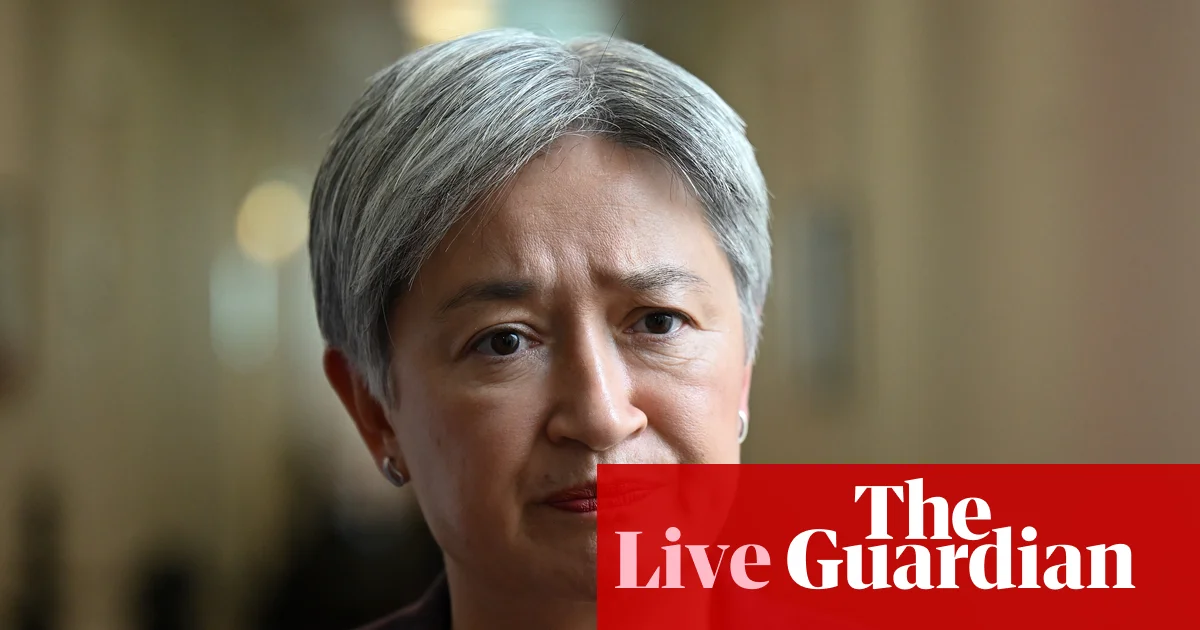
Middle East ceasefire is fragile, Penny Wong says
Penny Wong says the US-Iran ceasefire is fragile but must hold for the sake of the world economy and energy markets.
Speaking on ABC’s 7.30, the foreign affairs minister said there were obvious differences between the two parties but the potential downsides to the truce failing meant it was imperative that it worked.
This ceasefire is fragile, there’s no doubt about that. The ceasefire is fragile but the world does need it to hold. There are obviously substantial points of difference between the parties. But I think we all know that the damage that is happening to the global economy, to global energy markets, means that the world does need this ceasefire to hold.
Asked about whether Australia was on top of its fuel supplies problems, she said the gap in supply still had to be managed, noting Albanese’s trip to Singapore and her own contacts with governments in the region.
And you know, I spoke early on to Singapore, to Korea, to Malaysia, the prime minister, as you said, is going to Singapore, we’ve seen one announcement already and we will continue to work with them. I spoke to the Japanese foreign minister just before this interview, we want to keep engaging with our counterparts, because this is a very large shock to global energy markets, and one that will continue to have an effect.
And asked if the war had achieved its aims, she said:
I can understand people being really concerned about what is happening on global markets and what has happened in the Middle East, and the way this has escalated, which is why we have been saying for some time, it’s time for de-escalation.

Key events
Wong says any further fighting in Lebanon risks ‘whole ceasefire’
Wong spoke to RN Breakfast this morning about the statement, saying if fighting continues in Lebanon, “it risks the whole ceasefire across the region”.
We don’t want that. We want the ceasefire to hold. We know it’s fragile. We know what it means for the world, and we know what it means for Australians at the petrol bowser.
Wong added that Australia led the joint statement with deep conviction that health and aid workers should be protected in conflict zones.
These are the best of us, and they should be protected. They should not be at risk doing their job.
Penny Wong urges ceasefire to include Lebanon in joint statement with other nations
The foreign affairs minister, Penny Wong, released a joint statement this morning urging an end to hostilities in Lebanon as part of the ceasefire announced by US president Donald Trump yesterday.
Wong, alongside dignitaries from Brazil, Colombia, Indonesia, Jordan, Sierra Leone and the UK, said she remained “deeply concerned” by the worsening humanitarian crisis in Lebanon. The group wrote:
Attacks that threaten the safety and security of humanitarian personnel must stop. International humanitarian law must be upheld by all parties to the conflict in all circumstances.
Respect for international humanitarian law is essential to preserving human dignity, mitigating civilian harm, and maintaining the space needed for humanitarian action and access.
Wong added Australia condemns “in the strongest terms actions that have killed UN peacekeepers and significantly increased the risks faced by humanitarian personnel in southern Lebanon”.
Good morning, Nick Visser here to pick up the blog. Let’s see what Thursday has in store.
Li Qiang noted that China-Australia economic and trade cooperation has strong internal momentum and still holds great potential in the long run. Beijing will adhere to expanding domestic demand as a strategic priority, vigorously boost consumption, promote a marked increase in the household consumption rate, and continuously unleash market demand, he said.
Both sides should accelerate the review and upgrade discussions of the bilateral free trade agreement to provide stronger institutional support for cooperation.
The statement said:
There is great potential for China-Australia green cooperation, and China is willing to leverage complementary advantages with Australia to deepen cooperation in such areas as clean energy, electric vehicles, energy storage and carbon reduction, jointly building stronger momentum for the development of the green economy, he added.
For his part, Albanese said the Australian government has always been committed to developing a stable, mature and constructive relationship with China. Under the current international circumstances, the steady development of Australia-China relations is particularly important.
Australia has long adhered to the one-China policy and is willing to strengthen high-level exchanges with China, expand cooperation in trade, investment, mining, clean energy and people-to-people exchanges, properly manage differences in the spirit of mutual respect, and advance the Australia-China comprehensive strategic partnership.
Details of PM’s discusing with China’s premier
More details have emerged of the discussions Anthony Albanese held on Tuesday night with the China’s premier, Li Qiang.
According to a statement issued by the Chinese embassy last night, Li told Albanese that Beijing was ready to work with Australia “to expand and upgrade bilateral trade, support enterprises of both countries in conducting cooperation based on market principles, and promote mutual benefit and win-win outcomes”.
Despite global uncertainty, China and Australia were important partners, Li said, and should “strive to foster and maintain a positive atmosphere, and consolidate the positive momentum in bilateral relations and cooperation”.
Pointing to the success of talks between Albanese and President Xi Jinping last year, China was ready to “maintain high-level exchanges, strengthen communication and coordination, consolidate mutual political trust, deepen mutually beneficial cooperation, safeguard multilateralism and free trade, inject momentum into the development of the two countries and provide more stability for the region and the world at large”.
Middle East ceasefire is fragile, Penny Wong says
Penny Wong says the US-Iran ceasefire is fragile but must hold for the sake of the world economy and energy markets.
Speaking on ABC’s 7.30, the foreign affairs minister said there were obvious differences between the two parties but the potential downsides to the truce failing meant it was imperative that it worked.
This ceasefire is fragile, there’s no doubt about that. The ceasefire is fragile but the world does need it to hold. There are obviously substantial points of difference between the parties. But I think we all know that the damage that is happening to the global economy, to global energy markets, means that the world does need this ceasefire to hold.
Asked about whether Australia was on top of its fuel supplies problems, she said the gap in supply still had to be managed, noting Albanese’s trip to Singapore and her own contacts with governments in the region.
And you know, I spoke early on to Singapore, to Korea, to Malaysia, the prime minister, as you said, is going to Singapore, we’ve seen one announcement already and we will continue to work with them. I spoke to the Japanese foreign minister just before this interview, we want to keep engaging with our counterparts, because this is a very large shock to global energy markets, and one that will continue to have an effect.
And asked if the war had achieved its aims, she said:
I can understand people being really concerned about what is happening on global markets and what has happened in the Middle East, and the way this has escalated, which is why we have been saying for some time, it’s time for de-escalation.
Albanese amps up regional diplomatic push with Brunei talks

Martin Farrer
Anthony Albanese has continued his diplomatic efforts across the Asia Pacific region as he tries to shore up Australia’s fuel supply.
Hours after a possible ceasefire deal was agreed between Iran and the United State on Wednesday, Albanese spoke last night to the sultan of Brunei, Darussalam Haji Hassanal Bolkiah.
The leaders discussed deep concerns with the situation in the Middle East and its consequences for the Indo-Pacific, including the shock to global energy markets.
They agreed to work together on energy supply chains.
Albanese heads to Singapore today to meet the country’s prime minister, Lawrence Wong. Singapore is one of the biggest sources of fuel delivered to Australian markets.
Welcome
Good morning and welcome to our live news blog. I’m Martin Farrer with the top overnight stories and then it’ll be Nick Visser with the main action.
Anthony Albanese has continued his diplomatic efforts across the Asia Pacific region, with talks with the sultan of Brunei last night as he tries to shore up Australia’s fuel supply. Those efforts will see him travel to Singapore today for talks with its prime minister, Lawrence Wong.
Penny Wong said last night the US-Iran ceasefire is fragile but must hold for the sake of the world economy and energy markets. This morning, she called the humanitarian situation in Lebanon – where more than 250 people were killed in Israeli strikes overnight – “deeply concerning”. More coming up.