Oil prices rose back to $100 a barrel on Thursday, reversing a historic single-day drop, as Iran maintained control of the Strait of Hormuz and an Iranian official accused the U.S. of violating elements of a two-week ceasefire agreement.
Brent crude oil futures rose about 6% to just above $100 a barrel, while West Texas Intermediate futures rose about 4% to more than $98 a barrel. Stocks also stalled after a big rally the day before, with the Dow Jones Industrial Average down about 100 points, or 0.2%, while the S&P 500 was off about 0.1% and the Nasdaq $NDAQ lost about 0.2%.
Sultan Ahmed Al Jaber, the CEO of the Abu Dhabi National Oil Company, said on social media that the Strait of Hormuz was not open despite the ceasefire deal.
“This moment requires clarity. So let’s be clear: the Strait of Hormuz is not open,” he wrote on LinkedIn. “Access is being restricted, conditioned and controlled.”
“Iran has made clear — through both its statements and actions — that passage is subject to permission, conditions and political leverage,” he added. “That is not freedom of navigation. That is coercion.”
Earlier, Mohammad Bagher Ghalibaf, Iran’s parliamentary speaker, said Washington had breached the terms of the truce. “The deep historical distrust we hold toward the United States stems from its repeated violations of all forms of commitments — a pattern that has regrettably been repeated once again,” Ghalibaf wrote in a social media post. According to Ghalibaf, three provisions of the truce had been breached: continued Israeli military activity in Lebanon, an unmanned aircraft crossing into Iranian territory, and what he characterized as Washington’s refusal to recognize Tehran’s right to uranium enrichment.
Vice President JD Vance, speaking from Hungary, pushed back on the allegations. “Ceasefires are always messy,” Vance said when asked about the drone. On the uranium question, Vance reiterated the U.S. position that Iran must be denied enrichment capabilities, and he rejected the notion that Lebanon fell within the scope of the deal. Vance also said there have been three different 10-point proposals in circulation — Iran’s initial proposal, which U.S. negotiators rejected, a second draft that President Donald Trump accepted, and a third version circulating on social media.
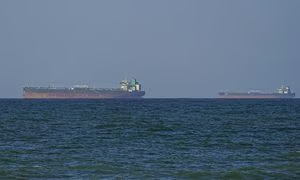
As of Thursday morning, MarineTraffic data showed hundreds of vessels sitting idle in the Persian Gulf, according to CNN, with passage through the Strait of Hormuz barely registering more than twenty-four hours into the ceasefire. Iran’s Islamic Revolutionary Guard Corps claimed shipping through the waterway stopped after Israel’s continued bombardment of Lebanon. Lloyd’s List data shows that before the conflict erupted, the strait handled roughly 107 loaded cargo ships on a typical day.
Talks between the U.S. and Iran are scheduled to begin Saturday in Islamabad, Pakistan. The U.S. team is set to include Vance, special envoy Steve Witkoff, and Trump’s son-in-law Jared Kushner. Iran’s envoy to Pakistan confirmed via social media that his country’s negotiators would touch down in Islamabad before the weekend session.
The ceasefire — brokered by Pakistan and announced by Trump late Tuesday — had sent oil prices sharply lower on Wednesday, with WTI shedding more than 16% and Brent falling more than 13%. The conflict began on Feb. 28 when the U.S. and Israel attacked Iran. Tehran retaliated by targeting commercial vessels in the Strait of Hormuz, a chokepoint that handled roughly a fifth of the world’s oil supply before the war. The disruption has been described as the largest global oil supply shock in history, with analysts estimating a deficit of about nine million barrels a day even after emergency stockpile releases and pipeline rerouting.
AAA’s Thursday figures put the national average for a gallon of regular unleaded at $4.17 in the U.S. — a rise of $1.18, or 40%, compared with prices at the war’s outset.