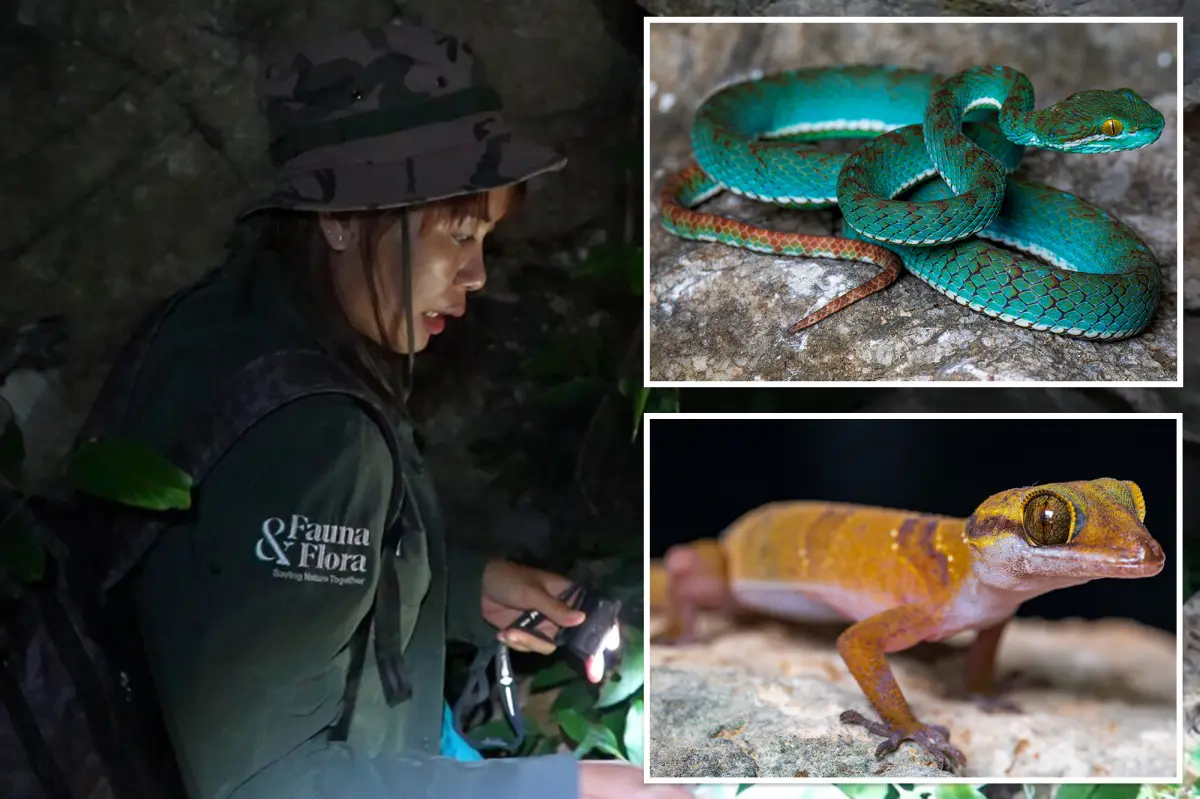
There was a real underground wildlife scene.
A groundbreaking survey of previously unexplored caves in Cambodia has yielded 11 species that are new to science, including pit vipers, snails and other unique critters.
The subterranean excursion, detailed in a March report, was a joint effort by UK conservation charity Fauna & Flora and Cambodia’s Ministry of Environment to study the biodiversity in the labyrinthine cave systems of Western Cambodia’s Battambang Province.
Between 2023 and 2025, the team surveyed over 64 caves across 10 limestone hills in the region’s Karst landscape — a unique topography formed when limestone and other rocks dissolve over time, creating sinkholes, caverns and other manner of underground drainage.
Each of Cambodia’s “karstic hills and caves,” which rank among the world’s most unexplored, serves as a “laboratory of natural selection and evolution,” per Lee Grismer, professor of biology at La Sierra University, USA, who supported the survey team, Jam Press reported. “Think of it as their own vignette of biodiversity, where nature is performing the same experiment over and over again independently.”
A standout unique, newly-discovered menagerie was a resplendent emerald pit viper, which the team described as “highly venomous.”
Identifiable by their diamond-shaped head, these serpents are able to “track down their warm-blooded prey using the heat-sensitive pits behind their nostrils,” per the study.
The team also discovered several species of geckos, two micro-snails and two millipedes believed to be quite poisonous. Some are still formally being described.
The ecosystem was also home to some rare, already-documented species such as the Sunda pangolin, Indochinese silvered langur, long-tailed macaque and green peafowl.
But this wasn’t just some ecological scavenger hunt.
By analyzing the species’ DNA and habitat, researchers are able to get “an idea of what the driving forces are behind the way they evolve,” per Grismer, who added that this knowledge can help them protect them.
“If we are truly going to conserve the biodiversity on this planet, we need to understand what is there,” he said. “We can’t protect something if we don’t know it exists.”
Thankfully, the team has only just scratched the surface when it comes to the region’s biodiversity.
“Cambodia’s karst areas are a treasure trove of scientific secrets waiting to be uncovered,” declared Sothearen Thi, the karst biodiversity coordinator at Fauna & Flora. “From undiscovered reptiles and snails to hidden caves – there is still so much we do not know about these unique ecosystems and the diversity of creatures living within them.”