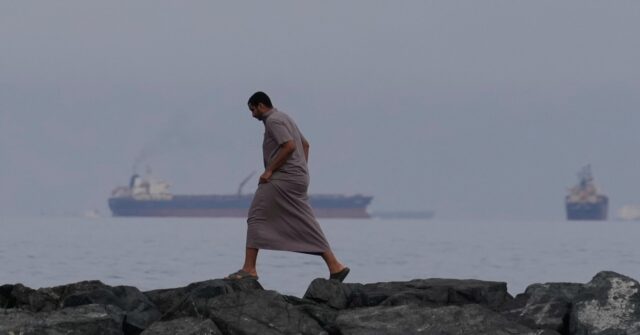
Ship tracking services reported on Thursday that traffic through the Strait of Hormuz remains at less than ten percent of its normal level, despite Iran ostensibly promising to halt terror attacks on civilian vessels as part of its ceasefire agreement with the U.S. and Israel.
Iran closed the long and narrow strait soon after Operation Epic Fury began on February 28, leaving hundreds of oil tankers and cargo ships trapped in the Persian Gulf. The world’s oil supply was cut by about 20 percent, with the most severely affected consumers in China and Southeast Asian nations.
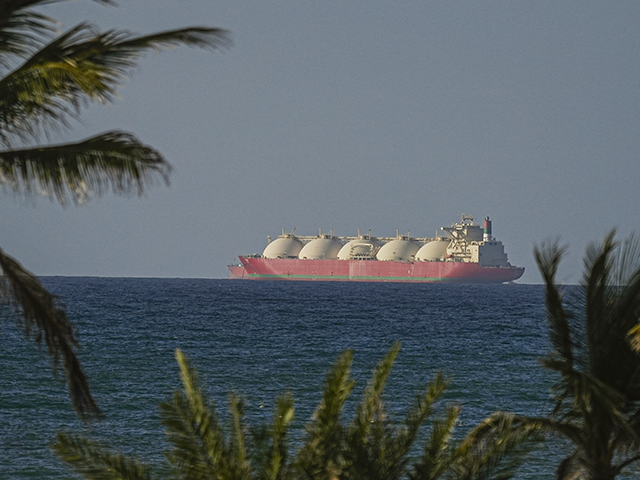
A view from Oman of the vessels passing through the Strait of Hormuz following the two-week temporary ceasefire reached between the United States and Iran on April 8, 2026. (Shadi J. H. Alassar/Anadolu via Getty Images)
The two-week ceasefire agreement announced by President Donald Trump on Tuesday included a commitment by Iran to “the complete, immediate, and safe opening of the Strait of Hormuz.”
Only a few ships managed to make it through the strait before Iran reneged on the agreement, claiming Israel had violated the ceasefire by continuing its operation against the Iran-backed Hezbollah terrorists of Lebanon. Israel and the United States insisted Lebanon was not part of the ceasefire deal.
Reuters on Thursday cited ship-tracking data that showed only seven ships passed through the strait in the previous 24 hours, far below the 140 ships that normally pass through every day. Only one of the seven ships was an oil tanker.
WATCH — Sen. Cotton: China, Iran Are Allies in Fighting U.S. Leadership of International Order:
Iran’s Islamic Revolutionary Guard Corps (IRGC) has told ship captains it is safe to proceed through the strait, provided they follow a particular route to avoid mines laid by the Iranians, but very few ships appear to be risking the passage.
Iran has threatened to begin charging “tolls” of up to $2 million per ship for safe passage, even though it has no legal right to restrict travel through the international waterway. One of the few ships that made the trip on Thursday, an Indian-flagged liquid petroleum gas (LPG) tanker, told Reuters it did not pay a toll or ransom.
Maritime intelligence firm Windward issued a bulletin on Wednesday that said the Strait of Hormuz “remains effectively closed” to most traffic.
“Coordination with Iranian armed forces is still required for all transits,” Windward noted, assessing the intimidating Iranian tactic as a sign “the Islamic Republic is seeking to retain its leverage over the waterway during ceasefire negotiations.”
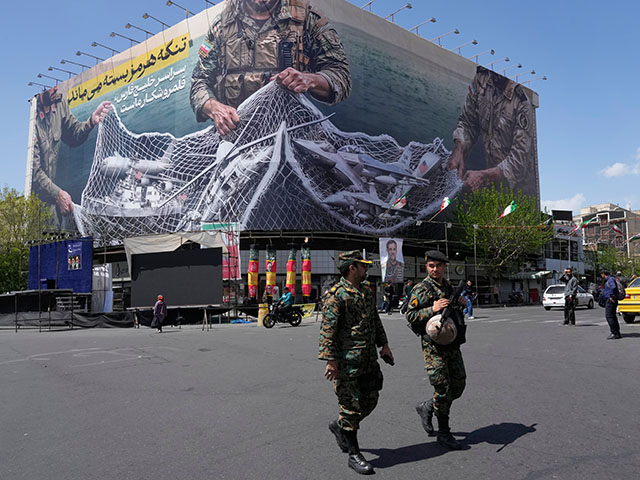
Two police officers walk in front of an anti-U.S. billboard depicting the American aircrafts into the Iranian armed forces fishing net with signs that read in Farsi: “The Strait of Hormuz will remain closed, The entire Persian Gulf is our hunting ground,” at the Eqelab-e-Eslami, or Islamic Revolution square in downtown Tehran, Iran, Sunday, April 5, 2026. (AP Photo/Vahid Salemi)
Ship trackers said two Chinese oil tankers loaded with crude oil from Iraq and Saudi Arabia moved close to the entrance of the Strait of Hormuz on Thursday but apparently changed their minds about passing through.
Shipping giant Maersk issued an advisory on Wednesday that said the ceasefire “may create transit opportunities,” but the situation was probably still too risky.
“Any decision to transit the Strait of Hormuz will be based on continuous risk assessments, close monitoring of the security situation, and available guidance from relevant authorities and partners,” Maersk said.
The state oil company of the United Arab Emirates, ADNOC, said on Thursday that Iran must immediately open the Strait of Hormuz without conditions.
“Iran has made clear — through both its statements and actions — that passage is subject to permission, conditions and political leverage. That is not freedom of navigation. That is coercion,” said ADNOC CEO Sultan Al Jaber, who is also the UAE’s minister for industry and advanced technology.
“Energy producers must be able to swiftly and safely restore production at scale. At ADNOC, we have loaded cargoes and we will expand production within the constraints of the damage we have suffered,” he said.
Jaber restated the UAE’s demand that Iran must be “held accountable and fully liable for damages and reparations” after attacking Emirati infrastructure over the past month.
“The Strait must be open — fully, unconditionally and without restriction. Energy security and global economic stability depend on it,” he said, stressing that Emirati ships loaded with oil are ready to make the trip through the Strait of Hormuz and ease the worldwide oil shock from its closing.