Listen to this article
Estimated 3 minutes
The audio version of this article is generated by AI-based technology. Mispronunciations can occur. We are working with our partners to continually review and improve the results.
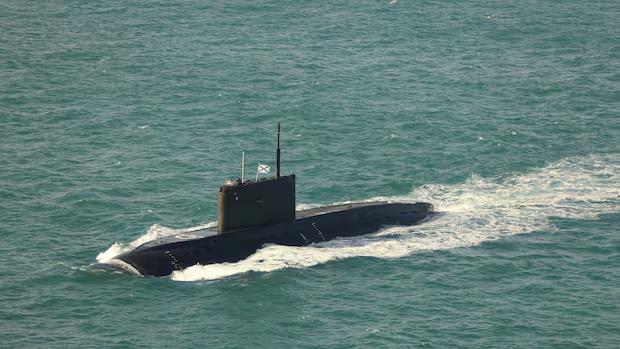
Britain deployed military vessels to prevent any attacks on cables and pipelines by Russian submarines that spent more than a month in and around British waters earlier this year, Defence Minister John Healey said on Thursday.
Britain accused Russia of using the distraction of events in the Middle East to try to conduct the covert operation in the High North maritime region, home to key shipping routes and critical infrastructure such as undersea cables.
Healey said British forces and allies including Norway tracked and deterred malign activity by the Russian vessels, adding that the submarines had now left the area and there were no signs of damage to underwater infrastructure.
Revealing the operation publicly at a news conference, Healey said the intent was to show Russian President Vladimir Putin that the activity had been detected.
“To President Putin, I say ‘We see you. We see your activity over our cables and our pipelines, and you should know that any attempt to damage them will not be tolerated and will have serious consequences,'” he said.
“Our armed forces left them in no doubt that they were being monitored, that their movements were not covert, as President Putin planned, and that their attempted secret operation had been exposed.”

Russia’s embassy in London said Healey’s statement was “impossible to either believe or verify.”
“Russia does not threaten undersea infrastructure, which is of critical importance to the UK. Nor do we employ aggressive rhetoric in this regard,” the embassy said in a statement.
Moscow has previously denied allegations of involvement in a series of incidents in which European countries’ cables were damaged.
Warship, patrol aircraft sent
Healey said the Russian operation involved a Russian Akula-class attack submarine and two specialist submarines from Moscow’s Main Directorate for Deep-Sea Research (GUGI).

Investments are being made across Europe to shore up its defence capabilities in the face of increased Russian aggression and an uncertain defence alliance with the United States. Andrew Chang explores the steps Europe is taking to deter a possible Russian attack.
Images provided by The Canadian Press, Reuters and Getty Images
“They are designed to survey underwater infrastructure during peacetime, and sabotage it in conflict,” Healey said.
After detecting the Russian vessels passing into international waters, Britain sent a frigate, a support tanker and a maritime patrol aircraft to monitor their movements.
Norway’s defence ministry said its armed forces had also deployed a P-8 maritime patrol aircraft and a frigate.
Healey said the submarines had not entered Britain’s territorial waters, but had been in the wider band of sea around the country, known as its “Exclusive Economic Zone,” and the waters of British allies.
Britain’s naval capacity has been under scrutiny in recent weeks after U.S. President Donald Trump criticized the British response to the Iran war, describing Britain’s aircraft carriers as “toys.”
Healey referenced that criticism in his statement, saying it had not been in Britain’s national interest to deploy all its military assets in that region.
“The greatest threats are often unseen and silent. And as demands on defense rise, we must deploy our resources to best effect,” he said.
NATO allies have boosted their presence in the North Atlantic and the Baltic Sea, after a series of power cable, telecom and gas pipeline outages since Russia invaded Ukraine in 2022. Most have been caused by civilian ships dragging their anchors.