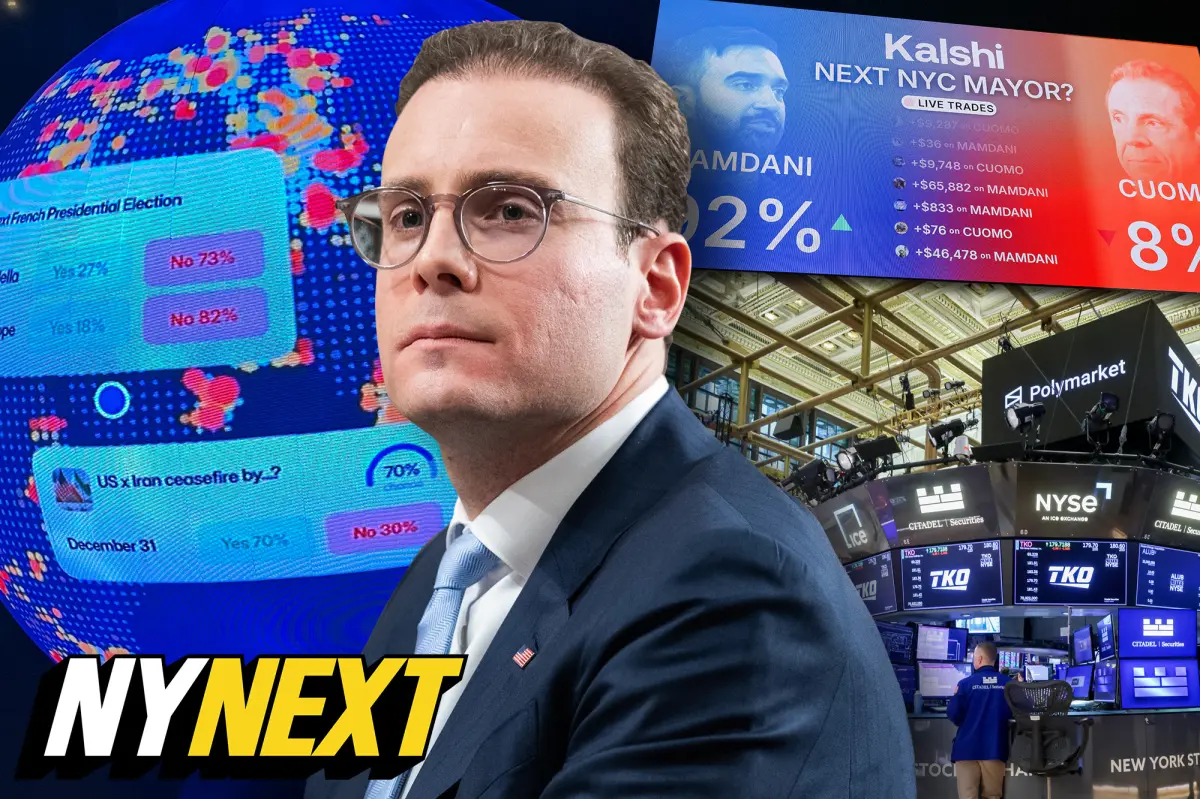
Commodity Futures Trading Commission chairman Michael Selig wants America to be the hub for prediction markets. He also wants the industry to know he is watching every trade.
In a sit-down interview with NYNext at CFTC headquarters in Washington this week, Selig, 36, laid out his vision. The regulator is intent on keeping prediction markets — which allow users to bet on everything from election outcomes to Oscar winners to oil prices — safe for traders. He wants to balance innovation and enforcement in the new regulatory framework he is trying to codify
”I want the United States to be the markets capital of the world,” Selig said. “Whether it’s prediction markets, crypto, traditional markets — if we don’t take leadership there, we’re going to see these markets flourish offshore.”
Ironically, Selig, who was sworn in on Dec. 22, 2025, expected to spend his tenure wrestling with digital assets — e to regulate Bitcoin and Ethereum spot markets or overseeing DeFi developers. Instead he has been inundated with something nobody saw coming at scale: prediction markets, and what Washington’s role in regulating them should be.
Prediction markets drew widespread attention during the 2024 election cycle, when platforms such as Kalshi and offshore rival Polymarket forecasted a Trump landslide at a time when major polls said the race was a toss-up. Now, Washington is racing to figure out how to regulate an industry that didn’t exist at scale just a few years ago — and whether the rules are adequate to stop those with inside knowledge from cashing in.
“We’re investigating various participants in the markets on a daily basis, we’re working with the exchanges … and the exchanges have brought several actions now against persons for insider trading and manipulation in their markets,” Selig told NYNext. “When we see unusual trading activity ahead of a big event … the Oscars … we take action.”
Last month, following the Academy Awards, The Post reported that some betting on the awards may have had an inside track.
But in recent weeks, Selig has been less concerned with bad actors (or Oscar-winning actors) and more concerned with states.
The agency filed suit last week against Illinois, Arizona, and Connecticut, which Selig said are “effectively trying to nullify federal law” by regulating prediction markets as gambling products under state jurisdiction.
He tells me they notched a significant legal win in the Third Circuit Court of Appeals on Tuesday in Philadelphia, where a judge ruled that federal law, not state gaming statutes, governs prediction markets.
This story is part of NYNext, an indispensable insider insight into the innovations, moonshots and political chess moves that matter most to NYC’s power players (and those who aspire to be).
Last month, the CFTC issued an advanced notice of proposed rulemaking — which allows anyone to chime in on whether they think those guidelines are fair. The framework has received more than 1,000 comments which the CFTC is working to fold in.
Some proposed rules are obvious red lines. “An injury contract where a sports player might try to injure another player — that could be manipulated,” Selig said. Contracts tied to unsportsmanlike conduct calls, assassination, or terrorism would be similarly flagged.
But Selig is clear-eyed about what over-regulation costs. He said the Biden administration “drove many of these markets offshore” through regulation by enforcement.
“Unfortunately … there was this attempt just to ban these contracts outright and not set real clear guidelines and rules for what’s susceptible to manipulation.”
He points to the way music was regulated in the early days of the internet as a way for the US to become the hub for prediction markets.
“If you think back to the Napster or Spotify versus iTunes saga,” Selig said, “Once you had clear rules of the road in the United States, once there was a reason to use the more well-regulated and legal platform, everyone started doing that. No one’s using Napster or BitTorrent to get their music anymore. They’re on iTunes or Spotify — and we expect to see the same with prediction markets.
Some critics are worried that Selig may not be aggressive enough and that these markets are inherently predatory.
“If you’re going to use inside information to bet on particular stocks, there are a whole bunch of things that can affect the prices of these things,” David Bieri, an economist at Virginia Tech, told NYNext. Bieri argues prediction markets make insider trading uniquely easy because they allow you to bet on a single, discrete event.
Selig believes it’s not the markets but the inability to oversee them in the US that is the problem.
”The exchanges have to do KYC (Know your customer) and AML (anti-money laundering) checks on all the traders, so they understand who’s in the markets,” he said.
Kalshi requires every user to upload a government-issued ID and submit to identity verification. All trading activity is reported to the CFTC daily, Kalshi’s head of enforcement, Bobby DeNault, told me.
Exchanges that are based and operate overseas, like Polymarket, have no such oversight, which means anonymous crypto wallets with money from anywhere in the world can potentially sway public perception in an election.
Robin Hanson, the George Mason economist who pioneered prediction market theory, believes all of this is ultimately trying to undermine free markets entirely
“People don’t like prediction markets and decided that [highlighting possible] insider trading is the approach to take” to undermine them, he told me.
Insider trading, he argues, is far more rampant elsewhere. “Ordinary markets have insider trading they don’t like to admit [to], and the vast majority of it is never caught.”
He notes that a significant amount of price movement in a stock happens before a company makes a public announcement, “and that is due to insider trading … and that is vastly more than the level that is caught.”
Not surprisingly, Kalshi makes the same argument. “The average retail trade on Kalshi is well under $100 … making it hard to profit meaningfully from inside information without triggering automatic flags,” DeNault said.
“Any trading activity that’s abnormally large is going to stand out,” he added. “We don’t have anybody making those kinds of profits in our market.”
Hanson added this is the same debate that always pops up following financial innovation whether it’s insurance, commodity futures, options, or stocks.
“Almost all financial markets were illegal initially because they were seen as gambling.”