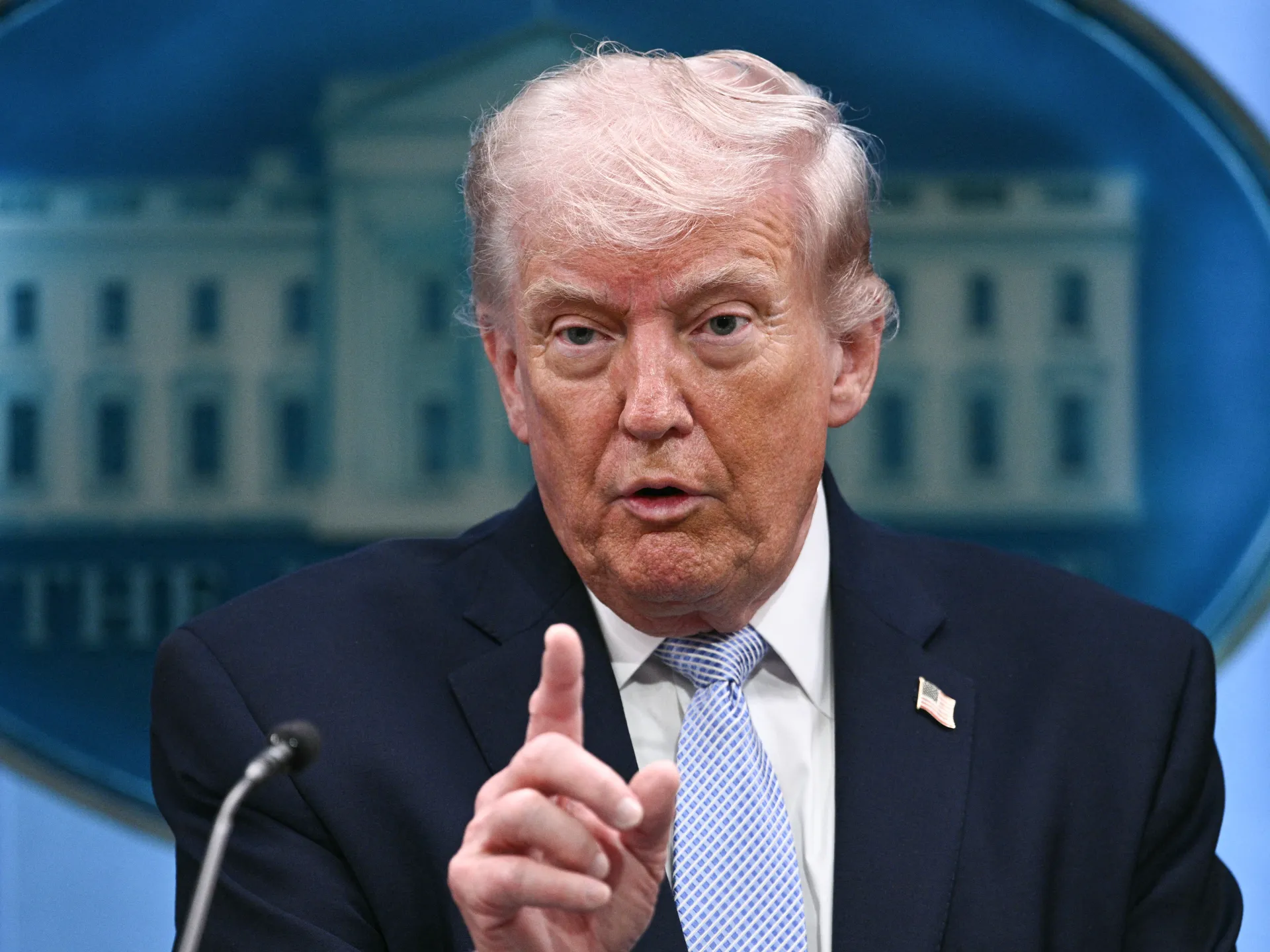
The case is to overturn the temporary tariffs that Trump imposed after the Supreme Court struck down his earlier ones.
Published On 10 Apr 2026
The centrepiece of United States President Donald Trump’s economic policy — sweeping taxes on global imports — is under legal assault again.
A three-judge panel of the US Court of International Trade, a specialised court in New York, is hearing oral arguments on Friday in an attempt to overturn the temporary tariffs Trump turned to after the Supreme Court in February struck down his preferred choice — even bigger, even more sweeping tariffs.
Recommended Stories
list of 4 itemsend of list
Several US states and small businesses have said the 10 percent global import tax that Trump imposed in February sidesteps the Supreme Court ruling that invalidated most of his previous tariffs.
A group of 24 mostly Democratic-led states and two small businesses sued the Trump administration to stop the new tariffs, which went into effect on February 24.
Oregon’s lawyer Brian Marshall told the judges they should block the 10 percent tariffs rather than let them expire on the normal 150-day timeline, to keep Trump from invoking a variety of laws to keep them indefinitely.
“[If] we have a successive series where there’s always tariffs in place, that’s a problem,” Marshall said.
Marshall also said the tariffs were based on archaic authority that was meant to protect the US dollar from sudden depreciation in the 1970s, when dollars could be exchanged for gold reserves held in Fort Knox.
He said that authority was meant to resolve significant “balance-of-payments deficits”, and Trump cannot repurpose it to address routine trade deficits.
Tariffs, a central pillar
Trump has made tariffs a central pillar of his foreign policy in his second term, claiming sweeping authority to issue tariffs without input from Congress.
The administration has said that global tariffs are a legal and appropriate response to a persistent trade deficit caused by the fact that the US imports more goods than it exports.
“President Trump is lawfully using the executive powers granted to him by Congress to address our country’s balance of payments crisis,” White House spokesperson Kush Desai said.
Trump imposed the new tariffs under Section 122 of the Trade Act of 1974, which authorises duties of up to 15 percent for up to 150 days on imports during “large and serious United States balance-of-payments deficits” or to prevent imminent depreciation of the dollar.
The states and small businesses argue that the Trade Act’s tariff authority is meant only to address short-term monetary emergencies, and routine trade deficits do not match the economic definition of “balance-of-payments deficits.”
Trump announced the new tariffs on February 20, the same day the Supreme Court handed him a stinging defeat when it struck down a broad swath of tariffs he had imposed under the International Emergency Economic Powers Act (IEEPA), ruling that the law did not give him the power he claimed.
No US president before Trump had used the IEEPA or Section 122 to impose tariffs. The two lawsuits do not challenge other Trump tariffs made under more traditional legal authority, such as recent tariffs on steel, aluminium, and copper imports.