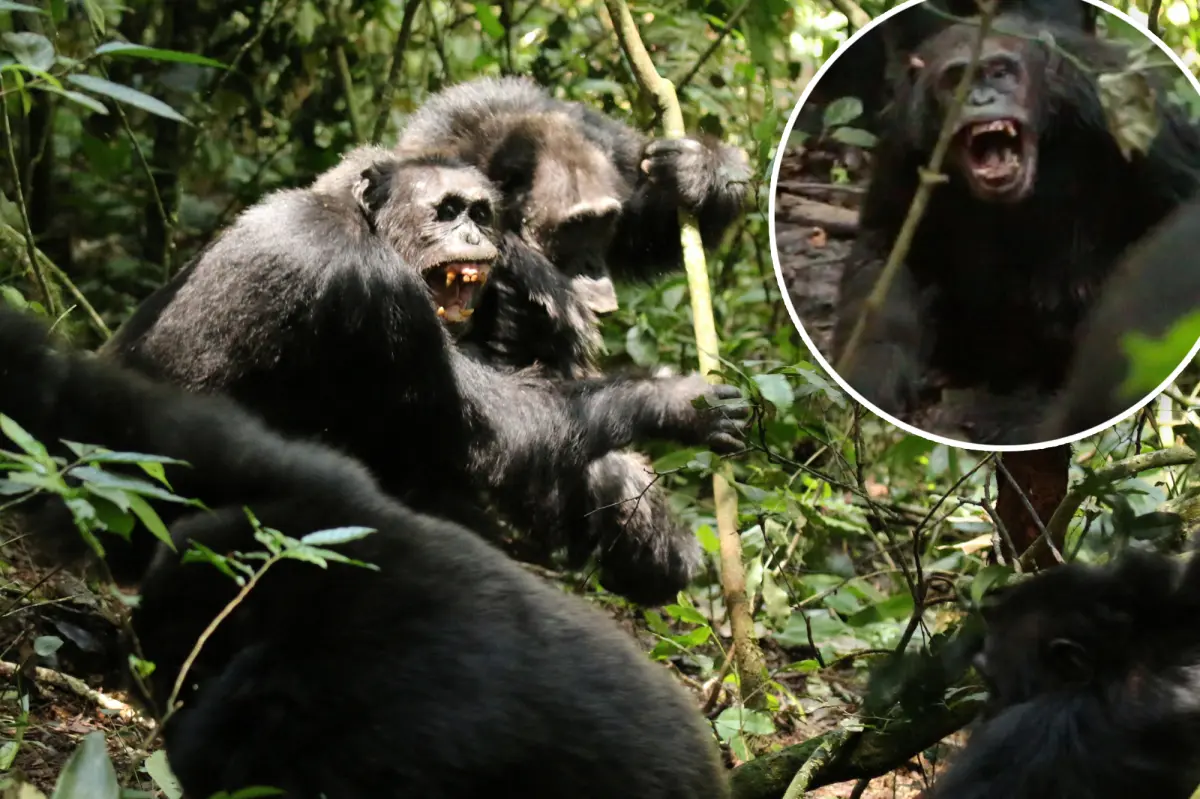
They’re going apes–t.
A scenic Ugandan jungle has become a bloody battlefield as two rival chimpanzee clans wage what could be the first recorded primate “civil war.” The ongoing simian conflict was detailed in a study published April 9 in the journal Science.
“Chimps from one group began attacking and killing those from the other group and that turned into an escalated period of lethal violence,” study author Aaron Sandel, an anthropologist at the University of Texas at Austin, told Livescience.
While the late great primatologist Jane Goodall had reported of a similar “fissure” 50 years ago, this marked the first time that such an intra-tribal schism had been researched and documented as it occurred, the Times reported. Although chimp communities often compete with neighbors over land and resources.
Sandel and his team had been researching the Ngogo chimpanzee community of Uganda’s Kibale National Park, a large and well-known group of primates that has been extensively studied for 30 years.
Comprised of over 200 members, the ape clan appeared fairly tight-knit aside from a few “clusters” and subgroups that existed within the troop.
However, between 1998 and 2014, a noticeable rift sprang up as disparate cliques formed, including a gang of three males.
By 2015, the formerly cohesive community had split into two clans that lived and reproduced separately with the aforementioned trio presiding over one of them.
It’s yet unclear what caused the schism. However, the researchers postulated that several adult males who acted as ambassadors between different factions died, leading to strained relations and a “change in the male dominance hierarchy.”
James Brooks, an evolutionary anthropologist at the German Primate Center in Göttingen who wasn’t involved in the study, postulated that there weren’t enough resources to sustain such an unusually group, which notably boasted 30 males.
By 2018, ties had fractured completely and, like with every group from the Mongols to the Mexican cartels, these splinter factions began vying for primacy.
They even occupied separate territories, similar to gangs presiding over turf.
“What followed was a series of lethal attacks by the western group on members of the central group,” the researchers wrote. “These raids resulted in multiple killings of adult males and, beginning in 2021, expanded to frequent infanticide, averaging several deaths per year.”
The dead young were often eaten, per the study.
It’s yet unclear how the apes dispatched one another, but chimps typically beat each other to death and tear at flesh with their teeth.
Chimps who had been pals in the halcyon days turned on each other after the split.
“What’s especially striking is that the chimpanzees are killing former group members,” said Sandel, who said that the conflict is ongoing with attacks as recent as this year.
Nonetheless, the researcher was reticent about labeling the spat a “civil war.”
“Civil war means something very specific when we talk about humans, and chimps don’t have nations and things like that, but there’s an important conceptual point when thinking about war against strangers versus civil war,” he said. “These are chimps that know each other.”
However, Brooks believes the somewhat anthropomorphic term is apt and even helps shed light on how division can lead to bloodshed in “human societies” as well.