Cheers and clapping erupted inside the John H. Chapman Space Centre in Longueuil on Friday evening as Canada’s Jeremy Hansen successfully returned to Earth with the Artemis II crew.
“Now is the beginning,” former astronaut Steve MacLean told The Gazette.
More than 100 workers and their families gathered at the agency, watching the return on live screens, as hundreds of thousands tuned in on NASA’s live stream around the world.
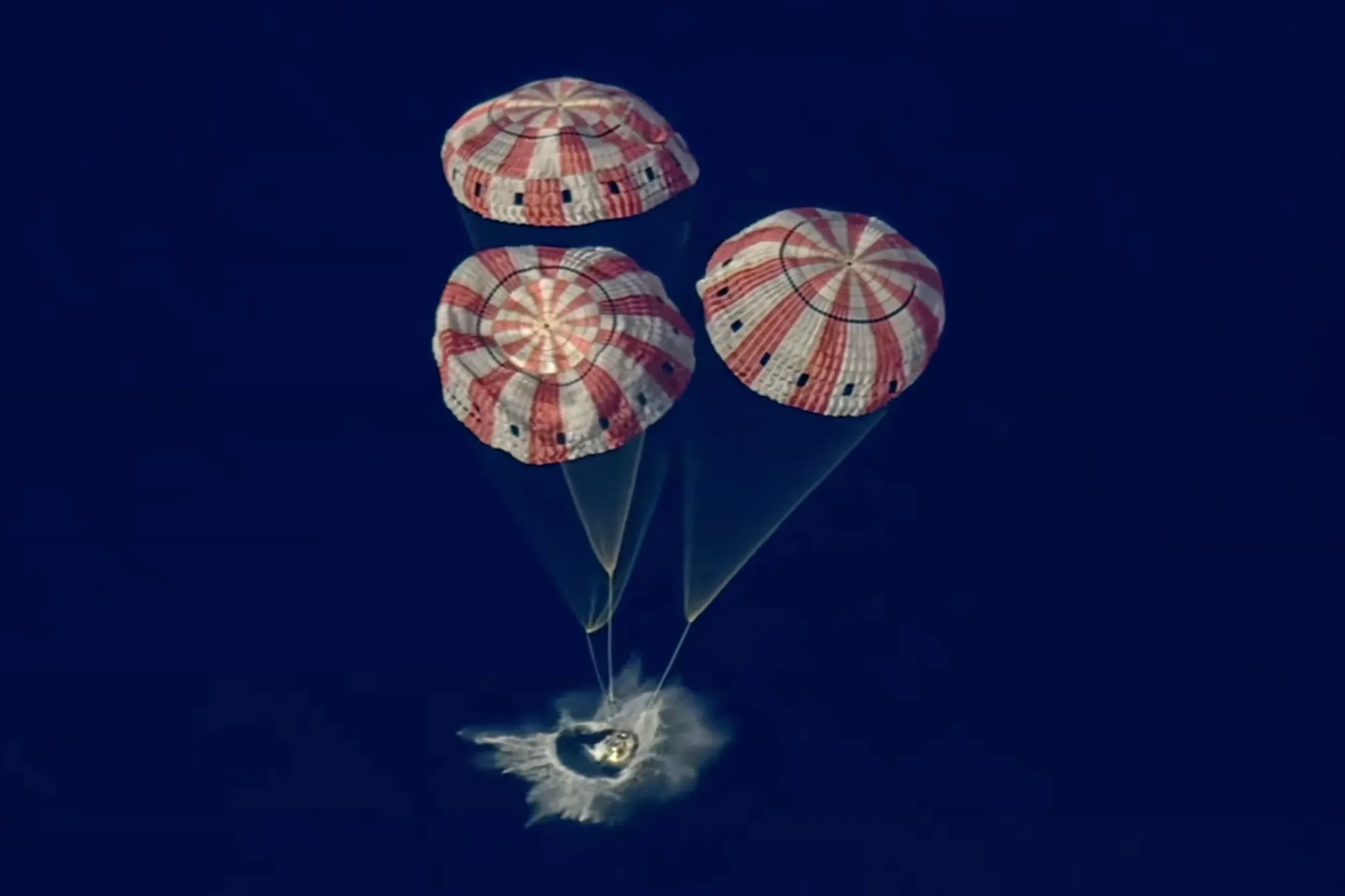
At 8.07 p.m. ET, the crew splashed down in the Pacific Ocean.
“What a journey. We are stable one, four green crew members,” Commander Reid Wiseman reported to mission control. (“Green” meaning healthy.)
Hansen and crew’s return marked the end of a mission that carried humans farther into space than any crew in more than half a century.
The four-member Artemis II crew — Cmdr Wiseman, pilot Victor Glover, mission specialist Christina Koch and Hansen — left Earth on April 1, looping around the far side of the moon and witnessing a solar eclipse.
“Mission accomplished,” NASA administrator Jared Isaacman celebrated in a post on X. The mission lasted 9 days 1 hour 31 minutes and 35 seconds, according to NASA, rounding up to call it a 10-day mission.
“This was a test mission, the first crewed flight of SLS and Orion, pushing farther into the unforgiving environment of space than ever before, and it carried real risk,” he said, praising the crew.
The about 13-minute re-entry back to Earth saw plasma built up on the outside of Orion and temperatures reached nearly 2,760C. Orion re-entered Earth’s atmosphere at roughly 40,234 kilometres per hour.
That plasma build up also caused a blackout with mission control for around six minutes.
Editor’s Picks
“It starts when they come through the atmosphere. As soon as you have a plasma around it, the plasma reflects all the radio waves, so they can’t go out or come in,” MacLean said earlier at the agency Friday evening.
Once through, parachutes then deployed, slowing it to around 27 km/h before it splashed down in the ocean.
Recovery teams are expected pick up the capsule by helicopter and take the crew to the USS John P. Murtha, where the astronauts will undergo initial medical checks before returning to shore and flying to Johnson Space Center in Houston.
The crew have been living in a space roughly the size of a minivan, sleeping in suspended bags and eating prepackaged meals while exercising daily to maintain muscle strength in microgravity.
There were also minor early glitches during the course of the mission, like a temporary communications issue and a fault in the toilet system.
Each astronaut was permitted to bring a selection of foods they were willing to eat at room temperature. Hansen said his choices included a handful of Canadian staples, including maple syrup.
A subsequent viral video showing a jar of Nutella floating inside the spacecraft prompted Carney to, jokingly, remind the crew Canadians prefer maple syrup on their pancakes.
Upon take off, Hansen described the disorienting view from orbit: watching Earth shrink dramatically from the capsule window, only to feel as though they were plunging back toward it.
“It felt like we were going to hit it,” he said, recalling the ascent into orbit. “It’s amazing that we’re actually going to go around and miss this thing.”
In the days leading up to their return, the astronauts had regular contact with Earth. Along with media, U.S. President Donald Trump and Prime Minister Mark Carney each spoke with the crew. Both congratulated them and extended invitations to meet upon their return.
Maclean said before that among his top priority was the safe return of the crew.
“It’s just such a sense of relief,” he said after. “You know, I said before, I was confident, but it’s risky.”
“It’s just really refreshing to have good news. The fact that this kind of a program can kind of make the world think as one.”
Leonard Wang, who studies Machine learning at University of British Columbia Internship and is interning at the agency, was also among those who gathered at the agency Friday.
“We’re so lucky to be here at such a time,” he said, applauding Hansen and the Artemis 2 crew.
Over the past week and a half, he added that the mission has galvanized the agency’s atmosphere.
Asked if he’s been inspired by Hansen: “Absolutley,” he repied, adding that he hopes to do something useful in society.
Hansen, a former Royal Canadian Air Force fighter pilot from London, Ont., was selected as an astronaut by the Canadian Space Agency in 2009. He had since worked in mission control in Houston and taken part in underground and underwater space simulations.
The Artemis II crew was announced in 2023, a milestone that signalled Canada’s deepening role in NASA’s return-to-the-moon program.
“It is such an extraordinary example of collaboration,” Hansen said from inside the Orion spacecraft early Saturday morning, reflecting on the partnership between the United States and Canada.
“I am so proud of our country,” he said.
“If we can send a human around the moon in 2026, just imagine what we’re capable of doing next.”
What do you think about Jeremy Hansen and the Artemis 2 mission? Write to me at hnorth@postmedia.com