Donald Trump has hung nine glowering portraits of himself throughout the White House, each one projecting a variation on the theme of intimidation. But gazing into his narcissistic pool of grimacing images has not calmed him when in his mind’s eye he stares into the abyss of the worst failure of his life.
Trump’s fiasco has inspired him to heightened performances of profane, vile and vicious threats. His grammar of atrocity has escalated from hateful rhetoric to threats of war crimes. What might have initially appeared as rage-quitting the video game that the White House communications department makes of his Iran War has crossed an inviolable red line of international law. His pouting and foot stomping have led him into the gravest territory.
When Trump launched his war, he seemed to have convinced himself that it would be over within days, with the complete capitulation of the Iranians and its oil in his hands to auction off at his whim and self-enrichment. He had been warned by the chair of the joint chiefs, however, that military hardware could not resolve the problem of geography. He waved away the caution as meaningless. The Iranians proceeded to achieve superior leverage by clamping a vise on the strait of Hormuz. The prospect of a lone drone or mine was sufficient to teeter the global economy. Trump had nothing to say to counter the fees of Lloyd’s of London, the shipping insurance firm, which declared the strait a “very high-risk area” and raised the rate of its premium astronomically on a daily voyage-by-voyage basis. The traffic dried up. Trump had the bombs, but not the cards.
Less than two weeks after he had begun his war, on 11 March, Trump confidently said: “Any time I want it to end, it will end.” He knew it would end “soon” because there was “practically nothing left to target”. His greatest monument, greater even than his ballroom, more lasting than the glittering gold appliques he slapped on every wall in the White House, would be rubble and ruin. Two days later, he said he would know when to end the war “in my bones” – presumably not his bone spurs.
In his only significant speech to the nation on the war, on 1 April, Trump blustered that he was “now winning bigger than ever before”. He had “beaten and completely decimated Iran”. The job already done, he passed on the task to “the countries of the world that do receive oil through the Hormuz strait” to “just take it,” which “should be easy”. He added brightly: “It will just open up naturally.” Declaring victory, he waved the white flag.
Trump’s speech, the most confused and banal wartime address ever delivered by a president, was at best a stopgap. But for what? He did not even offer a sliver of Micawberism, the empty hope that something will turn up. But, in a phrase, he offered a rudiment of an idea. All at once, he expressed his exasperation, exhaustion and anger at his impotence.
The day before his speech, Trump had signaled his rhetorical escalation, speaking about “very hard” strikes and “finishing the job”, despite having also talked about having “won” and proclaiming “victory”.
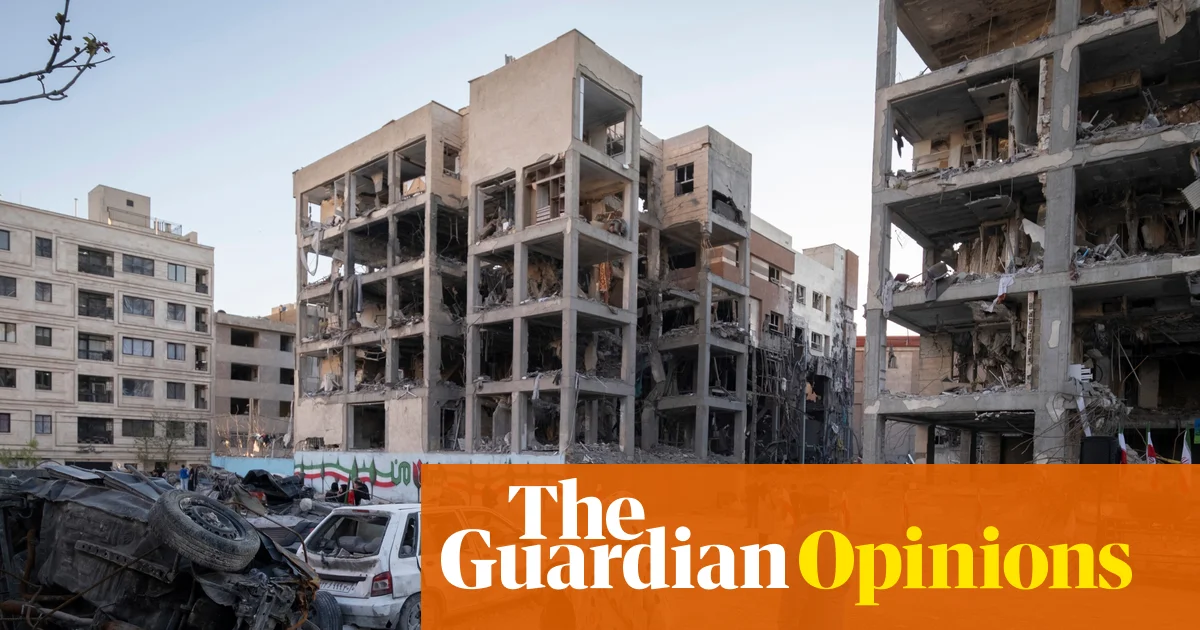
Now, he introduced a new trope. “We’re going to bring them back to the Stone Ages, where they belong,” he said. His targets, it became clear, would be infrastructure: power plants and oil fields. His disinhibition had formed itself into a doctrine of war crimes. Secretary of defense Pete Hegseth posted the next day: “Back to the Stone Age.” Trump’s words were reduced to a slogan for official messaging.
In his strategic vacuum Trump had swiftly spiraled down to Hegseth’s primitive level. When Hegseth assembled the generals and admirals on 30 September last year, he lectured them on his “warrior ethos” denouncing “wokeness” “beardos” and “fat generals”. He declaimed: “No more politically correct and overbearing rules of engagement, just common sense, maximum lethality and authority for warfighters … You kill people and break things for a living. You are not politically correct and don’t necessarily belong always in polite society.” His speech was an assault on the US Standing Rules of Engagement, which incorporated the Geneva Conventions. Hegseth’s great crusade, which called him to Trump’s attention, was to exonerate three men charged with war crimes, for whom Trump granted pardons.
If there were to be a volume about the Trump national security team along the lines of James Mann’s classic work of the group surrounding George W Bush, Rise of the Vulcans, it might be entitled Rise of the Flintstones, based on the 1960s cartoon about a Stone Age family and their pet dinosaur. Unlike Hegseth’s vision, though, The Flintstones was a peaceable kingdom.
Trump’s and Hegseth’s evocation of the “Stone Age” floated effortlessly out of the ether of a toxic past, echoed without reference to its author, air force general Curtis LeMay, who said that the correct strategy for the Vietnam War was to “bomb them back to the Stone Age”. LeMay was the most vocal of the critics within the military’s high command of John F Kennedy, accusing his diplomacy that ended the Cuban Missile Crisis as “almost as bad as the appeasement at Munich”. JFK privately encouraged the making of the film Seven Days in May about a rightwing military coup as a warning. It appeared three months after his assassination. LeMay became George Wallace’s vice-presidential running mate in 1972 on the American Independent Party. At a press conference, LeMay announced nuclear weapons would be “most efficient” to be used in Vietnam. Wallace grabbed the microphone to disagree. LeMay was not heard from again, until his “Stone Age” refrain was repeated by Trump.
Consumed with fear of losing his Iran War, Trump tweeted on 5 April: “Tuesday will be Power Plant Day, and Bridge Day, all wrapped up in one, in Iran. Open the Fuckin’ Strait, you crazy bastards, or you’ll be living in Hell – JUST WATCH. Praise be to Allah.” Trump’s targeting of civilian infrastructure would be a war crime, his vulgarity starkly revealed his flop, and his mockery of Islam of a piece with his contempt for the Other. Trump’s blast of hatred fit his early Muslim ban and thousands of statements captiously describing immigrants as “bloodthirsty killers”, “vicious monsters”, “bloodthirsty rapists”, and “poisoning the blood”.
By Easter morning, the 37th day of Trump’s Iran war, on 7 April, he had thoroughly terrorized himself. He ramped up his rhetoric to threaten genocide. His exit strategy was annihilation. “A whole civilization will die tonight, never to be brought back again,” he tweeted.
If Trump’s world crumbles, the world itself must end. The level of his threats measures the degree to which he feels threatened himself. If he threatens extinction, it is because he is frightened that he faces extinction.
Trump’s statement, an incitement to genocide, was by itself a war crime. He had violated numerous treaties ratified by the United States. The Geneva Convention, Additional Protocol 1, Article 48, states: “In order to ensure respect for and protection of the civilian population and civilian objects, the Parties to the conflict shall at all times distinguish between the civilian population and combatants and between civilian objects and military objectives.”
The Geneva Convention, Additional Protocol I, Article 54: “It is prohibited to attack, destroy, remove or render useless objects indispensable to the survival of the civilian population … ”
The Geneva Convention, Additional Protocol I, Article 51, Paragraph 2: “The civilian population as such, as well as individual civilians, shall not be the object of attack. Acts or threats of violence the primary purpose of which is to spread terror among the civilian population are prohibited.”
The Genocide Convention, Article III, which the US has also ratified explicitly, punishes “direct and public incitement to commit genocide”.
The crime of “incitement to genocide” originated in the trial of the Nazi propagandist Julius Streicher, who was found guilty of “incitement to murder and extermination” at the International Military Tribunal at Nuremburg in 1946 and hanged. The law on “incitement to genocide” evolved from Streicher’s prosecution.
Robert P George, a professor at Princeton, a highly influential conservative legal scholar and political philosopher, and a preeminent figure in the Federalist Society, issued a statement: “I don’t see any way to interpret President Trump’s ‘prediction’ that ‘a whole civilization will die tonight’ as other than a threat to order the military to commit crimes against civilians. If he issues such an order, it will be the duty of military leaders to refuse to comply.”
Then, with Trump’s doomsday deadline approaching, rather than order Hegseth to re-enact the last scene of Dr Strangelove in which Slim Pickens as Major TJKong rides a bomb down to its target like a bucking bronco to trigger the destruction of the world, Trump abruptly stopped the movie. He blinked. A ceasefire was declared.
Calamitous at war, Trump has set out to prove himself dreadful at peace. He offered the Iranians a joint venture to charge tolls at the strait of Hormuz. He said “big money” could be made. “It’s a beautiful thing.” Will he seek to build an Arch of Triumph at the strait?