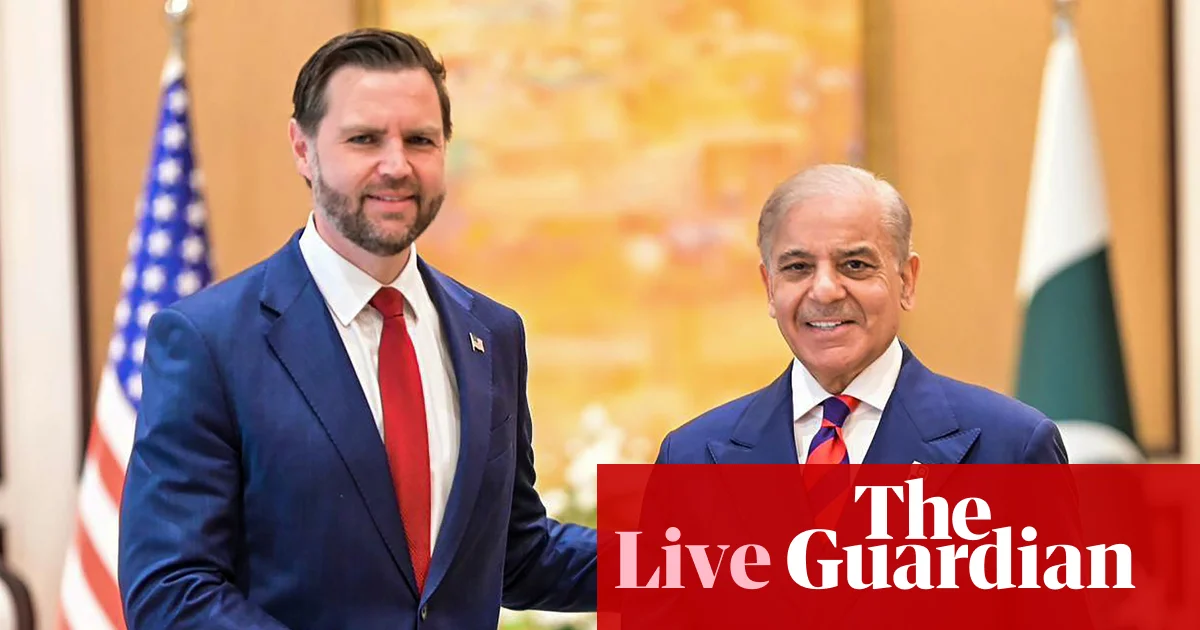
White House confirms peace talks are happening face to face
The White House has confirmed that the negotiations between the US and Iran currently under way in Islamabad are happening face to face.
The meeting today marks the highest-level direct engagement between Washington and Tehran in decades. The core US delegation is led by Vice-President JD Vance, alongside special envoy Steve Witkoff and Jared Kushner, supported by senior advisers including Dr Andrew Baker and Michael Vance.
This high-stakes diplomatic summit, facilitated by Pakistani prime minister Shehbaz Sharif and chief of army staff Asim Munir, aims to secure a peace agreement to end the weeks-long conflict.
The White House also confirmed that a “full suite of US experts on relevant subject areas are present in Islamabad” and “additional experts are supporting from Washington.”

Key events
Trump says reaching a deal with Iran makes ‘no difference’ to him
Donald Trump told reporters outside of the White House that it makes “no difference” to him if a deal is reached with Iran, amid ongoing peace talks in Pakistan.
“Regardless of what happens, we win,” Trump said. “Whether we make a deal or not, makes no difference to me.”
When asked about the prospect of unfreezing Iran’s assets, the president said: “We’ve defeated them militarily. They’ve dropped a couple of water mines … We’ve defeated all of their water boats, too.”
“We’ve totally defeated that country and so let’s see what happens,” Trump added. “Maybe they make a deal, maybe they don’t, it doesn’t matter. From the standpoint of America, we win.”
Trump acknowledged that the US is currently undergoing “very deep negotiations” with Iran, as vice-president JD Vance has been engaged in talks in Islamabad for several hours.
Trump also issued a threat to China, telling reporters that the country will have “big problems” if it ships arms to Iran.
Death toll in Lebanon reaches over 2,000
The latest Israeli attacks on Lebanon have pushed the death toll to over 2,000 with more than 6,300 wounded, according to the health ministry.
Mourners in Lebanon are burying 13 state security officers killed when Israeli airstrikes hit their office headquarters in the southern Lebanese town of Nabatiyeh. Funeral scenes similar to this one on Saturday have played out hundreds of times across the country in recent weeks, as Israel intensifies attacks against what it claims to be Hezbollah infrastructure and militants.
Israel is not present at today’s negotiations in Islamabad as its military said yesterday it had bombed 200 Hezbollah targets in southern Lebanon, and Netanyahu said on Saturday that Israel remains committed to keep fighting Iran.
Earlier, the Iranian negotiators demanded a ceasefire in Lebanon, reparations and commitment to unblock frozen assets as part of a peace deal in a preliminary meeting with Pakistani mediators, led by Pakistani prime minister Shehbaz Sharif.
A new round of talks between Iranian and US delegations has begun in Islamabad following a break, with Pakistani officials acting as mediators, Iran’s semi-official Tasnim news agency reported, citing its correspondent.
“Considering the US’s excessive demands, it seems that this is the Iranian team’s last chance to reach a common framework in this round of talks,” the agency said.
The Gulf region has experienced a significant lull in hostilities, with no strikes reported on Saturday as high-stakes, face-to-face negotiations between the US and Iran continued in Islamabad.
This relative calm marks the first weekend of a formal two-week ceasefire that went into effect last Tuesday. The pause in combat was brokered to allow diplomatic delegations, including US vice-president JD Vance and Iranian officials, the opportunity to negotiate a potential end to the war involving the US, Israel and Iran, which has gripped the region since 28 February.
A spokesperson for Iran’s joint military command has denied an earlier claim by the US military that two navy destroyers transited the waterway, saying that “initiative over the passage of any vessel rests with the armed forces of the Islamic Republic of Iran”, according to Iran’s state media.
The strait of Hormuz, the narrow passage through which 20% of all oil and natural gas trade once passed, is already reported to be one of the main points of “serious disagreement” during negotiations between the US and Iran, now taking place in Islamabad.
In his strongest words yet, Pope Leo XIV on Saturday denounced the “delusion of omnipotence” that he says is fueling the US-Israel war in Iran and demanded political leaders stop and negotiate peace.
Leo presided over an evening prayer service in St Peter’s Basilica on the same day the US and Iran began face-to-face negotiations in Pakistan.
The first US-born pope didn’t mention the US or Trump by name in his prayer, which was planned before the talks were announced. But Leo’s tone and message appeared directed at Trump and US officials, who have boasted of US military superiority and justified the war in religious terms.
“Enough of the idolatry of self and money!” Leo said. “Enough of the display of power! Enough of war!
“Stop! It is time for peace! Sit at the table of dialogue and mediation, not at the table where rearmament is planned,” he added.
Leo, who is known for choosing his words carefully, has emerged as a vocal critic of the Iran war.
Netanyahu says Israel will keep fighting Iran
Israeli prime minister Benjamin Netanyahu says Israel remains committed to keep fighting Iran, despite ongoing negotiations between the US and Iran.
“Israel under my leadership will continue to fight Iran’s terror regime and its proxies, unlike Erdogan who accommodates them and massacred his own Kurdish citizens,” Netanyahu wrote on social media.
Israel is not present at the US-Iran talks in Islamabad.
The strait of Hormuz remains among the main points of “serious disagreement” in talks between Iranian and US delegations in Islamabad, Iran’s semi-official Tasnim news agency reported on Saturday. It added that consultations were continuing despite what it described as excessive US demands, while Iran insisted on preserving its military gains.
French president Emmanuel Macron said on Saturday that he had spoken with Iranian president Masoud Pezeshkian, and had emphasized to him the importance of de-escalating the current situation through the ceasefire talks in Pakistan.
“I stressed the need for Iran to restore freedom of navigation and security in the Strait of Hormuz as quickly as possible, to which France stands ready to contribute. I insisted on the importance of fully respecting the ceasefire, including in Lebanon,” Macron said in a post on X.
The US military says it “began setting conditions for clearing mines in the strait of Hormuz” in an update released on Saturday afternoon.
“Today, we began the process of establishing a new passage and we will share this safe pathway with the maritime industry soon to encourage the free flow of commerce,” said Adm Brad Cooper, commander of Centcom, in the statement.
Navy destroyers USS Frank E Petersen and USS Michael Murphy have transited the strait of Hormuz into the Arabian Gulf, marking the start of a mission to clear the waterway of sea mines laid by the IRGC, according to the statement.
The operation aims to restore passage to the world’s most vital energy corridor, which has been effectively blocked for over six weeks, causing a global surge in oil prices and historic supply disruptions.