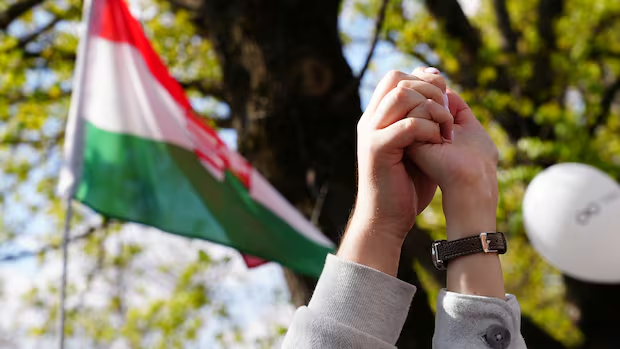
In the hours before polling stations opened up across Hungary, while candidates wrapped up last-minute campaigning in cities and villages spanning the Hungarian plains, a sense of nervousness swept through the electorate ahead of what’s being seen as a pivotal vote.
Independent polls have suggested that Viktor Orbán’s Fidesz party could lose to the opposition party Tisza, which is led by Péter Magyar, a one-time Fidesz loyalist-turned-challenger.
Loyal supporters of Hungary’s strongman fear an end to his 16-year-rule, while those who have been campaigning against him for years are worried a surge in opposition support still may not be enough to clench the two-thirds majority they covet.
“I’m really scared … to be honest,” said 26-year-old Gergely Lázár, who spoke to CBC News while attending a Tisza rally in the Hungarian town of Újfehértó.
“Viktor Orbán has been in his position for a very long time, and I don’t think it will be very easy to give up his power.”
Long-time leader
Orbán, who is the European Union’s longest-serving prime minister, is a polarizing figure at home and abroad.
His critics accuse him of creating an iron grip on the state by exerting control over the judiciary and the media, and enabling rampant corruption.
But his self-described quest to create a so-called illiberal democracy in Hungary has earned him praise from the far right as well as some in the U.S. MAGA movement.
Orbán’s vision is for a democracy that is not bound by liberal norms, but that prioritizes family, country and what the state considers traditional values. His approach has coincided with more state control, hostility towards foreign institutions and independent media, along with anti-immigration policies.
U.S. Vice-President JD Vance visited Budapest earlier this week to openly lend his support to Orbán’s re-election campaign.
Orbán’s friendly ties with Washington and Moscow, and his fractious discord with the EU, means Hungary’s election is being closely watched by many more than the nearly ten million people who live in Hungary.
The outcome of the election has the potential to reshape the country’s international relations.
Lázár, who works as an architect in eastern Hungary and has considered leaving the country because of the political climate, sums up the choice voters need to make.
“It’s very simple, “ he said. “We decide between West or East, Europe or Russia.”

Party loyalist to challenger
Lázár spoke to CBC News as he waited for Magyar to show up for one of his final campaign stops on Saturday, which included visiting a district that is traditionally considered a Fidesz stronghold.
Magyar, whose last name means Hungarian, admitted to being inspired by Orbán when he was young, even taping a picture of him to his wall.
But two years ago, after his ex-wife who was serving as Orbán’s minister of justice resigned because of public backlash over a pardon related to a sex-abuse case, he called out the party, accusing it of corruption and propaganda.
During one of the campaign rallies on Saturday, he repeatedly compared Orbán’s government to the Mafia.
“Hungarian history is being written here on streets and squares,” Magyar told the crowd on Saturday.
“Not in Moscow, not in Brussels, not in Washington.”
While Magyar focused much of his campaign on domestic issues, like health care, education and infrastructure, he and his party are pro-European Union and want to reset ties with other member countries.

EU friction
Billions of euros worth of funds have been frozen by the European Commission because of concerns related to Hungary’s democratic backsliding, including instances of corruption and lack of rights and freedoms for minority groups.
Hungary, which is heavily reliant on Russian oil and gas, has repeatedly clashed with the EU over Ukraine, and Orbán has repeatedly blocked or delayed aid and loans for Kyiv as well as sanction packages targeting Russia.
Most recently, Orbán has accused Kyiv of not acting fast enough to repair the Druzbha pipeline, which Ukraine says was damaged in a Russian drone attack.
The pipeline carries Russian oil to eastern and central Europe. As part of the dispute over the repairs, Orbán has been trying to block a 90 billion euro loan to Ukraine.

The Ukraine factor
The war in Ukraine has been at the centre of Orbán’s re-election campaign, which is designed to foster fear around the idea that Hungary could be dragged into the conflict at any moment.
Images of Ukraine’s President Volodymyr Zelenskyy are plastered on Fidesz posters, suggesting that Hungary’s opposition could lead the country into war,
At a rally on Friday in Székesfehérvár, a city southwest of Budapest, Orbán went as far as to say that the choice to be made in Hungary’s election was about whether to support him or Ukraine’s president.
In the same speech, he repeatedly said is the only leader who can deliver peace and security. It’s a message that seems to resonate with Fidesz supporters.
Listening in a crowd of hundreds waving Hungarian flags was 18 year-old Milan, who didn’t provide his last name.
He said that he believes that the current government has made Hungary a good place for young people. While wages might be higher in countries like Germany, he said peace and stability are most important and are what’s at stake in this election.

Election observers
The election is being observed by local and international monitors including a team from the Organization for Security and Co-operation in Europe. In a recent report, it noted that much of the campaigning in the run-up to the vote has been “underpinned by increasingly fear-mongering messaging.”
The OSCE noted concerns around the electoral districts, which were redrawn in December 2024 and have been criticized as being favourable to the ruling government.
Hungarians do not directly elect the prime minister, but elect 199 members of parliament through a mix of voting for local representatives and selecting from national party lists.
“We can say with confidence that there is very heavy gerrymandering,” said Andrea Virag, the strategic director of Republikon Intézet, a Budapest-based independent think-tank that is focused on democratic governance and public policy.
Virag says she considers the country’s election to be free but not fair, given that the majority of the media are either controlled by or affiliated with the government and that the lines between party and state funds are extremely blurred.
“Average citizens cannot follow anymore when state funds are being used, when Fidesz is using their own resources, they have essentially become one and the same.”