Mark Zuckerberg spent years being one of the most ridiculed CEOs in big tech — touting augmented reality (AR) glasses, virtual offices, and a metaverse that nobody asked for. Then the billionaire entrepreneur leaned into artificial intelligence (AI), Meta Platforms (NASDAQ: META) stock price tripled, and Wall Street crowned him an expert in capital allocation.
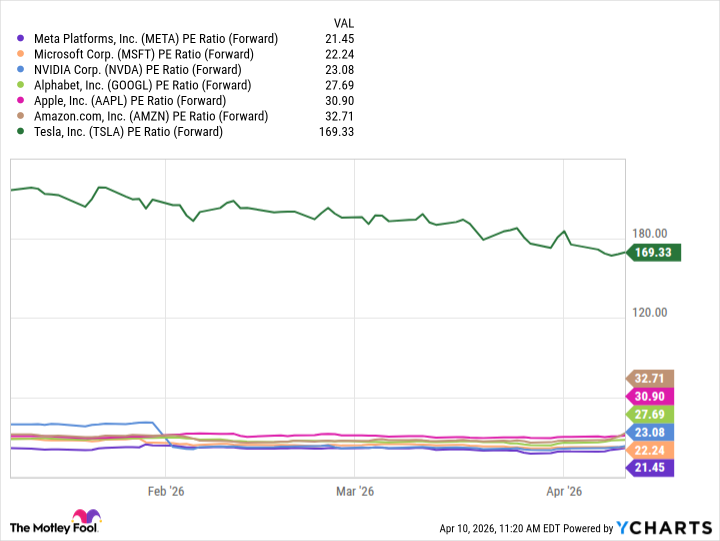
Now, just as Meta has become the most attractively valued stock in the “Magnificent Seven” based on forward earnings projections, investors are souring again. The irony is poetic. Let’s unpack why the reflexive fears surrounding Meta are almost certainly wrong.
Will AI create the world’s first trillionaire? Our team just released a report on the one little-known company, called an “Indispensable Monopoly” providing the critical technology Nvidia and Intel both need. Continue »
Investors aren’t rotating away from Meta because its business is deteriorating. Rather, the panic-selling is really a function of Meta’s aggressive capital expenditure (capex) ambitions in a potentially recessionary macro environment. When the Federal Reserve looks unsure regarding which direction monetary policy should move while consumer confidence slides, a company announcing $135 billion in infrastructure commitments becomes an easy target.
In these scenarios, the market often rerates first and asks questions later. Meta went from being viewed as visionary to reckless in a single earnings cycle — not because the company’s underlying profitability changed, but because the risk tolerance around it did.
There’s also a more subtle issue at play. Meta’s advertising business is deeply tied to small and medium-sized businesses (SMBs) — a segment that is highly vulnerable to consumer downturns. When economic uncertainty rises, the SMB cohort is usually first to rein in digital ad spend before large enterprises do.
Smart investors understand this relationship, and they are now accounting for a scenario in which Meta’s top-line growth stalls while its cost base expands.

The sell-off in Meta stock (down as much as 20% on the year in late March) showcases how the market is conflating two different risks: the possibility of near-term advertising softness and the opportunity cost of long-term capital misallocation. These factors are independent of one another, yet Meta’s current valuation treats them as if they are two sides of the same coin.