A strong villain can make or break a story, even in animated shows. A complex, well-drawn antagonist offers an opportunity to highlight a particular trait in a hero, demonstrating a level of self-awareness and depth as the hero is forced to confront an inverted reflection of themself. This can heighten the emotional pull of a hero, as evil scientist Aldrich Killian did for Tony Stark in the wildly successful Iron Man 3.
This isn’t the only route strong villains can take, though. Sometimes, knowing less about an antagonist can make them even more chilling, as evidenced by, among others, the Joker’s reign of terror in Gotham. In other cases, villains can even offer moments of levity, quirkiness, or relatability in the eyes of the audience as their motivations strike a human chord.
Animated shows especially offer a unique playground for strong villains. They’re well-poised for longevity, creating opportunities for a whole lineup of antagonists who threaten their heroes in different ways. Meanwhile, the unique medium allows for fight sequences, violent confrontations, and even the appearance of the villains themselves to reach new visual heights.
From action to dark adult comedy, anime to youth-focused cartoons, these series spanned the genre possibilities of animation, yet all offered historic rosters of near-perfect villains.
8
Batman: The Animated Series
1992-1995
The Joker was just one of a whole slew of antagonists in Batman: The Animated Series, a show that focused on its villains just as much, if not more, than Batman himself. The Animated Series is still lauded today for its supremely dark style and relevant and mature themes.
The show took a unique approach to its hero by allowing much of his character to be developed through his interactions with and connections to the show’s villains. This felt true to Batman’s historic characterization as a broody hero in a dark, gritty city.
The villains of The Animated Series challenged Batman and Robin mentally as well as physically, with two of its most iconic antagonists, Harley Quinn and Riddler, having backgrounds as a psychiatrist and psychologist, respectively. Just as Bruce Wayne and Dick Grayson were real people behind their masks, so, too, were The Animated Series’ villains, and the show was all the better for it.
7
Rick And Morty
2013-Present

Rick and Morty represents animation’s potential in more ways than one. With its ninth season on the horizon, the show is a strong example of animation’s often long lifespan. Some could say Rick and Morty went too far, but the show has a much denser plot and richer themes than many of its long-lasting counterparts (Family Guy, The Simpsons, etc.).
These elements have all come together to deliver villains that are both comedic and thought-provoking, and whose presence consistently contribute to the overall spectacle that is Rick and Morty. The interdimensional element of the show has created no shortage of visually engaging villains, but perhaps most notable were the alternate versions of Rick and Morty themselves.
The sheer number of them added a level of comedic chaos to the show, but Evil Rick and Evil Morty also generated moments of authentic emotion and complex ruminations about Rick and Morty’s capacities for evil.
6
The Powerpuff Girls
1998-2005

On the whole, The Powerpuff Girls was much funnier than it ever got credit for. The narrator, the mayor, the girls, and Professor Utonium all had frequent moments of well-placed comedy. Even the frequent villain, Mojo Jojo (an evil chimpanzee with a giant brain), generated his fair share of laughs.
Yet despite his mostly lighthearted presence on the show, Mojo Jojo posed a genuine threat to the city of Townsville. Even more significant than that, he was a product of the same “Chemical X” that created the girls, which forced them to consider their own capacity for evil.
The Powerpuff Girls‘ real big bad, though, was HIM, a feminine-coded demon who felt like a villain ahead of his time. HIM was genuinely scary, especially (but not exclusively) for young viewers. He wasn’t devoid of the show’s signature sense of humor, but in his case it landed in a more eerie, off-putting way that gave The Powerpuff Girls real stakes.
5
Regular Show
2010-2017

Regular Show deserves inclusion for its sheer number of villains alone. The series had over 130 antagonists. The series’ surreal nature paved the way for a near-infinite number of weird Regular Show episodes, complete with bizarre-looking villains that kept Mordecai and Rigby distracted throughout what would otherwise be monotonous work days.
Like Rick and Morty, Regular Show had almost limitless visual and world-building potential, and Regular Show similarly used that potential to both comedic and grounding effect. Fan favorite villain Garrett Bobby Ferguson (GBF) was a floating human head who ultimately exploded, yet the character bore a notable physical and narrative resemblance to real-life gamer Billy Mitchell.
4
Dragon Ball Z
1989-1996

Dragon Ball Z‘s story was so sprawling and iconic that several characters were largely considered the show’s primary antagonists. Yet despite the show and franchise’s massive scale, every Dragon Ball Z villain felt distinct, with a unique place in the series’ story. The show spanned generations through its focus on both Goku and Gohan, and their respective foes were tailored to each of them.
Each Dragon Ball villain brought their own personality to their conflict with the show’s heroes, providing great character development as Goku and Gohan were forced to confront each villain in a new way. Frieza was an especially unique and chilling antagonist as he was notably articulate, speaking with a respectful formality that didn’t at all soften his completely ruthless personality.
Yet Dragon Ball Z also held space for its villains to change, as in the case of Vegeta, who had a fully realized redemption arc. Whether they doubled down on their evil or experienced a change of heart, Dragon Ball‘s antagonists were greatly strengthened by the show’s giving them the breathing room to explore the full extent of their characters.
3
Naruto
2002-2007

Naruto similarly delved deeply into its villains’ backstories, which served to develop not only the villains, but Naruto himself. Through its characters’ clashing philosophies, Naruto explored big, mature themes of pain, peace, and the fine line between utopian and dystopian societies. Naruto’s antagonists largely had extremely tragic origin stories, making them compelling and, if not agreeable, worth hearing out.
Nagato, who gave himself the alias of Pain, served as a direct and tragic inversion of Naruto’s own life philosophy. While both claimed to desire peace, Nagato aimed to force it on the world through the use of pain. The concept of deep sensitivity being a key character trait for a villain was a memorable, unique choice that brought topics like empathy and trauma to the forefront of a show geared towards children.
2
Avatar: The Last Airbender
2005-2008

Avatar: The Last Airbender‘s Zuko is perhaps one of the most compelling TV anti-heroes of all time. The show created a level of investment in his story and willingness to see him be redeemed that rivaled even the desire to see the supremely likable Aang succeed. Zuko made his share of harmful choices, but also experienced his share of pain, and Avatar made a point to hold space for that duality.

How Powerful Aang Really Is In Avatar: The Last Airbender
Aang’s journey in Avatar: The Last Airbender shows that real power isn’t about winning battles but learning how to use strength responsibly.
The show’s themes of balance and peace, with harmless people coming under threat of literal fire, all harkened back to the origins of storytelling itself, while Aang and Zuko brought a personable, youthful perspective that challenged traditional, two-dimensional archetypes, allowing the show and each of its characters to be more than their best or worst qualities.
1
Teen Titans
2003-2006

The original Teen Titans animated series had a pervasive dark seriousness befitting Robin’s DC Comics origins. The Titans had to battle their internal demons just as much as their external ones, and the series expertly personified their inner conflicts.
Even minor villains largely serve to force the Titans to think critically about themselves. In “Sum of His Parts,” the robotic Fixit forced Cyborg to confront whether he is more machine than man, while “Nevermore” explored Raven’s fear of her own powers, instilled in her by her genuinely terrifying, villainous father.
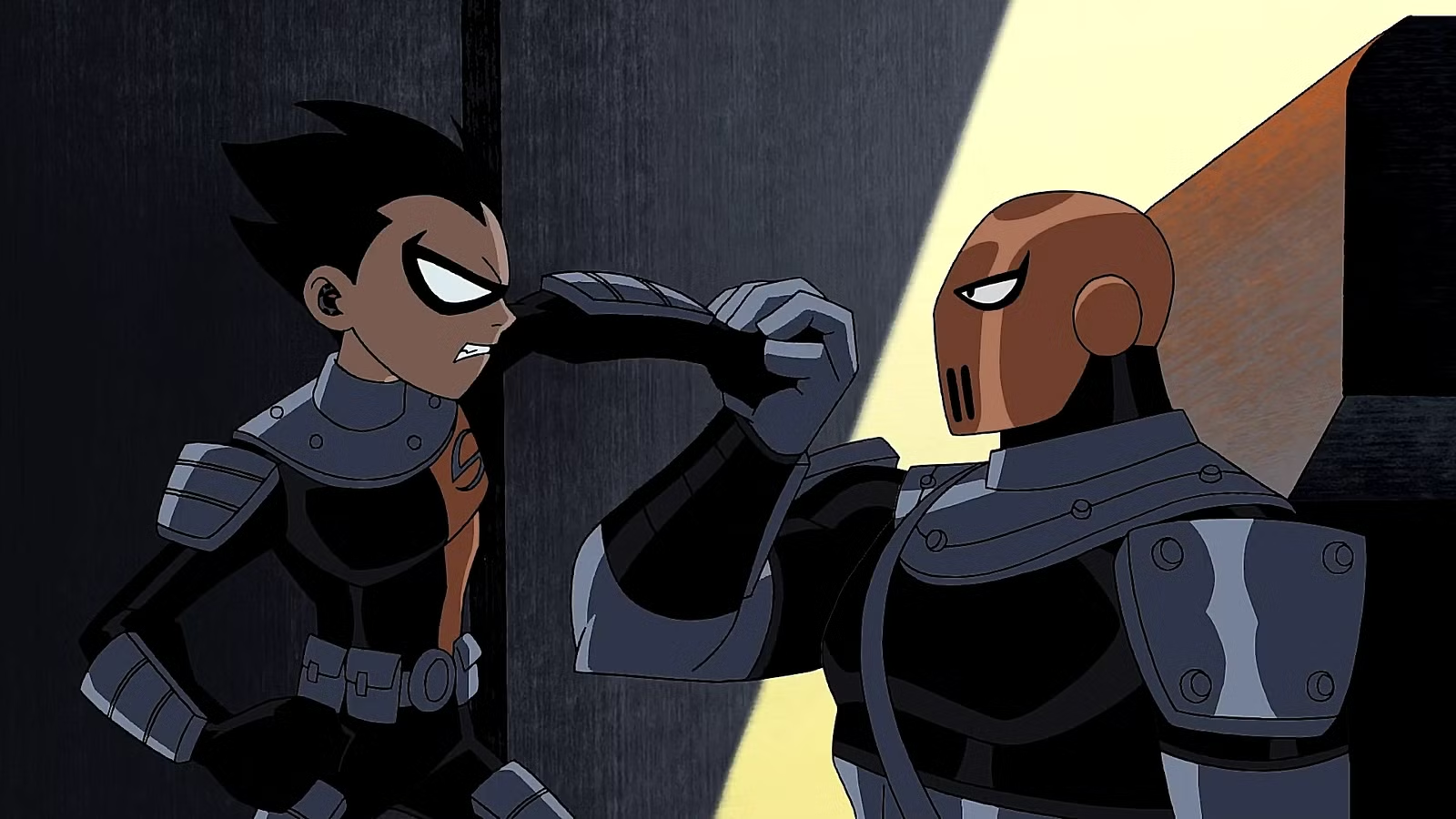
Yet the show’s most impressive villain was its big bad, Slade, and the truly dark road he steered Robin down. Robin’s singular focus and intense ambition are turned against him as he’s driven to extremes in his ongoing battle against Slade, who then only has to hold up a mirror to show Robin how thin the line is between good and evil.
Teen Titans was truly unique as an animated show geared towards kids that leaned heavily into drama and, at times, even horror.