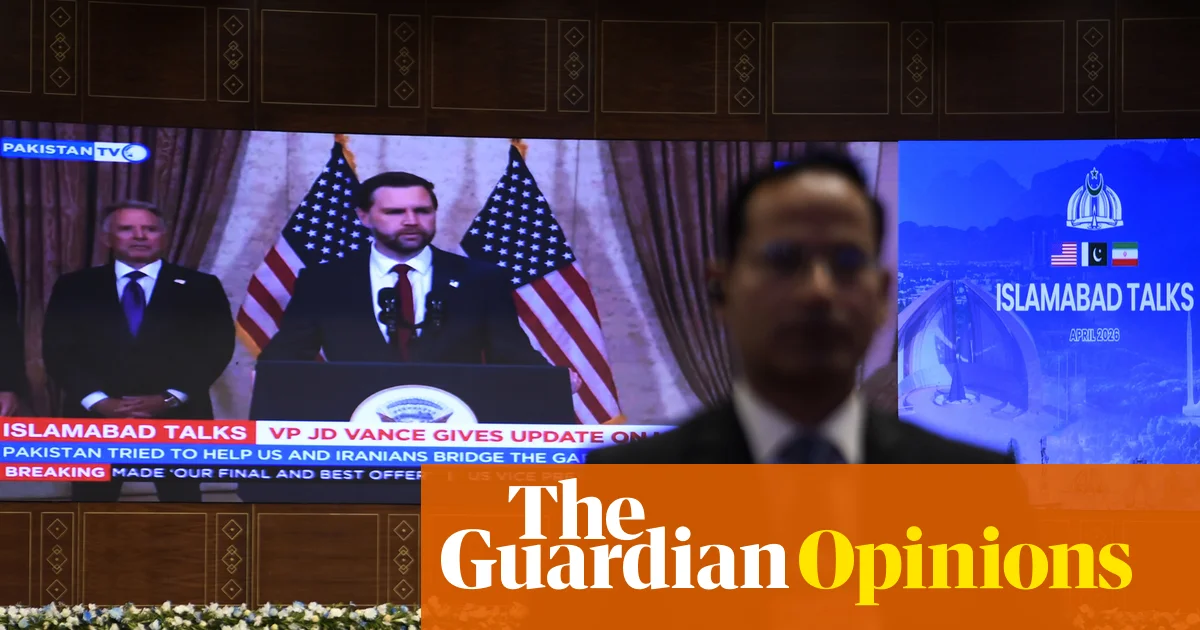
As the US vice-president, JD Vance, took to a podium in Pakistan after 21 hours of diplomacy and said no deal had been reached to end the war with Iran, his boss Donald Trump was in Miami watching a mixed martial arts fight. The contrast was stark. Just when the outcome of a war and the stability of global markets hung in the balance, the president chose spectacle over engagement. Mr Trump may intend to project strength. But the impression he creates – in Tehran and among America’s allies – is of a president less interested in the substance of diplomacy than in the politics surrounding it.
The talks in Islamabad didn’t fail accidentally; the US and Iran were talking past each other. Washington’s position is that Iran must abandon its capacity to develop a nuclear weapon, while Tehran insists it is not seeking one and has the right to a civilian nuclear programme. The US vice-president’s “final and best offer” would have required Iran to give up that capacity altogether – terms that looked less like the basis of a negotiation than an attempt to impose the conditions of victory.
Washington also wanted free passage through the strait of Hormuz, a vital global energy artery. Tehran, instead, sought control of the strait through transit fees as well as having sanctions lifted, assets unfrozen and reparations paid, alongside a wider regional ceasefire. Given the gap, the positions were never likely to be reconciled in a single round of negotiations. The result was talks without trust – and a war without resolution.
Winston Churchill rightly argued that jaw-jaw is better than war-war. Talks are preferable because fighting is destructive, unpredictable and costly. The irony is that Mr Trump is negotiating over a nuclear programme that was once contained by a deal he ripped up, while trying to reopen a strait closed by an illegal war he chose to start. A deal between Iran and America – however imperfect – would leave the world better off than continued conflict. This is especially true when markets in oil, gas and finance are so intimately linked.
Time is running out to get back to the negotiating table. The fate of the current ceasefire depends not only on Washington and Tehran, but on Israel, whose forces’ expanded campaign in southern Lebanon against Hezbollah – razing villages to establish a buffer zone – has seen it accused of committing war crimes.
Markets are unlikely to respond positively to the weekend’s events. The White House treats threats as diplomacy, bizarrely expecting submission. Mr Trump may want to play the tough guy, but American voters are confronting a different reality each time they pull up at the pump. With fuel prices already surging, his decision to impose a naval blockade on Iran and the strait of Hormuz risks intensifying the very pressures it is meant to relieve. Disrupting a route that carries a fifth of global oil would send prices higher, with effects rippling far beyond the Gulf. For Tehran, survival is itself a form of success.
The ceasefire runs out in little over a week. The talks are not over, but there’s a stalemate. However, the logic of escalation is taking hold. Iran is unlikely to back down – opting instead to test US resolve at sea. A full-scale ground offensive may be constrained for now by the Gulf’s summer heat, but the conflict risks shifting into more dangerous forms – naval confrontation, airstrikes and proxy warfare – with no way out. There will be no winners in such a scenario, only losers.