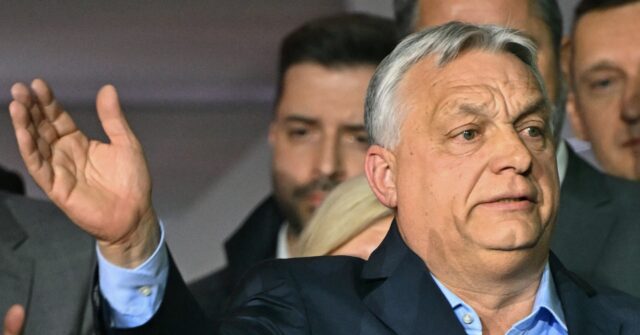
Hungarian Prime Minister Viktor Orbán conceded defeat in the parliamentary elections on Sunday, bringing an end to 16 years of governance in Budapest.
Following a hotly contested campaign against his rival, Member of European Parliament Péter Magyar, and his upstart Tisza Party, a record turnout of over three-quarters of voters decided to turn the page from Viktor Orbán’s Fidesz party, which had ruled the country since 2010.
With over two-thirds of the votes counted, Tisza held a lead of 53 per cent to 37 per cent, according to Magyar Nemzet, likely paving the way for a governing majority in the parliament.
It will not be the first time Orbán has been sent to the opposition benches. Despite persistent claims of being a faux dictator, Orbán accepted his first defeat in 2002 after serving four years as PM, before coming back to power eight years later.
Conceding defeat on Sunday evening, Orbán said: “The election result is painful for us, but understandable. I congratulated the Tisza Party.
“No matter how it turned out, we in the opposition will serve our country and the Hungarian nation,” he declared, adding: “We never give up!”
For his part, Magyar said that “Hungary made history” on Sunday and that his victory means that his party has the “authority to build a functional and humane homeland for all Hungarians.”
The issue of the Ukraine war played a central role in the election, with Orbán accusing his rival of being a Brussels puppet and a pro-Zelensky partisan who would fast-track Kyiv’s accession into the European Union.
Orbán argued that this would drag Hungary into the war and endanger its supplies of Russian energy, which have been critical to keeping consumer costs down in the landlocked country. Orbán also warned that allowing Ukraine into the EU would be devastating for Hungarian industry, particularly farmers, who would face steep competition from their neighbours to the East, who have much lower wages.
Magyar has claimed he would not vote to fast-track Ukraine’s EU membership and, in turn, has attempted to portray Orbán and his party as beholden to Russia.
Competing scandals in the final days of the campaign sought to validate both claims, with recordings emerging of Orbán’s Foreign Minister, Péter Szijjártó, allegedly passing on EU classified information to Moscow’s top diplomat, Sergey Lavrov, which Magyar described as potentially treasonous.
Meanwhile, Serbian and Hungarian officials claimed to have disrupted an alleged attempt to bomb the Turkish Stream gas pipeline near the Hungarian border just days ahead of the vote. Orbán implied that the attempted attack was of Ukrainian origin and suggested that it was seeking to empower his rival.
Even prior to the war in Ukraine, Orbán has been at odds with the globalist woke faction in Europe, having made it his government’s mission to confront plunging birth rates with pro-family policies, such as tax incentives for mothers having more children, rather than using immigration to bolster population figures.
The longtime Hungarian leader has been a consistent critic of open borders advocates and put himself forward as the top opponent to former German Chancellor Angela Merkel in 2015, when she unilaterally opened Europe’s borders to mass migration from the Middle East and Africa.
Orbán’s government had also faced financial sanctions from Brussels over conservative legislation barring LGBT content from being shown on children’s television and officially banning Pride Parades, given that they often feature public displays of sexually explicit scenes. However, despite foreign observers often accusing Orbán of having been a dictator, the Budapest Pride Parade went ahead this year in defiance of the ban.
However, the government’s reputation on such issues was severely damaged after it was revealed in 2024 that then-Hungarian president Katalin Novák had pardoned the ex-deputy director of the Kossuth Zsuzsa Children’s Home after being convicted of helping cover child sex abuse by his boss. The scandal led Magyar to break from Orbán’s party and join Tisza.
The campaign for Orbán’s Fidesz was further complicated by a struggling national economy, which had suffered some of the highest inflation in Europe in the wake of the energy crisis sparked by the Ukraine war. This was unfortunately compounded by one of the worst droughts on record in 2022.
Hungary’s economic woes were also in part as a result of sanctions levied by the European Union, in part over its supposed “homophobic” laws and refusal to take in alleged asylum seekers.
In the days leading up to the vote in Hungary, Republicans in Washington accused the European Commission of having interfered in the election, through economic pressure, the funding of opposition media and activist groups, and digital censorship. Such accusations were also made by U.S. Vice President JD Vance, who said this week that the EU’s actions represented “one of the worst examples of foreign and election interference” he had ever seen.
Regardless, Orbán’s loss in Hungary will represent a significant blow to the Trump administration and to the international populist movement, which had been fostered in large part in Hungary, with Orbán frequently hosting conferences such as the Conservative Political Action Conference (CPAC).
His loss was instantly hailed by globalists in Brussels, with longtime opponent, unelected EU chief Ursula von der Leyen, saying: “Hungary has chosen Europe. Europe has always chosen Hungary. Together, we are stronger. A country reclaims its European path. The Union grows stronger.”