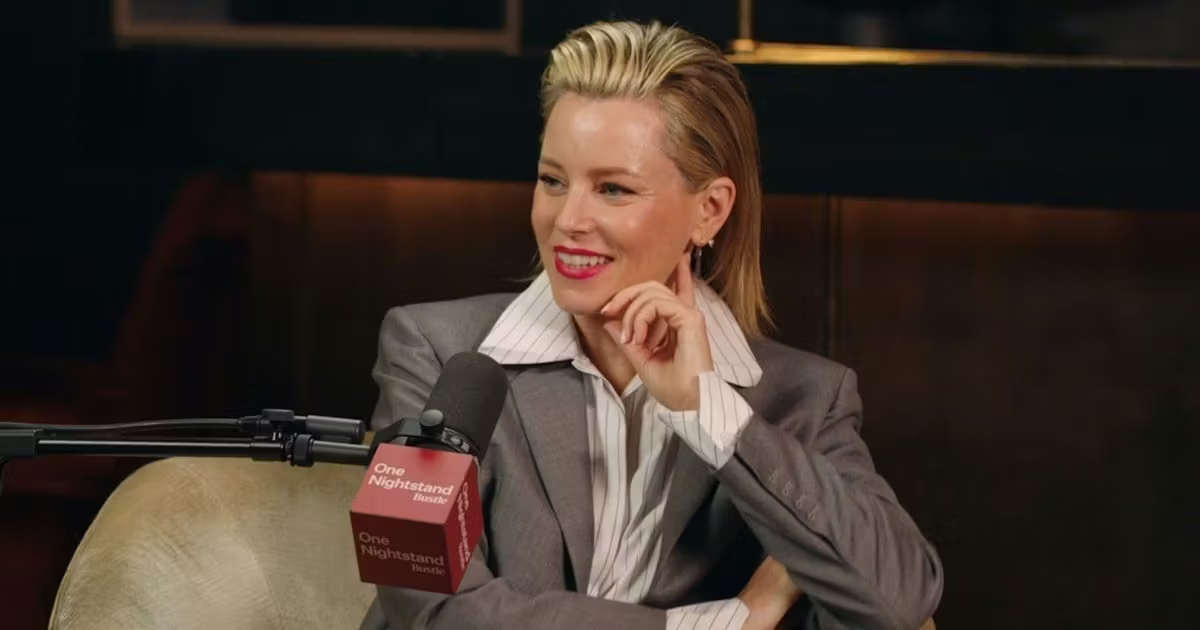
In One Nightstand, celebrity readers and writers join us at the blond in 11 Howard to discuss some of their favorite books, allowing us to learn about their tastes and lives in the process.
Like many actors and filmmakers, Elizabeth Banks often reads with the goal of finding things to adapt. Sometimes it works out, sometimes it doesn’t. “I devoured the Hunger Games and immediately looked for the rights,” the 52-year-old actor says of Suzanne Collins’ dystopian series. She was out of luck — the book was already in development — but Banks found her way in via the role of Effie Trinket, the theatrical Capitol chaperone assigned to District 12’s tributes.
“I saw a whole larger world for Effie, I saw her whole backstory,” says Banks, whose performance was so captivating the filmmakers expanded the role beyond what Collins had written for the franchise’s four movies. “I think Effie is one of the characters that has the greatest arc that I’ve ever played,” adds Banks, noting her journey from being “the representative, besides Snow, of the fascism in the Capitol” to becoming a revolutionary. “She gets turned by the events of it,” says Banks. “And I think that’s… I wish more of us were becoming revolutionaries. Effie is the model, guys.”
The franchise became a $3 billion cultural phenomenon, and the novels are currently being reimagined for a new generation with a prequel series in which a young Effie will be played by Elle Fanning. “I think she’s perfect,” says Banks of the casting. “And you know what’s great is the fans, I think, really helped. They wanted her. I think she’s so delightful and I think she’ll play that wide-eyed idealism of being taken along by Snow. I’m really interested to see how that all plays out.”
Since her work in the Hunger Games, Banks has built a formidable career on both sides of the camera. She directed Pitch Perfect 2, which had the largest opening weekend for a first-time director and the biggest debut for a musical film, and later helmed the 2019 Charlie’s Angel’s reboot and Cocaine Bear. Now she’s starring in Peacock’s The Miniature Wife, playing a Pulitzer Prize-winning novelist who is accidentally shrunk to six inches tall by her scientist husband, played by Matthew Macfadyen.
“I was on a green screen, alone, having to imagine the whole world — looking at a tennis ball 150 feet away from me on a camera that is literally across a stage,” she says of the show’s production. “When the prop department could give me actual things to use, it was such a huge relief. So they made everything — a 30-foot tall toilet plunger, a Chanel lipstick that was fabulous.” Her favorite: “They made me a Fiji water bottle that we could all stand inside of.”
Working opposite Macfadyen, who played Mr. Darcy opposite Keira Knightley in Joe Wright’s beloved 2005 Pride & Prejudice, made it worth it, though. “He’s my Mr. Darcy,” she says, before also noting her excitement for the new Netflix adaptation starring Jack Lowden and Emma Corrin. “I think that’s going to be incredible,” she says. “Matthew told me — this is telling a total tale that is not my story to tell — but I thought it was so sweet. He and Colin [Firth] wrote to Jack to say, ‘Welcome to the party. You’re the new version.’ They’re such gentlemen.”
Keep reading to discover four of Banks’s favorite books.
Her first pick is Nine Stories by J.D. Salinger, a collection of short fiction written upon the author’s return from serving as Staff Sergeant during WWII. “I feel like his characters are all sort of steeped in that sense of post-war Americana that is so important also to feminism,” she says. “I also think J.D. Salinger’s presentation of masculinity is really interesting, whereas [John] Updike is like, they’re such dudes. Salinger’s men are a little softer. They’re more complex. They’re more vulnerable.”
That portrayal also resonated with her own family history. “My father fought in Vietnam and did not speak about it for 20 something years,” she says. “I got a sense of the trauma mostly from researching what happened, not from personal stories he told me…I think it just was something he didn’t want to infect our very young lives when we were kids. And I think it was something he struggled with for a long time.”
Her second selection is The Road by Cormac McCarthy, a bleak novel following a father and son traversing a post-apocalyptic United States. “There’s a little sense of sci-fi and futurism — when is it? Where is it? Is it in the past, is it in the future? It’s a little hard to pin down,” she says. “But at the end of the day, what we’re talking about is the simplicity of caregiving and humanity. When you realize that it’s just a father trying to be the best parent, I found it so devastating.”
Despite its harrowing premise, the Pulitzer Prize winner’s underlying sense of hope also resonates in the current moment. “The Artemis II mission has also been very moving to me,” she says. “I think it is sort of the best of humanity and science and caregiving, and these people are out in the world looking at humanity from this whole other vantage point. That’s the feeling of what’s happening in that book — despite all the danger surrounding them at all times, it’s the worst of humanity and the best of humanity all in one story.”
Her third choice is The Underground Railroad by Colson Whitehead, a book she believes “should be required reading.” The Pulitzer Prize-winning novel follows a young enslaved woman, Cora, as she flees her Georgia plantation via the historic network of escape routes. “There’s this sort of fantastical magical realism that gives the whole notion of the resilience of the people that come through and their humanity and their dignity. All of it is so beautifully woven together by this literary device.”
Reading the book also inspired Banks to educate herself further on Black history. “I didn’t know about the Tulsa Massacre until five years ago. There’s just so much to know, and I just feel like it’s every American’s responsibility to understand the history of America,” she says. “And so any notion that we would sanitize it or whitewash it or not teach it, which is a trend in education right now, especially in red states, is mind blowing to me. We need to understand this.”
Her fourth and final selection is The Red Tent by Anita Diamant, which reimagines the story of Dinah, daughter of Jacob and Leah, through her own eyes. For Banks, who grew up in a Catholic home and now practices Judaism, it was “a way for me to see myself in religion, and I’d never really felt that. And also just the caregiving of these women for each other, the community, the sense of community in the red tent and also the absolute fear that men have of women — menstruating women and motherhood and mothers — and I just loved everything.”
Watch the full episode below: