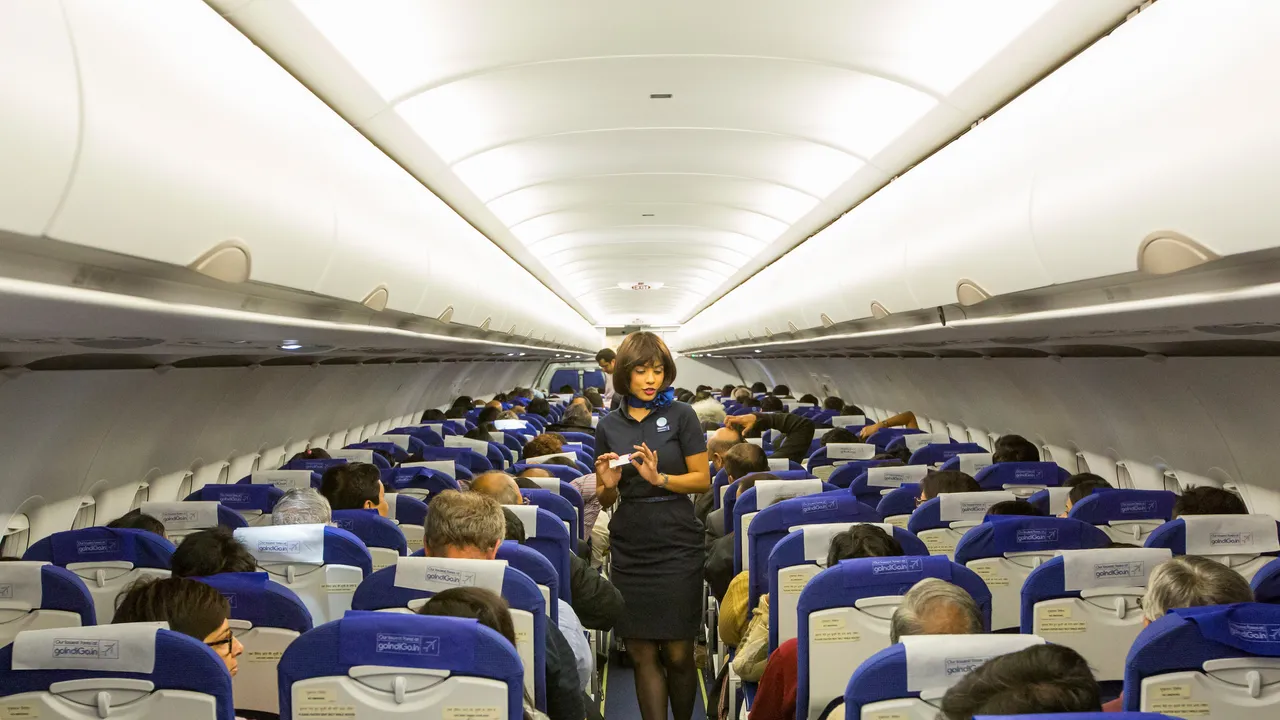
Every airline passenger knows flight attendants give critical safety guidance during their pre-takeoff briefings about seatbelts and emergency exits. But many observant passengers often watch cabin crew throughout the flight for unspoken safety cues, too.
If you’re one of these watchful fliers, you might have noticed a certain way that cabin crew sit during takeoff and landing: on their hands. If you’re a nervous—or simply curious—flier, you might be wondering why flight attendants sit in this peculiar way; whether it indicates a potential emergency; or if passengers should follow suit.
Fortunately, nervous fliers don’t need to worry when they see this, as it’s standard operating procedure for cabin crew that applies to every flight. “In aviation, we call this position the ‘brace position’ for flight attendants,” says Lia Ocampo, a former flight attendant and the author of the memoir Life, Love, and Lessons in the Sky. Brace positions are a safety protocol that flight attendants follow in case of accidents and sudden emergencies.
Assuming a brace position means strategically positioning parts of the body such as the head and arms, by flexing, bending, and leaning forward to help reduce any potential impacts that may occur. “The brace position for flight attendants depends on the direction their seats face, and the type of restraint system those seats are equipped with,” Ocampo says.
One of the most common brace positions involves flight attendants sitting on their hands to keep the arms secured to the body. “During the critical phases of flight, which are takeoff and landing, you see flight attendants sitting on their jumpseats in a brace position,” Ocampo says. “If passengers see flight attendants do this, it means they are doing the right thing and fulfilling their role in ensuring safety.”
This isn’t the only way flight attendants ensure safety during takeoff. While seated on their hands, cabin crew also conduct a silent review, or go over a mental checklist of key safety elements that might be needed during critical flight phases, according to Ocampo. These include reviewing the locations of the emergency exits and how to operate them, identifying passengers who could potentially assist crew in an emergency, going over the commands to use during an emergency, and checking the location of other evacuation equipment that would be needed in case of emergency.
Although fliers don’t necessarily need to sit on their hands during takeoff and landing, there are situations when passengers might be told to adopt a brace position to mitigate chances of injuries. Information on the correct position can be found on the safety card in the seatback pocket, which passengers should always read before takeoff. “In a planned emergency, flight attendants will brief passengers on what to do, including brace-for-impact positions,” says Ocampo. ‘However, during an unplanned emergency, they may not have time to do so.”
Reading the safety card every time you board a plane, as well as listening to the crew’s safety briefing, can help ensure fliers are prepared for an unexpected emergency. Flight attendants are highly trained safety professionals who know how to react in an emergency, and passengers should always pay close attention when they are speaking about safety matters.
Even frequent fliers should listen intently to every safety briefing, as there could be new information, depending on the type of aircraft or cabin class. “Traveling today has its challenges and setbacks,” Ocampo says. “But if we travel prepared and with a positive mindset, we can overcome some of those challenges and make our journey safer and more enjoyable.”