Summary
- Collider’s Steve Weintraub talks with writer-director Takashi Yamazaki at CinemaCon for Godzilla Minus Zero.
- Yamazaki discusses how the sequel ramps up VFX for more complex, jaw‑dropping kaiju sequences and captures more action sequences in IMAX.
- He also discusses the sequel’s runtime, the scene that gave him goosebumps, and bringing Godzilla to America.
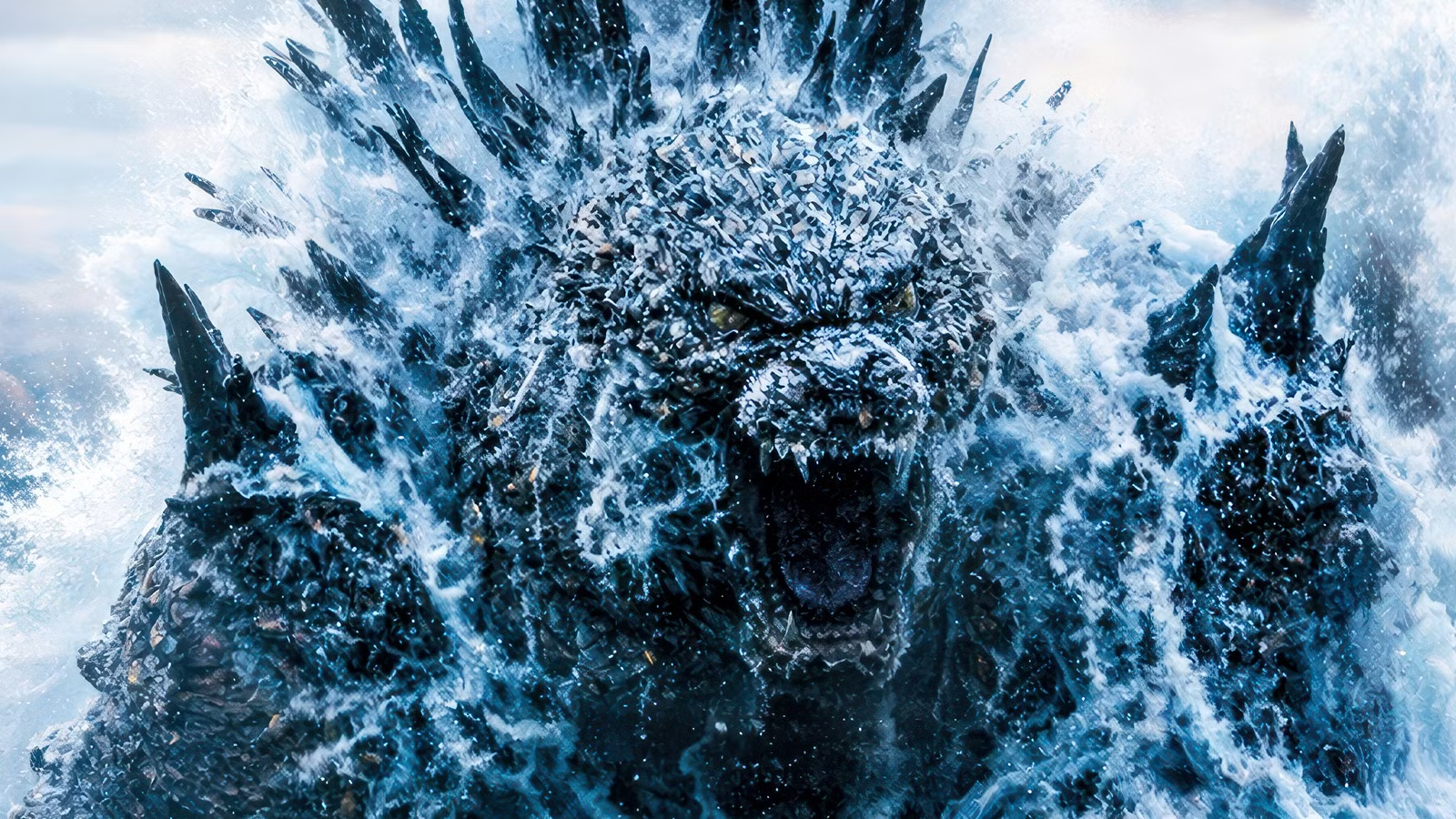
After delivering a stunning and critically acclaimed addition to Toho’s kaiju films, Oscar-winning writer and director Takashi Yamazaki says he’s moved the goalposts even further. Godzilla Minus Zero is taking the stakes even higher with more VFX shots and even more full-frame IMAX, the way Godzilla should be experienced. While at CinemaCon in Las Vegas, Collider’s Steve Weintraub had the opportunity to sit and talk with Yamazaki about exactly what fans can expect after the teaser trailer’s release.
It’s been two years since Godzilla brought devastation to Tokyo. Now, in 1949, the story continues with the Shikishima family as they and the people of Japan must face another attack when Godzilla resurfaces, even stronger than before. Also returning are stars Ryûnosuke Kamiki as Kōichi Shikishima and Minami Hamabe as Noriko Ôishi.
Check out the full conversation in the transcript below, where Yamazaki discusses the sequel’s more complex VFX shots, exactly how much full-frame IMAX fans can expect from Godzilla’s return, and the action sequence that gave even Yamazaki goosebumps. The filmmaker also discusses the movie’s runtime, returning to the Shikishima family, bringing Godzilla to America, and what he holds tight to when he knows directors like Steven Spielberg and James Cameron are watching.
‘Godzilla Minus Zero’ Throws the Shikishima Family “Back Into Peril”
COLLIDER: One of the reasons the first film is so awesome is that you made a Godzilla movie where people really care about the characters. With Godzilla Minus Zero, can you talk about balancing the humans with Godzilla again, and how you are balancing that in the sequel?
TAKASHI YAMAZAKI: What I learned with Godzilla Minus One is, because a lot of the events and the scale of the kaiju is so immense, we needed a smaller lens or a smaller perspective to be able to kind of see the actual scale of the drama. Having a family unit and watching them overcome certain challenges, I think, is very relatable to audiences, given the circumstances in their surroundings. So, I once again am featuring the Shikishima family.
At the beginning of Minus Zero, they’re a very happy family. But in the two years that have been from Minus One to Minus Zero, of course, Godzilla appears, and the sequence of events are going to throw this family back into peril, and they’re going to go back to minus again. So I think audiences are going to be on the same emotional rollercoaster that these family members, the Shikishima family, are going to be on, and we’re going to see them really struggle and overcome challenges and witness the courage of what this family unit can do.
The first film is 125 minutes. Is the sequel going to be around the same length? Will it be longer or will it be shorter? What can you say?
YAMAZAKI: It’s about the same in terms of runtime.
By the way, again, congratulations on your Oscar.
YAMAZAKI: Thank you! It’s been two years, but I still appreciate it. [Laughs]

Did ‘Godzilla Minus One’ Just School Hollywood on Movie Making?
Let’s not get carried away, there’s a middle ground to be found here.
It’s amazing. Especially you and Stanley Kubrick. The first film has 610 VFX shots, and what you did is so jaw-dropping. With the sequel, how many VFX shots do you have? Is it the same amount? Is it a lot more? What can you tell fans?
YAMAZAKI: I haven’t counted the shots yet, but I can certainly say that there are going to be more cuts that require VFX, and each shot that requires VFX is more complex than Godzilla Minus One. But thankfully, Toho gave me more money this time, which means more people that I can bring on to the VFX team. But in the end, because we also moved the goalposts in terms of what we want to achieve in the VFX side, the same challenge still remains that I think we faced during Godzilla Minus One. But I do want to say, in spite of that, we have more people because we have more budget, so thank you, Toho.
What’s funny is that no matter how much money you have, there is never enough, because in the first film you did, I would imagine, as much as you could with the money, and now they’ve given you more money, and you’re going to do as much as you can with that money.
YAMAZAKI: Yeah, I think that is perhaps in the DNA of directors. As soon as you give us more money, we start to think, “Oh, I could do this and that and that too!” And as much money as you give us, we’ll find a way to put it on the screen.
Godzilla Is Coming to America — in IMAX
“A lot of the important fights and the important action sequences that are happening in the film are definitely going to be in full IMAX.”

I love the end of the teaser trailer where you show the Statue of Liberty, because you’re revealing that some of the movie will take place in America. Can you say how much of the movie takes place outside of Japan or in America, and is some of the movie in English?
YAMAZAKI: It’s a very short sequence, but a very important sequence for a certain character in the film, in regards to the Statue of Liberty. And as far as the English dialogue and how much of the film is in Japanese versus English, there are certainly some parts that are in English and some Japanese characters speaking in English, as well. That’s partially because the US Department of Defense, the Navy, like the whole Army and military, is going to be a big part of the central theme of this film. Unfortunately, it’s really hard to tell you a percentage of this much more if I see that much in the other.
I love that you’re shooting this for IMAX. I love IMAX.
YAMAZAKI: Me too!
Can you say how much of the movie will be full frame? Generally, a lot of directors will go full frame on a big action spectacle sequence, and I’m just curious how you’re planning on using it.
YAMAZAKI: This being a kaiju film, and with the added branding of “filmed for IMAX,” I would say there is a fairly high percentage of shots that are filmed in full IMAX. With such a close collaboration with IMAX, of course, we want audiences to, when they’re in the theater and watching the IMAX version, just really be stunned and wowed, and for that reason, a lot of the important fights and the important action sequences that are happening in the film are definitely going to be in full IMAX. But the downside of that is these frames require a lot more CG processing and rendering than they did before.
This ‘Godzilla Minus Zero’ Scene Gave Takashi Yamazaki Goosebumps
“Audiences are going to see something they’ve never seen before.”

You definitely got more money. One of the reasons why people go to see Godzilla movies is for Godzilla, and it must be amazing as a director to be able to decide what Godzilla will do, who Godzilla will fight. Can you talk about what it was like in the writing process, in terms of figuring out, “What do I want Godzilla to do in this movie? What can I do with Godzilla that hasn’t been done before?”
YAMAZAKI: It’s, again, very hard to go into details on this, but I will say that this morning, my VFX team in Japan, they send me shots every day, but I got one this morning, and it was probably one of the best kaiju sequences that I’ve ever seen before. I think it’s going to look amazing in IMAX. Given my career and how close I’ve been associated with VFX, I think it’s very hard to get excited about VFX shots, because I feel like I’ve seen most of it knowing how VFX is produced, but the fact that I got goosebumps looking at even just a rough, in-progress version of this VFX sequence means audiences are going to see something they’ve never seen before.
I absolutely love that. Where are you in the editing process? How much of the movie is done so far, and when do you need to have it done so it can make its release date around the world?
YAMAZAKI: Right now, I have a rough assembly of the entire film. So I think we have the general beats and the overall edit we want to tell the narrative of the film. That being said, we’re deep in VFX land, and as you kind of already mentioned and hinted, VFX is something that the more passes you can do, it generally becomes better. So, I’m probably going to keep working on the VFX and polishing it right up until the moment Toho rips it out of me and says, “You can’t work on VFX anymore!” And I’ll probably sneak in a few more shots, and then it’ll be done.
Many huge Hollywood directors have praised your film, from Spielberg to James Cameron. What is it like making a movie, knowing that the biggest directors on the planet and all these fans around the world just can’t wait to see it? What is that like behind the scenes for you and the crew? Does it add a little bit of pressure or is it more excitement?
YAMAZAKI: There is certainly a lot of pressure, but I think I’m the type of character where pressure becomes my source of energy. I begin to think about, “Well, how do I exceed everyone’s expectations now that I already know that the expectation goalposts have been moved? How do I go beyond it?” When making films, I always think about the feeling that I want someone to see it. The only exception this time is that the people on the other side of the screen are going to be James Cameron, Steven Spielberg, and J.J. Abrams, the directors who really define the modern Hollywood, directors who I absolutely love what they’ve done. So I do think about, “Well, what do I want them to see within my film and what can I put in there?”
Godzilla Minus Zero opens in theaters and IMAX on November 6.

- Release Date
-
November 6, 2026
- Director
-
Takashi Yamazaki
- Writers
-
Takashi Yamazaki
-

Ryunosuke Kamiki
Koichi Shikishima
-
Minami Hamabe
Noriko Oishi