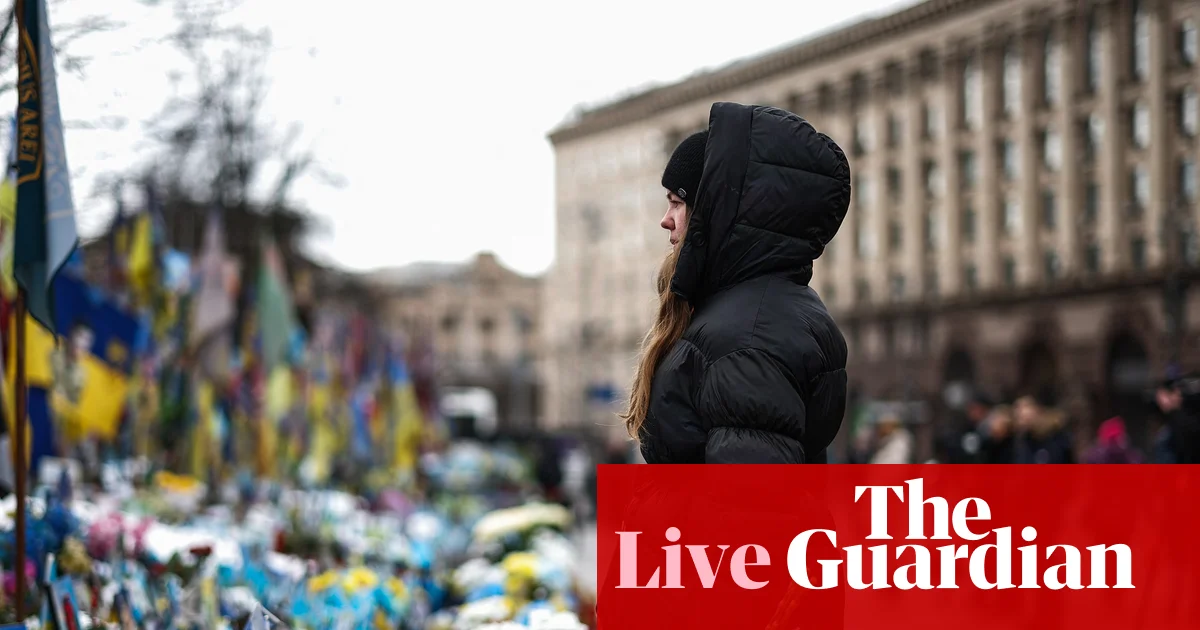
Macron ‘very sceptical’ about short-term peace as ‘no willingness’ on Russia’s side
France’s Macron is speaking next.
He doesn’t mince his words as he says he is “very sceptical” about the prospect of short-term peace, as “there is no willingness on the Russian side to have peace.”
He calls for more support for Ukraine, and also puts pressure on the EU leadership to make sure the €90bn loan gets paid out soon. “We will deliver that, no choice,” he says. (Tell that to Hungary’s Orbán.)
He then also mentions the need for further sanctions on Russia, including on its shadow fleet to “kill its business model.”
On security guarantees, he says these are “being finalised,” and they need to be “agreed on in concrete terms.”
He ends with his words of admiration and solidarity with the Ukrainians.
Key events
-
Ukraine dismisses ‘absurd’ Russian claims on nuclear weapons
-
Mostly western states rally behind Ukraine, condemn Russian aggression at UN meeting in Geneva
-
G7 reiterates ‘unwavering support for Ukraine’ in anniversary statement, first since Trump’s return to White House
-
Q&A: Thanks for all your questions
-
Q&A: What’s the future of Zaporizhzhia?
-
Q&A: Do you believe we are close to point where Russia could use nuclear weapons?
-
Q&A: What are the lessons from the 2015 Minsk agreement?
-
Q&A: How important is Poland’s support for Ukraine?
-
Q&A: Who could be Putin’s successor, and what would it mean for Ukraine?
-
Q&A: Has this war been really going on for only four years – or twelve?
-
Q&A: What really stopped Prigozhin’s mutiny march on Moscow in 2023?
-
Q&A: What does Russia’s failure to progress the war means for Moscow’s ambitions in the region?
-
Q&A: What do you make of Russian claims about Ukraine’s plans to acquire nuclear weapons with UK, France’s help?
-
Shaun Walker answers your questions on Ukraine in Europe Live Q&A
-
Russian foreign ministry warns against risks of ‘direct clash between nuclear powers’, repeating unsubstantiated claims
-
Putin orders security services to step up protection of military leaders after recent assassinations
-
Four years of war in Ukraine – in pictures
-
Four years into Ukraine invasion, Russia’s gains are small, while Kyiv remains resilient
-
Reminder: Q&A with Shaun Walker on Ukraine at 2pm UK, 3pm Europe
-
No Time to Heal – Guardian documentary on psychological rehabilitation of Ukrainian soldier after Russian captivity
-
Kyiv marks fourth anniversary of full-scale aggression – in pictures
-
‘Russia is not winning,’ Germany’s Merz says, as he calls for more pressure on Moscow
-
Macron ‘very sceptical’ about short-term peace as ‘no willingness’ on Russia’s side
-
‘We need peace, but have to prepare’ for other scenarios, Zelenskyy says, hinting at further talks with Russia in 7-10 days
-
Coalition of the Willing’s meeting on fourth anniversary gets under way
-
Over 200,000 Russian soldiers killed in Ukraine identified
-
Russia will press ahead with its war aims in Ukraine, Kremlin says
-
Ask your questions about Ukraine war for our live Q&A at 2pm UK, 3pm CET
-
Putin is standing in way of peace, Starmer says, as he says Ukraine is ‘frontline of our freedom’ and marks its resilience
-
Ukraine needs ‘ammunition today and every day’ in its fight against ‘Russian terror,’ Nato’s Rutte says
-
Russia shows contempt for Europe, Zelenskyy warns
-
We must be as determined as when invasion began, Zelenskyy says, as he pushes for EU accession date
-
Ukraine never chose this war, Zelenskyy says
-
Ukrainian people ‘stand defiant in face of almost unimaginable daily hardship,’ EP president says
-
Zelenskyy urges Trump to visit Ukraine in first speech marking invasion anniversary
-
European Parliament sits to mark fourth anniversary of war
-
Russia accuses Britain, France of preparing to arm Kyiv with nuclear bomb without any evidence
-
European leaders arrive in Kyiv to mark the fourth anniversary
-
Nato’s Rutte marks fourth anniversary of war
-
Morning opening: Four long years

Jakub Krupa
As I’m taking a quick break, Tom Ambrose is here to keep you up-to-date.
Ukraine dismisses ‘absurd’ Russian claims on nuclear weapons
Ukraine has dismissed as “absurd” a Russian claim that Kyiv was trying to obtain nuclear weapons with the help of Britain and France (10:00, 14:59), Reuters reported.
“Russian officials, known for their impressive record of lies, are once again trying to fabricate the old ‘dirty bomb’ nonsense,” Heorhii Tykhyi, spokesperson for the Ukrainian foreign ministry, said.
“For the record: Ukraine has already denied such absurd Russian claims many times before, and we officially deny them again now. We urge the international community to reject and condemn Russia’s dirty information bombs.“
Mostly western states rally behind Ukraine, condemn Russian aggression at UN meeting in Geneva
Meanwhile, over in Geneva, dozens of mostly western states rallied behind Ukraine and condemned Russian aggression on Tuesday in a UN meeting in Geneva on the fourth anniversary of Russia’s invasion, Reuters reported.
“What Russia has done and is doing in Ukraine right now is violating every principle in the book,” Espen Barth Eide, Norway’s foreign minister, told a meeting on the sidelines of the Human Rights Council attended by dozens of countries including France, Britain, Canada, Japan and Peru. The US did not appear to have sent a representative.
“Everything the UN stands for is being violated,” he added, ending his speech with “Glory to Ukraine!”.
Earlier, a group of mostly European diplomats walked out of a meeting of the Conference on Disarmament in Geneva during a speech by Russian ambassador Gennady Gatilov. They gathered outside, holding the Ukrainian flag and wearing sashes in the national colours, Reuters noted.
The president of the UN general assembly in New York, Annalena Baerbock, said that a motion was planned there expressing concern about Russia’s invasion and calling for an unconditional ceasefire and a lasting peace.
G7 reiterates ‘unwavering support for Ukraine’ in anniversary statement, first since Trump’s return to White House
As we were chatting with Shaun, leaders of the G7 global powers, including US president Donald Trump, reaffirmed their “unwavering support for Ukraine” in a statement on the fourth anniversary of Russia’s invasion, AFP reported.
“We express our continued support for President Trump’s efforts to achieve these objectives by initiating a peace process and bringing the parties to direct discussions. Europe has a leading role to play in this process, joined by other partners,” the leaders of the United States, Britain, France, Germany, Italy, Canada and Japan said.
It marks the first joint declaration by G7 leaders on Ukraine since Trump’s return to the White House a year ago, noted France, which holds the G7 presidency this year.
Jakub Krupa
And with that we wrap up today’s Q&A with Shaun, but stay with us for more news from Ukraine and across Europe as the continent marks the fourth anniversary of the full-scale Russian aggression.
Thank you so much for all your questions and contributions!
Q&A: Thanks for all your questions

Shaun Walker
Central and eastern Europe correspondent
Thanks for all your questions and sorry if I didn’t manage to answer yours.
I’m off back to Kyiv next week.
The next few months will be a key test of whether Donald Trump’s negotiators are able to pull some kind of workable deal out of the bag or whether Russia’s demands still cross so far over Ukraine’s red lines that the war will grind on. Unfortunately, most of the smart money is on the latter scenario.
Thanks for following the Guardian’s coverage and tell us if there’s something you would like to see us cover in more depth in Ukraine.
Q&A: What’s the future of Zaporizhzhia?
ComradeRuss has this personal question on the future of Zaporizhzhia:
“My partner fled from Zaporizhzhia with her disabled autistic daughter when the war began. Her journey has been hellish and terrifying but she is safe now in Canada and we have made a wonderful life together.
She knows the chances of ever visting Zaporizhzhia again are low but I am curious what your opinion is on the continued offensive on that front?
The main city of Zaporizhzhia still stands free but slowly the orcs are grinding closer. While her first language is Russian she has always identified as Ukrainian and supported Ukraine, she says she never knew anyone in her circle of friends, co-workers, acquaintances that ever supported Russia or ever saw themselves as anything but staunch Ukrainian loyalists.
With that said, she is dismayed at the state of negotiations that would put most of her oblast in the hands of the oppressors. Is there any chance that Ukraine could capitulate to US/Russian pressure and give up this land for good? I could see the Donbas and even Crimea being potential areas they would have to give up, but with a large percent of Zaporizhzhia still stands free and in Ukrainian control I would hate to think this was an option.
I only ask because Zaporizhzhia does not seen to garner anywhere near the level of discussion that the Donbas and Crimea do.”
Here’s Shaun’s view:
“Thanks for your question and I’m sorry about the upheaval the war has caused for your partner and her daughter.
Zaporizhzhia is one of my favourite Ukrainian cities and I’ve written extensively from there over the past few years, including this story from last summer on how people there feel about the idea of land swaps.
Certainly, unlike Crimea, and to a lesser extent Donbas, where there was some pro-Russian sentiment for Russian propaganda to work with, this was always much lower in Zaporizhzhia and Kherson regions.
I don’t think Ukraine would give up its claim to the land ‘for good’, but certainly there is a chance that in an eventual deal (which I don’t think we’re close to achieving yet) the lines would be “frozen” at their current point, and this could potentially turn into a de facto border for years or generations.
Either way, the city itself does not seem to be at risk from occupation in the near future.
I hope you’ll all have the chance to visit a free and safe Zaporizhzhia some time in the future.”
Q&A: Do you believe we are close to point where Russia could use nuclear weapons?
migdom84 takes us back to the first question on whether there is a genuine risk of nuclear weapons being used in this conflict (14:59).
“I still have the nagging fear that russians will, sooner or later, use nuclear weapons, which will force the world into two blocks, in favour or against, and we all know where that will lead. Do you believe we are close to that point?”
Here is Shaun’s take:
“I don’t.
Every time Putin has wheeled out nuclear rhetoric it has not led to anything, and he stopped doing so for a while after he saw that it was having little effect early in the war.
On the other hand, I can see why planners in the West have to take seriously even a 1% chance of the war going nuclear, and it’s clearly the one thing in Russia’s arsenal that forces the world to take it seriously.
Do I think Putin has gone so mad that he’d nuke a European city, knowing the consequences that would ensue? No.
Would I be willing to bet that, in some hypothetical future situation, with his back against the wall and his regime threatened, he wouldn’t at least consider the option? Also no.”
Jakub Krupa
We will take a few more questions before wrapping up.
Q&A: What are the lessons from the 2015 Minsk agreement?
moleseyeview asks:
“In trying to understand the history and context of this horrendous war can anyone explain why the UN ratified 2015 Minsk agreement was unable to be implemented by Ukraine.
As I understand it this would have brought the civil war that had followed the 2014 change of government in Ukraine to a peaceful conclusion by creating a kind of federated structure within Ukraine to recognise and devolve a level of government to the Donbas oblasts ?
What was the problem with that very European looking solution?”
Shaun says:
“Here’s another question that would need a PhD thesis to answer properly (probably someone has written one).
The short answer, though, is that neither side ever took the Minsk agreements that seriously, and that they were always flawed as a path to real peace.
It’s true that the federal structure you mention might sound good on paper, but the key thing to remember is that Russia had been funneling troops, weapons and cash across the border since the beginning of 2014, and was insisting that Ukraine had to implement all its obligations under Minsk before it would allow Kyiv to retake control of the border.
For Kyiv this was an intolerable situation: basically reintegrating a part of the country that was still under effective Russian control and which Russia could flood with weapons at any time.
Whether or not Kyiv could have done more under Minsk is certainly up for debate, but I think it’s important not to lose sight of the fact that it’s hard to proceed in good faith when the other side has been sending in occupying troops and funding an insurgency and yet is outright denying those facts.”
Jakub Krupa
On that last point, I would add that Poland still has one of the largest communities of Ukrainians in Europe, after welcoming millions fleeing the conflict earlier in the conflict in what was a truly unprecedented and incredible show of solidarity and support.
Over a million of them are permanently resident in Poland, playing an important part in the country’s booming economy and society.
But, as Shaun says, there has been a notable change in how they are perceived, and the role they therefore play in domestic politics.
For example, Poland’s conservative president Karol Nawrocki opposes Ukraine’s membership in Nato, in stark contrast to the Polish government’s line on this.
Some questions also remain about what Ukraine’s accession to the EU – repeatedly requested by Kyiv – would mean for Poland and its farmers, for example.
Deploying Polish soldiers to Ukraine continues to be unpopular, as there is a feeling that Poland needs to completely focus on strengthening its own army “just in case.”
But close cooperation exists at all levels as Poland is keen to learn from Ukraine’s lessons – for example on drones – and continues to provide critical help on logistics, with the country effectively serving as the main hub for all sorts of deliveries to Ukraine.
Q&A: How important is Poland’s support for Ukraine?
SymbolofDawn asks:
“My question is “how important is Poland in terms of support for Ukraine, both politically and practically, and does it make a difference that the President and First Minister are from different parties?”
Here’s Shaun’s view on that:
“Poland is such an interesting and unusual case: on the one hand, one of Ukraine’s staunchest allies and one of Europe’s most hawkish nations on Russia; on the other hand, plenty of historical baggage between Poland and Ukraine, and a turning mood against the million plus Ukrainian migrants and refugees in the country.
As someone put it to me recently: Poland is perhaps the only European country where you can be anti-Ukrainian without being pro-Russian.
The split in the government of course makes for inconsistent messaging: prime minister Donald Tusk and foreign minister Radosław Sikorski are strong supporters of Ukraine while the new nationalist president Karol Nawrocki has made political capital from criticising Kyiv.
Poland remains an absolutely key ally for Kyiv, with much of the military and humanitarian support transiting the country, but there are irritations on both sides, and even among Tusk’s government there are limits to Polish support.
It was interesting to see, for example, that for all Tusk’s warnings that Europe has to take the Russian threat seriously, he was one of the first European leaders to rule out troops from his country having any part in a postwar mission on the ground in Ukraine.”
Q&A: Who could be Putin’s successor, and what would it mean for Ukraine?
MrJanuary has this question for Shaun:
“Who is likely to be an ailing Putin’s successor, and will it harden Russia’s stance in Ukraine?”
Here’s Shaun’s take on this:
“If only we knew!
There is all kinds of speculation on whom Putin might want to anoint as a successor but it’s hard to make predictions at this point.
Putin will also be wary of the idea of stepping back from day-to-day rule but staying as a kind of ‘supreme leader’ figure in the background while a handpicked successor rules in theory.
He tried that back in 2008, when he became prime minister and the once-slightly-more-liberal Dmitry Medvedev took over, but it didn’t work: Medvedev started getting above his station and Putin decided to come back in 2012. And here we are, 14 years later…
Putin might also look at his old friend Nursultan Nazarbayev in Kazakhstan, who tried the same thing after decades in charge only for his hand-picked successor to turn on him and his cronies.
So for now, it’s very much the Putin show.
I think in the ‘ailing Putin’ scenario you mention, all bets are off. There will then be a question about who in the elites can put together an alliance that’s able to take over, and things could develop in all kinds of unpredictable ways.
Looking at plausible candidates who might take over from today’s vantage point, I don’t think any of them are pro-western liberals of course, but it’s possible that a new leader might want some kind of a reset with the West, ending the disastrous Ukraine adventure and writing it all of as Putin’s mistake.
But until we get there, it’s very hard to speculate.”
Q&A: Has this war been really going on for only four years – or twelve?
Another question asked:
“To what extent would it be true to say this war has been going on for twelve years not four? With a genesis going further back to promises made at the time of the dissolution of the Warsaw pact?”
Shaun says:
“It’s absolutely true, and it’s why we always try to call it the start of the ‘full-scale’ war rather than simply saying the start of the war.
On the other hand, I think it is fair to mark these anniversaries as February 2022 really took the war to a very different level of intensity.
I was in Crimea in March 2014 during the annexation, and spent much of the summer in the Donbas region as Russian proxies and undercover Russian troops kicked off military action there, with the support of some locals.
What changed in 2022 was the masks came off – Russia was no longer hiding behind these supposed ‘local rebels’ or ‘local demands for referendums’ but openly sent its army into Ukraine.”
You can read Shaun’s story from Simferopol in Crimea from 2014 here …
… and further reporting including this claim by Vladimir Putin at the time:
Q&A: What really stopped Prigozhin’s mutiny march on Moscow in 2023?
RobbyDelaware has asked this:
“What was the real reason why Yevgeny Prigozhin and his Wagner group stopped their March on Moscow in June of 2023? Was there some sort of deal that was made between Prigozhin and the Kremlin?
In my opinion, Prigozhin’s survival after the mutiny was inexplicable. Why allow him to survive the mutiny but then kill him later? How would you summarize the mysteries of this event? If Prigozhin had been successful would there still be a war today?”
Here’s Shaun’s answer:
“There’s still a lot we don’t know about this story, one of the most fascinating and unexpected episodes of Putin’s long presidency.
Some things are clear: Prigozhin was frustrated and angry, but it seems he didn’t want to storm the Kremlin, and he did not have a plan for taking over nor a coterie of supporters in the elite (though the silence of some senior Russians as his troops advanced was fascinating and telling).
As for why Putin allowed him to survive: my best guess is he wanted to make sure he had steadied the ship properly in the initial post-mutiny moment, and led Prigozhin to believe he would be pardoned.
It was certainly a surprise when it seemed Prigozhin had been allowed to simply walk away after leading a rebel army on a march through half of European Russia. Then – allegedly, of course – the Kremlin dispatched him in a plane crash: something that could be easily denied but would be a clear message to everyone else: Don’t mess with Putin.
Prigozhin was a fascinating character of course, really unique in recent Russian history, and I am looking forward to more coming out about what was really behind the uprising and how it played out behind the scenes.”
Q&A: What does Russia’s failure to progress the war means for Moscow’s ambitions in the region?
There is a question from Jāna in Latvia:
“A question for both Shaun and Jakub: given that the Putin regime’s expressed motivation for the invasion of Ukraine has varied over time, those of us living in the region have always suspected that the true motivation is the re-establishment of the Russian Empire in yet another iteration.
How does the failure of this venture affect the likelihood of incursions into, say, the Baltic States or Finland?”
Here’s Shaun’s answer:
“Not an easy question to answer in a paragraph!
My personal view has always been that Ukraine is different in the way it sits in the Russian post-imperial psyche to almost anywhere else in the region.
Putin and other Russian nationalists see Ukrainians as “confused Russians” who need to be “re-educated” – and that is very different to the way they see Poles or Baltic nations.
Which is not to say that a revanchist Russia wouldn’t have designs on other places, but I do think the idea that ‘he will simply conquer as much as he can’ isn’t quite right.
Additionally, as you say, the failure – so far – of the maximalist goals in Ukraine hardly bodes well for successful Russian wars of conquest further west.
To my mind, what we’re more likely to see are more intense versions of the current “hybrid” tactics in Europe: attacks on infrastructure, power, cyber aimed at causing chaos, economic damage and increasing the cost of supporting Ukraine and standing up to Russia.
This seems to be much more likely than tanks rolling into Warsaw, Helsinki or Riga.”
Q&A: What do you make of Russian claims about Ukraine’s plans to acquire nuclear weapons with UK, France’s help?
To kick us off, I have asked our correspondent Shaun Walker what does he make of all this strong rhetoric coming from the Russian Foreign Intelligence Service SVR, Vladimir Putin and his aides about nuclear weapons (10:00, 11:19, 14:54, 14:59) and what could it mean for the war.
Shaun says:
“It’s almost certainly nonsense, of course, and it seems rather desperate from the SVR, even by their recent standards of implausible press releases.
I’m not fully sure who the audience is here, but the latest follow-up to this is Putin’s aide Yuri Ushakov saying Moscow ‘will inform the United States’ about the reported British and French plans (14:59).
It’s unlikely many people in Washington will believe it, of course.
But these days you never know: watch out for Donald Trump saying he ‘stopped a nuclear war’ some time soon…”
Shaun Walker
Just a reminder that Shaun Walker is the Guardian’s central and eastern Europe correspondent, regularly reporting from Ukraine throughout the war.
Previously, he spent more than a decade in Moscow and is the author of “The Long Hangover: Putin’s New Russia and the Ghosts of the Past” and “The Illegals: Russia’s Most Audacious Spies and the Plot to Infiltrate the West”.
Over the weekend, we published his exclusive account detailed how the US and Britain uncovered Vladimir Putin’s plans to invade, and why most of Europe – including the Ukrainian president, Volodymyr Zelenskyy – dismissed them, drawing on more than 100 interviews with senior intelligence officials and other insiders in multiple countries.