At the wedding venue in Gorton and Denton the Green Party chose for the news conference to mark a seismic by-election victory on national television, it was clear that Zack Polanski and his team were new to all of this.
There was a sea of empty chairs and but a smattering of supporters in a huge, near-deserted room.
Seasoned operators – be it Nigel Farage, Sir Keir Starmer or Ed Davey – would have had the placards lifted and the activists cheering, but Polanski and his new MP, Hannah Spencer, enjoyed just a smattering of applause as they took to the stage.
Politics latest: Police confirm report made over ‘family voting’ claims
But, make no mistake, if the celebration was muted in the moment, the implications of the result are absolutely mega.
The Green Party went from third in this seat at the 2024 General Election to winning by 4,400 votes over Reform UK, and overturning Labour’s 13,000 majority with a whopping 26 percentage point swing.
It was only the 18th time in 100 years that a party had come from third to take a seat, and the Greens clocked up 40% of the vote.
It was a stunning victory that proved the Polanski surge is real and that the Greens are a serious threat to Labour’s left flank.
Starmer ran a campaign claiming that only Labour could beat Reform. This by-election proved that wrong.
Read more:
Analysis: This is a parliamentary result for the ages
Gorton and Denton by-election ‘cheating’ claim explained
Greens can argue they can beat Reform in working-class Britain
Now the Greens can argue that they are the party that can beat Reform in working-class Britain as Polanski positions the party firmly on Labour’s left.
It is a nightmare for Labour as it finds itself fighting on two fronts.
Starmer’s stony face as he addressed the country on Friday said more than a thousand words could: the Greens, like Reform, are emerging as a serious, seat-winning electoral force.
Had Reform won, Starmer could have used it as proof that voting for the Greens was a waste of time. Instead, he now has to try to prove to Labour voters why they should stick with him rather than tack to the left with the Greens.
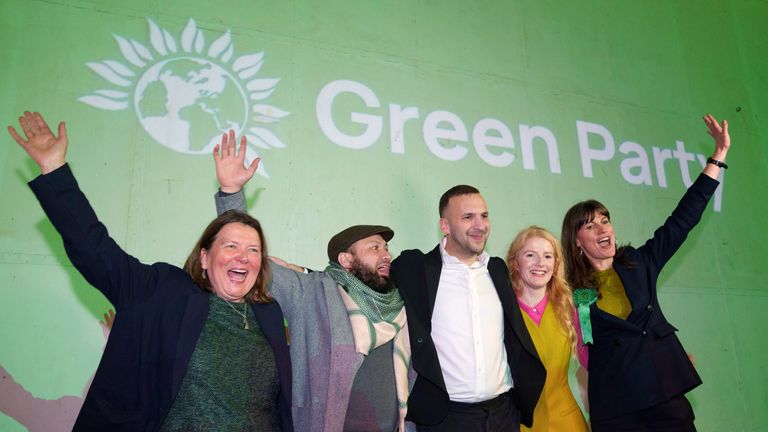
Spencer (second right) celebrates with party leader Polanski (centre) and supporters. Pic: AP
Starmer recriminated after results
In the hours after the results, the recriminations began.
Angela Rayner, the former deputy leader, said the result was a “wake-up call” that showed the party needed to be “braver” as she seemed to voice what many MPs think: that Labour needs to move more to the left.
The unions also piled in with Sharon Graham of Unite saying Labour needed to “stop listening to rich mates and listen to everyday people” while Fire Brigades Union general secretary Steve Wright said Labour has to change course and its “us versus Reform” strategy “is in tatters”, with the core vote collapsing.
Starmer, who looked shell-shocked, didn’t answer these criticisms as he addressed the cameras. Instead he reiterated his position that only Labour could unite the country and he would continue to “fight against extremes in politics” on both the left and the right that “want to tear our country apart”.
The two-party system has shifted to a multi-party one
It is important to say here that by-election results are in general not indicative of national elections, and – as Labour will be arguing – when it comes to a general election, people are picking a prime minister and government rather than registering, in some cases, a protest vote.
But this result does tell us something about the shape of our politics in this country.
It reinforces the idea that the two-party system has shifted to a multi-party one.
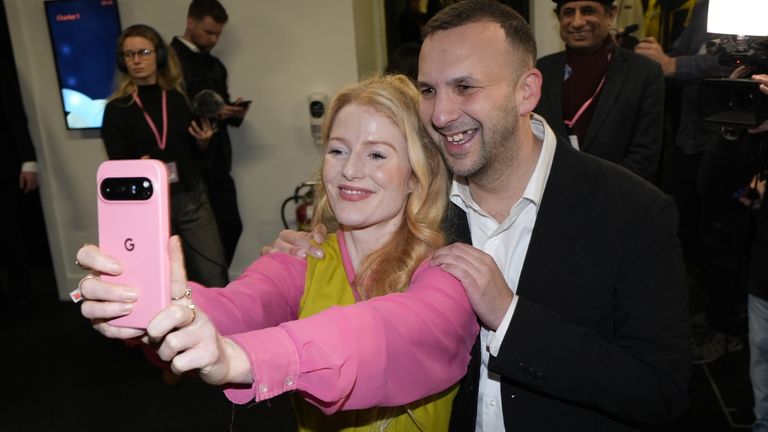
Spencer and Polanski celebrate winning the Gorton and Denton by-election. Pic: PA
Voters are looking for alternatives on the left and right
The Green Party and Reform UK took 70% of the vote in this by-election as Labour came in third in its once 38th safest seat, and the Conservatives lost their deposit.
It is a reminder that voters are impatient for change, have decided that Starmer’s government is not it, and are looking at alternatives on the left and the right of the two governing parties.
Starmer has spent much of his first 18 months facing out towards Reform, but this result shows that the Greens, positioning as the progressive left, can mobilise ethnic minority voters who have long been staunch Labour, younger voters, and more left-wing Labour voters who flocked to Corbyn’s Labour but feel politically homeless in Starmer’s Labour.
Polanski hails ‘seismic victory’
“Labour’s electoral stranglehold is over. This is a seismic victory. We have torn the roof off British politics, and that’s because people now recognise there is an alternative,” said Polanski at his news conference, telling me that, just as Reform are replacing the Conservatives, the Greens are beginning to do the same to Labour.
Starmer’s approach, and hope, is that as these insurgent parties become more successful at the ballot box and their policies and people become more scrutinised, voters may think twice about voting for them in a general election.
On Friday, Labour again took aim at the Green Party’s policy to legalise all drugs or withdraw from NATO as proof that Polanski doesn’t have a “serious programme for government”.
👉 Click here to listen to Electoral Dysfunction on your podcast app 👈
Voters want a full-fat version of progressive politics
But what we saw on Friday is that voters don’t want, as pollster Luke Tryl told us on the Electoral Dysfunction podcast, a “Macron” strategy in which progressives are asked to compromise in the middle ground for fear of something worse (in this case Reform). They want a full-fat version of progressive politics instead.
What inspired a huge swathe of voters to Corbyn’s Labour seems to be now pushing them into the arms of Polanski’s Greens.
For Starmer, it is the stuff of nightmares as he contemplates attacks on both flanks.
The squeeze that broke the Conservatives at the last general election – Reform to the right and Labour/the Lib Dems to the left – now threatens to sink Labour too. It makes the May local elections all the more daunting and consequential for Starmer’s premiership.