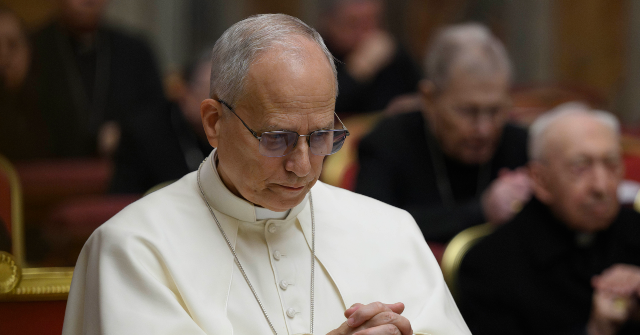
Pope Leo XIV warned priests in a recent engagement in Rome to beware of artificial intelligence (AI) and not rely on it to prepare homilies, as AI “will never be able to share faith.
The head of the Catholic Church remarked on the matter alongside other issues critical to Catholics in an event which allowed several local priests to ask questions about how best to spread the word of Jesus and the messages of the Church. Pope Leo has prioritized granting the Church a coherent and influential voice in the expanding of technology since he took over for the late Pope Francis last year, stating shortly after that that even in choosing his papal name he had considered that he would be the steward of the Church at a time of great technological upheaval.
The event Pope Leo attended with priests in the Diocese of Rome, where he is Archbishop, took place on February 19, but his comments on AI began circulating widely online this week. According to Vatican News, the pope took the opportunity to encourage priests to enthusiastically seek friendships among each other and real-life human interactions with those that they serve. He named artificial intelligence and the Chinese social media application TikTok as threats to the work of clergy in the Church and specifically warned against “the temptation to prepare homilies with Artificial Intelligence.”
“Like all the muscles in the body, if we do not use them, if we do not move them, they die,” Pope Leo said. “The brain needs to be used, so our intelligence must also be exercised a little so as not to lose this capacity.”
Pope Leo described life for young people, especially, as increasingly isolated in the face of the destruction of social bonds during the pandemic and the constant use of smartphones.
“They live a kind of distance from others, a coldness, without knowing the richness, the value of truly human relationships,” he explained, encouraging priests to consider avenues such as culture and sports to engage with young people.
“We must go ourselves, we must invite other young people, go out into the streets with them; perhaps offer different ways,” he suggested.
“It is not you: If we are not transmitting the message of Jesus Christ, perhaps we are mistaken, and we must reflect very carefully and humbly about who we are and what we are doing,” Vatican News quoted the pope as saying.
“With a ‘life authentically rooted in the Lord,’ one can offer something different, he explained,” according to the outlet, “adding that often ‘an illusion on the internet, on TikTok,’ is to think one is offering oneself and gaining ‘likes’ and ‘followers’ in that way.”
Pope Leo has made artificial intelligence a top concern of his papacy, indicating in comments after becoming pope that he had chosen his name as a continuation of the legacy of predecessor Pope Leo XIII, who is best known for leading the Catholic Church during the Industrial Revolution.
“I chose to take the name Leo XIV. There are different reasons for this, but mainly because Pope Leo XIII in his historic Encyclical Rerum Novarum addressed the social question in the context of the first great industrial revolution,” he explained in May 2025, when he became the Archbishop of Rome.
“In our own day, the Church offers to everyone the treasury of her social teaching in response to another industrial revolution and to developments in the field of artificial intelligence that pose new challenges for the defense of human dignity, justice, and labor,” he said.
The pope has commented extensively on AI, suggesting that its application in human life will be a challenge for those seeking to preserve the general consensus around the value of human life.
“AI, especially Generative AI, has opened new horizons on many different levels, including enhancing research in healthcare and scientific discovery,” the pope said in June 2025, “but also raises troubling questions on its possible repercussions on humanity’s openness to truth and beauty, on our distinctive ability to grasp and process reality. Acknowledging and respecting what is uniquely characteristic of the human person is essential to the discussion of any adequate ethical framework for the governance of AI.”
Pope Leo was addressing a conference on AI and ethics at the time. He emphasized, “access to data — however extensive — must not be confused with intelligence, which necessarily ‘involves the person’s openness to the ultimate questions of life and reflects an orientation toward the True and the Good.’” This comment references a quote from the January, 2025 statement by then-Pope Francis, the “Note on the Relationship Between Artificial Intelligence and Human Intelligence.”
In January, in a message marking the World Day of Social Communications, again the pope discussed AI, this time in the context of the use of human likenesses in artificially generated content.
“Preserving human faces and voices, therefore, means preserving this mark, this indelible reflection of God’s love,” he explained. “We are not a species composed of predefined biochemical formulas. Each of us possesses an irreplaceable and inimitable vocation, that originates from our own lived experience and becomes manifest through interaction with others.”
“No sector can tackle the challenge of steering digital innovation and AI governance alone,” Pope Leo asserted. “Safeguards must therefore be put in place. All stakeholders — from the tech industry to legislators, from creative companies to academia, from artists to journalists and educators — must be involved in building and implementing informed and responsible digital citizenship.”
Follow Frances Martel on Facebook and Twitter.