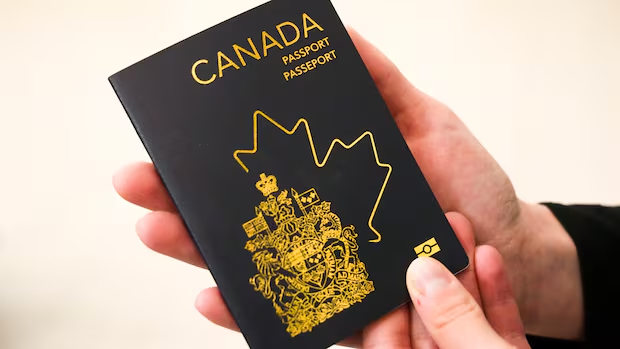
The cost of a Canadian passport is about to rise and plans by Prime Minister Mark Carney’s government to overhaul the way it sets prices could result in them being even more expensive in the future.
An order-in-council adopted in late January calls for the government to begin tying passport prices to the consumer price index (CPI). On March 31, the cost of a Canadian passport will rise by 2.7 percent, the CPI increase in April 2024.
For example, the price of a five-year passport applied for in Canada would rise to $123.24 while a 10-year passport applied for outside of Canada would cost $267.02.
However, in an impact statement accompanying the move, Immigration, Refugees and Citizenship Canada says that’s just the first step.
“The passport program’s base fee structure alone can no longer support the cost of program operations,” the department wrote. “Since the last time inflation was accounted for in program fees, the CPI increased by 14.5 per cent, leading to expenditures outpacing revenues by approximately $121 million in fiscal year 2024-25.
“The program is in the midst of a comprehensive fee structure review, which will result in options for fee adjustments to account for the true cost of operations.”
The department said several costs aren’t considered in the current passport fee structure, including program support expenses such as salaried employees, processing costs for domestic delivery of passports as well as information technology costs.
“Altogether, the adjustment formulas do not account for roughly 85 percent of the passport program cost of operations,” it wrote.
The document does not say just how much passports could cost if all of those expenses are taken into account.
NDP immigration critic Jenny Kwan said some residents of her Vancouver East riding already have difficulty affording what has become an important piece of ID, even within Canada.
“That’s another burden that the Liberal government is putting on everyday Canadians,” she said.
Kwan said the plan to overhaul passport prices to better reflect the program’s cost “is absolutely code for the government to look to increase the cost of accessing a passport for everyday Canadians.”
The department acknowledged increasing fees will affect the ability of some to obtain or renew a travel document, in particular “clients with low incomes, families with multiple children, elderly clients, those with fixed incomes, students and youth, refugees and vulnerable consular clients.”
Between January and November 2025, the government received 4.19 million applications and issued approximately 4.02 million passports or other travel documents.
Conservative immigration critic Michelle Rempel Garner said many of her constituents are still facing challenges in passport processing times.
“I think a lot of Canadians who have had challenges getting their passports processed in a timely fashion are going to wonder why they are paying more to get worse service,” she said.

The government has struggled in recent years to keep pace with the demand for passports that surged in 2022 as the COVID-19 pandemic waned and travel restrictions loosened. News reports at the time featured long lines of Canadian passport applicants camped outside government offices for hours.
While service has since improved, the government had to issue $40 million in passport and travel document fee refunds between Jan 31, 2023, and March 31, 2025, for failing to meet its service standards for processing applications.
Between March 31, 2025, and Nov. 30, 2025, it issued another 5,478 refunds totalling almost $315,000. During that time, 22,063 regular passports took longer than 30 days to process.
30 business days or it’s free?
Last March, Liberal MP Terry Beech, who was at the time minister of citizen services, promised to reduce the cost of passport delivery while increasing service standards.
“Canadians can expect their passports to be processed within 30 business days,” Beech told a news conference. “If not, then their passport will be free of charge.”
Nearly a year after Beech’s promise, the government has yet to implement it.
However, a separate Global Affairs order-in-council provides a clue as to when that may happen.
That order, to refund the $25 consular fee for travel document applications that aren’t processed within 30 days, says it will take effect at the same time as the 100 per cent passport delay refund.
“The remission order will come into force on April 1, 2026, in alignment with the implementation date set for the amended IRCC Passport Subordinate Remission Policy,” the government wrote.
Immigration Minister Lena Metlege Diab declined to answer questions from CBC News and her office referred questions about the refund promise to departmental officials.
Immigration Department officials wouldn’t say whether the government still intends to keep that promise and declined to comment on the April 1 date referenced in the Global Affairs order-in-council.
Kwan said Canadians expect the government to live up to its word.
“When they make a commitment, they should follow up and make sure that they follow through,” she said.