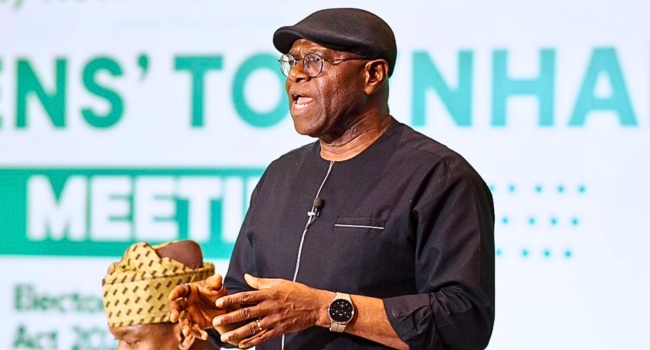
A Professor of Political Science and former electoral commissioner, Okechukwu Ibeanu, has warned that Nigeria’s amended electoral legal framework still contains gaps that could undermine the country’s democratic process.
Ibeanu made the remarks while delivering a keynote address at a Citizens’ Townhall, a policy dialogue on electoral reforms in Abuja, where he urged citizens to take greater responsibility in safeguarding democracy.
He said Nigerians often place excessive faith in legislation as the sole solution to electoral challenges, noting that overreliance on legal frameworks without institutional and civic reforms may not yield the desired outcomes.
“I think there are still gaps and loopholes in the law, and it’s unfortunate that it took us debating about a proviso for the country to come to a consensus that electronic transmission was actually in the 2022 act. But what we have done is actually to take us far back to 2018, where those debates were held in this country.
“We consistently tinker with the electoral legal framework as if that holds all the answers to our electoral problems. But more importantly, we hand the process of amending the Act to politicians, the same people the law is meant to regulate,” he said.
READ ALSO: 2027: INEC To Conduct Mock Presidential Poll
Frequent Amendments
The professor stated that Nigeria’s electoral law has been repealed and re-enacted multiple times, alongside several amendments, a pattern he described as unhealthy for a stable democracy.
“Amendment and repeal of the law should be its medicine, not its daily bread,” Ibeanu stated, warning that constant alterations risk turning reforms into tools for political calculation rather than safeguards for voters’ rights.
He added that persistent changes to the law could lead to provisions designed primarily to serve political interests rather than to protect citizens’ votes.
Ibeanu also cautioned against excessive regulatory oversight of political parties by the electoral commission, likening it to a “military regime spectre” if not carefully balanced with democratic principles.
Emphasising civic responsibility, he urged Nigerians to become more actively involved in defending their votes and holding leaders accountable.
“Citizens, this is about you. It is not about politicians; it is not about INEC.
Except citizens are in a position to protect their votes and control those who ostensibly represent them, our dream of a truly democratic country will remain an illusion,” he said.
The political scientist further called for a detailed review of specific provisions of the electoral law, including Sections 50, 60, and 62, urging the electoral body to issue clearer regulations and guidelines to remove ambiguities.
Electoral Act
Nigeria recently updated its electoral system after President Bola Tinubu signed the Electoral Act 2026 into law on February 18, 2026, replacing the 2022 legislation ahead of the 2027 general elections.
Key provisions of the new law include: Mandatory electronic transmission of results to the INEC Result Viewing (IReV) portal, recognition of the Bimodal Voter Accreditation System (BVAS), new timelines for election notices and candidate nominations, revised methods for party primaries, and earlier release of funding for the electoral commission.
While the reforms aim to strengthen transparency, opposition parties and civil society organisations have criticised aspects of the law, arguing that certain discretionary powers granted to electoral officials during technical failures could affect accountability.