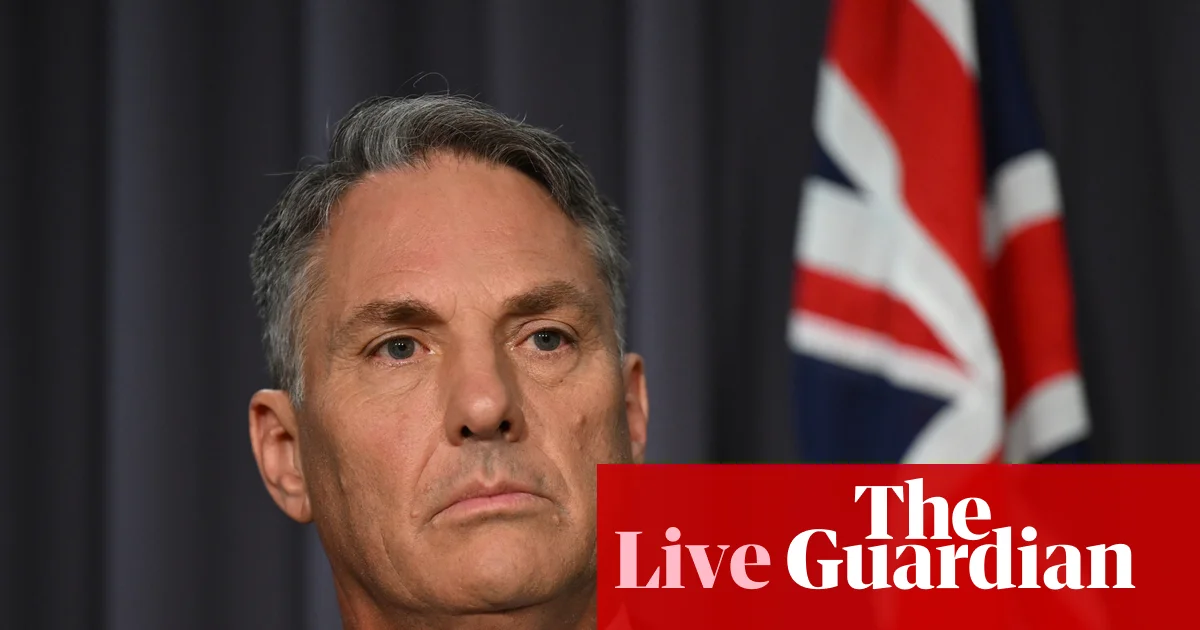
Marles says Australia was not involved in US-Israeli strikes on Iran
The deputy prime minister and defence minister, Richard Marles, is also doing the media rounds alongside Wong today, and says Australia supports action to stop Iran developing nuclear weapons, but confirmed the government was not told of the strikes before they happened.
Speaking to RN Breakfast this morning, Marles says Australia was not involved in the strikes, including the use of US joint facilities on Australian soil, such as Pine Gap.
Marles, like Wong, is asked whether the strikes on Iran were “legal” and also says that the question is for the US and Israel to answer:
We weren’t advised of this before it happened, but we wouldn’t have expected to be either.
We support the United States in preventing Iran acquiring a nuclear capability. The UN security council has long been in a position of doing everything within its power to stop Iran acquiring that capability. I mean, ultimately, the legality of these measures is a matter for both the United States and Israel to go through.

Key events
Australia imports crude oil from around the world: Marles
Moving over to Sky News, Richard Marles is asked about Barnaby Joyce’s earlier comments on Australia’s low reserves of crude oil and our limited refining capacity and whether Australia will be left exposed by this conflict.
Marles says Australia takes crude oil from all over the world – including the Middle East – but says the government will be “watching that very closely”.
He won’t say whether the reserves (where there are supposed to be 90 days worth of fuel reserves) should be increased by the government.
Look, we take crude oil from around the world, but that would include from the Middle East, but it’s not the only place where we take crude oil from. But I guess what that highlights is that, I mean, this is an important region. It has an impact on the global economy. We’ll all be watching that very closely, exactly what impact it has as a function of how long this continues.
Joyce says petrol prices will increase due to conflict
Speaking with Tanya Plibersek on a Sunrise panel this morning, One Nation MP Barnaby Joyce says Australia should focus on building up fuel supplies under risk due to conflict in the Middle East
The International Energy Agency states countries should have 90 days of fuel supplies, in the event of a crisis, but Australia has far less, with some reports from October last year that we have just 28 days’ worth of fuel.
Joyce says:
It’s a shame in a crisis like this that we’ve got ourselves down to two oil refineries, so that if there’s a crisis in the production of fuel, we’re in a bad spot.
We’ve got the old policies here – cross fingers, everything should be right as long as President Trump is able to bring this to a conclusion … People have got to start looking at what the effects are for Australia, not just the Middle East, and you can start looking for those effects at a petrol pump near you.
Plibersek tells Joyce he’s just made a “really good argument” for buying an electric vehicle (cue face palm from Joyce). She says:
There will be an economic impact of this. There was an economic impact of Russia’s invasion of Ukraine that affected the whole world, and that includes Australia. This is an area where a lot of our global oil and petrol, ultimately, is impacted by what’s being produced in the Middle East. I mean, it is a very good argument for Australia to have energy security and energy independence.
Marles says Australia was not involved in US-Israeli strikes on Iran
The deputy prime minister and defence minister, Richard Marles, is also doing the media rounds alongside Wong today, and says Australia supports action to stop Iran developing nuclear weapons, but confirmed the government was not told of the strikes before they happened.
Speaking to RN Breakfast this morning, Marles says Australia was not involved in the strikes, including the use of US joint facilities on Australian soil, such as Pine Gap.
Marles, like Wong, is asked whether the strikes on Iran were “legal” and also says that the question is for the US and Israel to answer:
We weren’t advised of this before it happened, but we wouldn’t have expected to be either.
We support the United States in preventing Iran acquiring a nuclear capability. The UN security council has long been in a position of doing everything within its power to stop Iran acquiring that capability. I mean, ultimately, the legality of these measures is a matter for both the United States and Israel to go through.
Wong not yet committing to repatriation flights
Making a stop in the press gallery corridor, Penny Wong says again that, due to the number of Australians in the Middle East, commercial flights will be the fastest way out of the region once the airspace reopens.
She won’t commit yet to the Australian government organising repatriation efforts.
As I said, given the numbers, the fastest way to get people home would be if commercial flights recommence. So we want to see whether that commences. I think that most, most of our like-minded [countries] are in a similar position, given the numbers of people in the region.
There’s conflict in the region, we’ve seen loss of life across the region and airspace is not open. So whether or not it is an Australian flight or a commercial flight, the flights are not able to occur.
On the risk of Iran developing nuclear weapons, Wong says Iran has consistently failed to comply with the decisions of the UN security council in relation to its nuclear program.
We know that the International Atomic Energy Agency, which is the nuclear watchdog, has already has given evidence about the enrichment stage at which Iran have reached, and they have also said that Iran has refused to fully comply with the inspection regime. So I think we all understand the intention behind the regime.
Insects, mould, bird lice: NSW announces review of ‘serious’ hospital maintenance issues

Imogen Dewey
As mentioned earlier, state health minister Ryan Park announced overnight that NSW Health is conducting a snap review of “serious hospital maintenance issues”.
So far, Park said, the ongoing review has identified 112 “non-routine” issues. His statement acknowledged reported instances of mosquitos, crickets, beetles and a possum, as well as mould, asbestos and a leaking roof, across a range of hospitals – and added further issues to the list including flies, birds, cockroaches, pigeons, bird live, and more possums.
In a highly critical Sunday statement, shadow health minister Sarah Mitchell said she feared these were “the tip of the iceberg”.
Patients go to hospital for treatment and care, not to be put in further danger due to toxic mould, or conditions caused by bird droppings and dead pigeons in roof cavities and air-conditioning units.
Hygiene in hospitals is paramount and my heart breaks for the families who have lost loved ones to these illnesses.
Legal ‘basis’ for strikes for US and Israel to explain: Wong
The foreign affairs minister, Penny Wong, says Australia has had no involvement in the strikes on Iran, and that the risk of a nuclear program cannot continue.
Staying on her interview with ABC News Breakfast, Wong says she has not spoken to her US counterpart, Marco Rubio, and “would not expect to” as she says Australia is not a central player in region.
She sidesteps a question about the legality of the strikes and says that it’s up for Israel and the US to explain that:
One of the distinctions with Iraq, between Iraq and now, is that we are not participating in these strikes. That’s the first point I’d make. The second is, what I’ve said is that the legal basis of this is for the United States and Israel to explain.
We’re obviously not party to the intelligence that both that the United States and the Israelis are referencing in their decisions. That is why it is for them to explain the legal basis of this. We do support action taken to ensure Iran does not have a nuclear weapon.
Wong is asked whether we will see a regime change after the death of Ayatollah Ali Khamenei. She says that should be up to the Iranian people, despite the US president, Donald Trump wanting a regime change:
The future of Iran is in the hands of the Iranian people. And what we do know from history is that regime change is not something that can sustainably be externally imposed.
In relation to Ayatollah Khamenei, as you said, no one will mourn his passing. This is the leader who has been responsible for brutally murdering his own people.
115,000 Australians in the Middle East region
As Australians are warned not to travel to the Middle East, Penny Wong says there are about 115,000 Australians in the region, and about 11,000 travelling regularly in and out of Australia on Etihad, Emirates and Qatar Airways.
Speaking to ABC News Breakfast this morning, Wong says Australians will get home most quickly if the government can help people get on to commercial flights over repatriations.
Wong says currently there are no flights to get Australians home:
It’s very difficult at the moment for government to provide a great deal of assistance in circumstances where flights are being cancelled, disrupted and their space is closed.
First we need to see if commercial flights will restart. Given the numbers of people in the region, people will get home most quickly if they, if, if we can facilitate people getting on to commercial flights. At the moment, the issue is not who is flying, it’s that people are not flying.
Smartraveller tells Australians not to travel to most countries in the Middle East
Smartraveller has updated its list of countries not to travel to in the Middle East, as conflict escalates in the region.
The countries include:
Bahrain, Iran, Iraq, Israel, Kuwait, Lebanon, Palestine, Qatar, Syria, the United Arab Emirates and Yemen.
The website says Australians should reconsider the need to travel to Jordan, Oman and Saudi Arabia.
In a statement this morning, the foreign affairs minister, Penny Wong, said Australians should expect travel disruptions.
We understand this will be a challenging time for many people, particularly those with family in the region or travel plans.
The Albanese government’s priority is the safety and security of Australians. We will continue to support Australians to navigate the disruption ahead, providing regular travel advice updates and consular assistance where we can, noting there are limits to what any government can do in a fast-moving and uncertain environment.
Wong warns that even travellers not going through the Middle East should expect some disruptions.
The statement says Australians should:
-
Closely monitor events and local media.
-
Check directly with their travel agent or airlines to confirm their plans.
-
Review their travel insurance to understand what is covered in the event of cancellations.
-
Follow Smartraveller for the latest advice and subscribe for updates.

Krishani Dhanji
Good morning, Krishani Dhanji here with you for a very busy sitting day ahead.
There will be lots of domestic reaction to the unfolding situation in Iran and the Middle East with the foreign affairs minister, Penny Wong, issuing a statement this morning warning Australians about travel disruptions. Wong and the defence minister, Richard Marles, will be doing the media rounds this morning for the government, so we’ll bring you those interviews as they come in.
As mentioned earlier, the House of Representatives is going to look pretty different today with Angus Taylor in the hot seat (opposition leader’s chair) for the first time since he ousted Sussan Ley. He’ll also have his new look frontbench sitting with him.
I’ve got my coffee, I hope you’ve got yours, let’s get straight into it.
House prices flatline in Sydney and Melbourne
Cotality’s latest Home Value Index shows home values in Sydney and Melbourne have flatlined, even as mid-sized capitals post bumper monthly gains. Perth remains the nation’s standout performer, with prices surging 27.1% in the past year.
Dwelling values climbed 2.3 % in February alone, adding more than $22,500 to the median home. Brisbane and Adelaide are also outperforming, rising 1.6% and 1.3%, respectively.
By contrast, median homes in Sydney and Melbourne saw zero growth over the month, rounding out a quarter of mild declines.
Cotality’s research director, Tim Lawless, described the “two-speed conditions” as extraordinary, saying the property markets of major and mid-sized capitals had been drifting apart for years. Tight supply and high demand are driving outsized gains in other capitals, he said.
Welcome
Good morning and welcome to Guardian Australia’s politics live blog.
Federal parliament is sitting as Anthony Albanese marks 30 years in politics and Angus Taylor his first week in Canberra as opposition leader. The Coalition is expected to press Labor on the return of women and children held in a camp in Syria, as well as speculated changes to capital gains taxes on investment properties.
The foreign affairs minister, Penny Wong, has warned Australians to expect “serious travel disruptions” in coming days due to the conflict unfolding in Iran, including changes at short notice to Europe routes. In a statement this morning, her office noted “many Australians in the Middle East are unable to leave due to airspace closures, including around major transit hubs”.
As New South Wales readies for budget estimates, the state health minister, Ryan Park, has ordered a snap review of “serious” hospital maintenance issues including instances of cockroaches, possums, bird lice, as well as mould, roof leaks and asbestos.
Krishani Dhanji will be with you soon.