Tim Andrews knew he needed a miracle.
The 67-year-old from New Hampshire had spent two years in kidney failure triggered by his diabetes, forcing him to spend six hours a day, three days a week in dialysis, which filters toxins out of the bloodstream when the kidneys cannot.
Much of Andrews’ time was spent confined to a chair as the dialysis machine kept his kidneys functioning, with intense fatigue and muscle wasting stealing his ability to walk. After six months of treatment, he suffered a heart attack.
‘I knew I was going to die,’ he told Daily Mail. ‘I thought there’s got to be another way.’
In his research for other treatment options, Andrews came across an article about Richard Slayman, a 62-year-old from Boston who had received a transplanted genetically modified pig kidney to treat his end-stage kidney disease in 2024 at Massachusetts General Hospital in Boston.
Although initially successful, Slayman died just two months after the procedure, which is known as xenotransplantation, after an unexpected cardiac event. Doctors at the time said there was ‘no indication’ his death was the result of the transplant.
‘The more I read about it, the more I thought it might work,’ Andrews said.
At the time, the procedure had only been performed a handful of times across the US, but the team at Massachusetts General Hospital agreed to consider Andrews if he completed several months of physical therapy to make himself stronger and reduce the risk of his body quickly rejecting the animal organ.
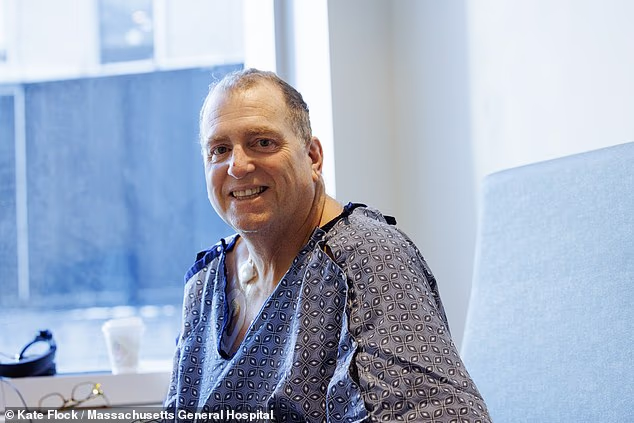
Tim Andrews (pictured above), a 67-year-old from New Hampshire, is the first person to receive both a pig and human kidney transplant
On January 25, 2025, Andrews underwent the three-hour procedure in which his diseased kidneys were removed and he received one pig kidney.
He spent a week in the hospital before being discharged on 51 different medications to keep his immune system from rejecting the pig kidney, which he named Wilma.
‘At first it was great, which I realized was the steroids. They made you feel real good, like I’m Superman. As they wean those off, it got a little tougher. Bumps in the road.’
‘Wilma’ kept Andrews off dialysis, but over the next few months, his condition gradually declined. He started urinating less and suffering flu-like symptoms such as fever, headaches and nausea, all signs of organ rejection.
Finally, after 271 days, a record for kidney xenotransplantation, Andrews had Wilma removed in October 2025.
‘For 271, days, we fought it and fought it and fought it,’ he said.
‘I knew probably a week before they’re going to take it out, that she was done. She was done fighting.’
Now left with no remaining kidneys, Andrews was forced back into the dialysis chair, becoming one of the 90,000 Americans awaiting a human kidney. Despite the demand, just under 30,000 kidney transplants are performed each year in the US.
‘I was like, “Here I am again,'” Andrews said. ‘I can’t walk, I want to sleep all day, I’m sick all the time. [Dialysis] is tough on the body, tough on the mind.’
By this point, he was convinced he would only have a few months left to live. Many people on dialysis with no kidneys can live several years, but being in later stages of kidney disease can slash that time down to months.
The kidneys are essential for filtering toxins out of the body and filtering minerals, so without them, waste and potassium build up in the bloodstream, damaging the lungs and the heart.
Andrews, a father of two daughters, was starting to make peace with the inevitable when he got a call just before midnight on January 12, 2026, nearly a year after his first experimental surgery: there was a human kidney ready for him, a near-perfect match, 87 miles away in Boston.

Pictured is the genetically-edited pig kidney that was transplanted into Andrews. He lived with it for 271 days

Pictured above are the surgeons at Massachusetts General Hospital performing Andrews’ xenotransplantation procedure
Doctors at Mass General implanted the kidney on a Wednesday morning, and by Friday afternoon, Andrews was already on his way home to recover. Now, he’s the first person in the world to have a human kidney transplant after a xenotransplantation.
Xenotransplantation was first attempted in the early 20th century by trying to insert pieces of a rabbit’s kidney into a child, which failed. It wouldn’t be until the 1960s when a chimpanzee kidney was successfully implanted into an adult, who lived with the organ for nine months.
In the 1990s, researchers identified pigs as the ideal choice for these transplants because they are widely available and similar in structure to humans, though primates have been used in older attempts. The procedure has been attempted roughly a dozen times since the early 1900s.
Slayman in 2024 was the recipient of the first successful genetically edited pig kidney.
A month after the lifesaving operation, recovering at home in New Hampshire, Andrews told the Daily Mail ‘there are still bumps’ in the road.
He now has a laundry list of 20 anti-rejection medications, down from 51 last year, and has to keep track of blood sugar spikes, as immunosuppressant medications can increase the risk of insulin resistance.
‘But I’m going to feel good,’ he said.
Andrews’ new kidney came from an unidentified deceased donor. Following his operation, he posted a message on Facebook for the donor’s family. ‘I am so sorry for your loss,’ he said in the message.
‘I grieve with you. It’s got to tear you apart, but I’m here to tell you, the donation of a kidney has saved my life, and you have given hope to millions. Your family member is a hero. He’s a hero, not just to me, but to the entire world.
‘I’ll never be able to repay you, but I promise you it’ll be in my heart. And it will be cared and loved for for as long as I live, and I will spend my life basically preaching, and I’m not a preacher, about what this love did.’

Andrews is pictured above after the xenotransplantation surgery. He had the organ for 271 days before it had to be removed because his body was rejecting it

Andrews, pictured center above with his doctors, has encouraged others to become organ donors
Andrews said he is most looking forward ‘to living longer than I thought I would.’
He also knows he is one of the lucky minority to receive a lifesaving donation and that more organ donors are desperately needed.
‘People should be donors,’ he said. ‘There’s no reason not to have your driver’s license say “donor” on it. Mine did from the time I was 16. I didn’t know I would be a recipient at that time; I thought I’d be a donor for sure, and it worked out the other way.
‘It’s an amazing feeling to have somebody save your life. It’s tough because mine was a deceased, so there’s a lot of emotion involved here with a person having to die for me to live. It’s tough, but I’m dealing with it.’
He also, however, hopes more people in need of organs can benefit from xenotransplantation as a bridge to further treatment.
Andrews said: ‘In a few years, we could see this becoming a lot more commonplace and more and more people getting the organs they need.’