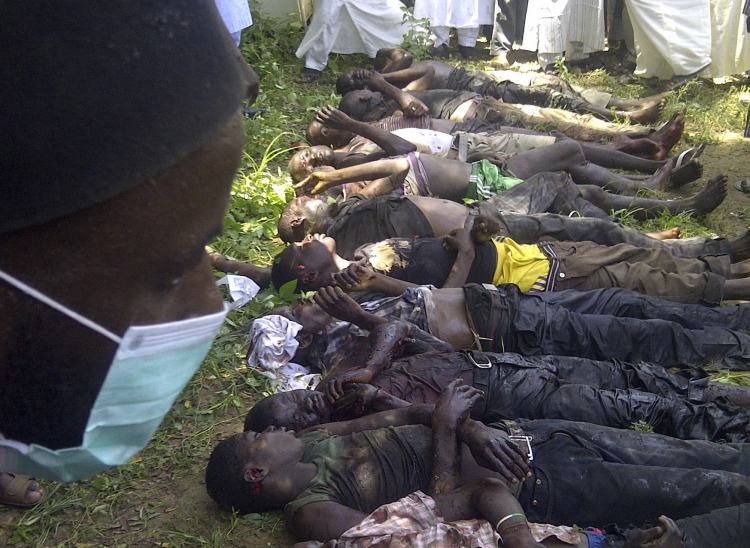
On Feb. 23, the House of Representatives’ powerful Appropriations and Foreign Affairs committees released their new report, “Ending the Persecution of Christians in Nigeria.” Appropriator Rep. Riley Moore, who, along with Appropriations Chairman Rep. Tom Cole, was tapped by President Trump to assess the issue, presented the report to the White House, which is now considering it.
The report opens with a statement of findings, which is a breakthrough in clarity:
After decades of persecution, Nigeria is the deadliest place in the world to be a Christian. Christians are subject to ongoing violent attacks from well-armed Fulani militias and terrorist groups, resulting in the death and murder of tens of thousands of Christians, including pastors and priests, the destruction of thousands of churches and schools, as well as kidnappings. Blasphemy laws in Nigeria’s northern states are used to silence speech and dissent, target Christians and minorities, and justify so-called “convictions” without due process.
The U.S. government had long insisted that the relentless mass atrocities against Christian farming communities in Nigeria’s central region by Fulani Muslim herders crying “Allahu Akbar” as they attacked had “nothing to do with religion.” To justify this, the State Department pointed to data by ACLED, an NGO contracted under the Obama administration by State’s recently dismantled Bureau of Conflict. ACLED’s founding director is British University of Sussex professor Clionadh Raleigh, who launched her career with the thesis that climate change is driving African conflicts, and whose skewed data omitted the religion of Nigeria’s perpetrators and victims of violence. State ran with this, reporting the Middle Belt violence as simply “clashes” between two socio-economic groups driven by climate change pressures.
President Trump rejected that assessment in October when he designated Nigeria a “Country of Particular Concern” for religious persecution against Christians.
The report sheds further light on the anti-Christian persecution and recommends new policies. Significantly, it states that Abuja must demonstrate “political will” to “immediately reduce and then end the violence.” For the past 20 years, such political will has been sorely lacking. Fulani militias have violently targeted Middle Belt Christians with complete government impunity, whereas in the north, the government deploys the military to defeat Islamist terrorists who victimize large numbers of Muslims and others. In a Feb. 26 communique, the Nigerian Catholic Bishops Conference, describing the impunity problem facing the targeted farming communities, states that “the gunmen operate brazenly, freely and unchallenged.” The International Religious Freedom Act mandates CPC designation when a government so “tolerates” persecution.
In December, Nigeria’s President Bola Tinubu replaced the country’s weak defense minister, a Muslim, with respected general Christopher Musa, a Christian, and began surging forces to the north to counter ISIS-linked terrorists and cooperate with the U.S. military there. Yet Tinubu continues to deny the Christians are persecuted. First lady Oluremi Tinubu, who is a Pentecostal pastor as well as a senator, claimed that our concern for Nigeria’s Christians is based on “propaganda,” according to The Hill. In Washington recently, she met with me and other experts at Hudson Institute offices. Joining us was Rev. Remigius Ihyula, a Nigerian Catholic priest with frontline experience of the Fulani attacks that he says are “systematically” taking lands to Islamize the region. He pleaded with her to use her influence to restore the stolen farms to their Christian owners who languish by the hundreds of thousands in displacement camps. She responded by saying that some she helped resettle in Abuja wanted to remain where “food will come free” rather that return home.
The congressional committees’ report aims to take the CPC process to its next phase. Calling this a “once-in-a-generation opportunity” to end the two-decade-old crisis, it urges making Nigeria a “strategic” partner through a binding bilateral agreement. Such an agreement would address protecting Christian communities from persecution, eliminating jihadist terror, furthering economic cooperation, and countering “adversaries” in the region, including “the Chinese Communist Party” and “Russian Federation.”
The report recommends including action steps ranging from the easily achievable “compelling Fulani herdsmen to disarm” and removing Fulani from confiscated farms so displaced owners can return, to the more complex ones of having security forces prevent and respond to attacks and ensuring Sharia’s repeal in Nigeria’s north. To foster the necessary political will, the report recommends U.S. government actions, including targeted sanctions, foreign assistance and visa restrictions, and the designation of Fulani militias with terrorist links as a “Foreign Terrorist Organization.”
A Fulani kidnapping of three church congregations in one southern Kaduna village on a Sunday morning last month shows the daily reality for millions in one of Africa’s richest and most influential countries. Over 160 Christians, a quarter of the population, were taken hostage at gunpoint and force-marched nearly 20 miles into the bush and beaten and abused. This was the village’s second mass kidnapping that month. Instead of a rescue operation, government authorities organized a press conference to deny that it happened. The region’s federal police chief announced that the report was a “mere falsehood being peddled by conflict entrepreneurs who want to cause chaos.” Kaduna’s internal security commissioner took the podium to threaten that “we will not tolerate the spread of such false information.” But later that week, feeling the international backlash, they acknowledged the kidnapping. In February, the traumatized hostages were ransomed but no arrests were made.
Brutal Fulani persecution of Middle Belt Christians continues unabated with government impunity. The congressional plan is the best hope for these victims and for Nigeria. The White House should adopt it.