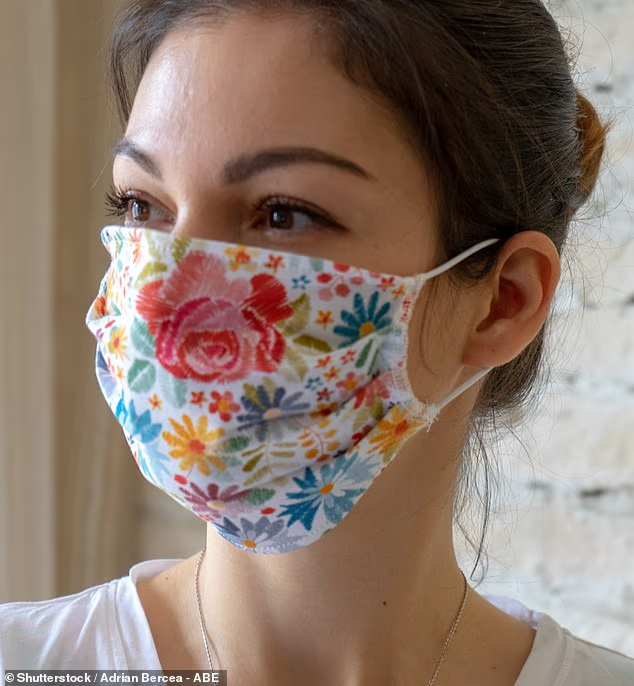
Could wearing a face mask help protect your heart? That’s the suggestion from researchers in Japan, who say face coverings worn during the Covid-19 pandemic may have reduced the risk of certain types of heart attacks triggered by air pollution.
The team from Kumamoto University used data from more than a quarter of a million patients hospitalised for a heart attack between 2012 and 2022 in Japan.
They examined short-term exposure to PM2.5 – tiny airborne particles released by vehicles, industry and household heating, which can penetrate deep into the lungs – and compared risks before and during the pandemic.
They found that short-term (defined as two days) exposure to PM2.5 significantly increased the risk of all types of heart attacks.
However, one subtype of heart attack, MINOCA (myocardial infarction with non-obstructive coronary arteries) showed a particularly strong association with air pollution.
‘This is a type of heart attack that happens without major blockages in the heart’s arteries,’ explains Professor Chris Gale, a consultant cardiologist at Leeds Teaching Hospitals NHS Trust.
It accounts for 5-10 per cent of all heart attacks (around 10,000 people in the UK every year) and is more common in women and younger individuals, he adds.
‘It can be triggered by things such as artery spasm, problems with the very small blood vessels of the heart or inflammation – and air pollution may make these issues worse,’ he explains.
Research shows the benefits of face coverings goes beyond preventing the spread of viruses
‘Polluted air can increase oxidative stress [where molecules called free radicals damage cells], reduce nitric oxide [which helps blood vessels relax] and make the artery walls more prone to tightening.’
After the onset of the pandemic, the PM2.5-related risk of MINOCA declined in Japan, the new study found. Since Japan didn’t impose strict lockdowns, this reduction probably wasn’t due to people staying home more and breathing less polluted air, said the researchers, whose findings are published in the European Heart Journal.
Instead, ‘mask wearing, which was rapidly adopted and consistently practised in Japan, played a particularly important role’.
While improving air quality remains a long-term priority to reducing heart risks, this ‘provides evidence that simple protective measures [i.e. mask wearing] can mitigate cardiovascular risks associated with environmental exposures,’ they concluded.
Jonathan Grigg, a professor of paediatric respiratory and environmental medicine at Queen Mary University of London, told Good Health: ‘This study strengthens the evidence that short-term exposure to small particles increases the risk of heart attacks.’
His own research last year had also shown the benefits of face coverings beyond preventing virus spread. It found that when volunteers were exposed to traffic on Whitechapel Road (a four-lane, major arterial road in East London) for 60 minutes, ‘wearing a FFP2 mask [which filters PM2.5] halved the amount of inhaled particles entering the blood’, reported ERJ Open Research.
Professor Grigg adds: ‘We do not fully understand the mechanism [of] how particles reaching the lungs trigger heart attacks – it is probably a combination of substances released in the lung itself getting into the bloodstream – and a direct effect of particles themselves in the blood.
‘Our study suggests that vulnerable people – for example, those recovering from a heart attack – may benefit from a FFP2 mask when moving through areas of high pollution, for example near main roads,’ he says.
Zongbo Shi, a professor of atmospheric biogeochemistry at the University of Birmingham, says he was ‘not surprised’ by the results of the Japanese study. ‘Both short-term and long-term PM2.5 exposure increases the risk of many health conditions, including heart attack.’
He recommends wearing face masks when in polluted places ‘such as when walking roadside or on the London Underground, especially the older lines such as the Northern Line’. A 2024 report found it had the highest dust levels on the tube network.
Professor Gale adds: ‘There are many ways in which people can reduce their risk of heart attack, including adopting a heart-healthy lifestyle: quitting smoking, eating a balanced, lower-salt diet [such as the Mediterranean diet], maintaining a healthy weight – and staying active, with at least 150 minutes of moderate exercise weekly.’
He added: ‘It is, however, important that we recognise the effect that air pollution has on our cardiovascular health.’
Professor Shi concurs, pointing out that it is not just vehicle pollution we need to be aware of – wood burners are a major source of outdoor air pollution, too.
‘If not handled properly, they can be a source of indoor pollution as well. Burning wet wood, restricting airflow, or using an old/open fireplace significantly increases wood-burning PM2.5 emissions.
‘Reducing wood burning would bring significant health benefits to UK residents, particularly the users themselves, whether or not they are vulnerable.’