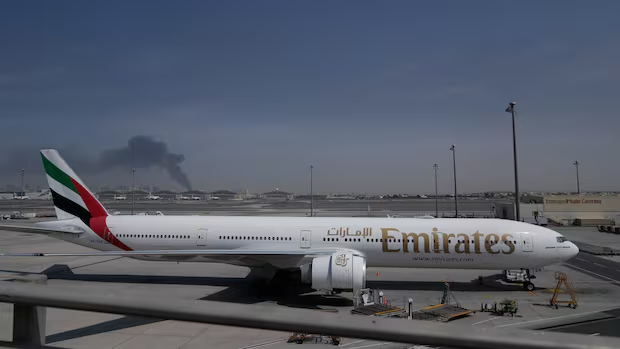
Air travel in the Middle East has been suspended since Saturday amid U.S. and Israeli airstrikes on Iran and the Islamic Republic’s retaliatory attacks on other countries in the region.
Vancouver’s Raymond Grewal was on his way back to Canada from his honeymoon in the Maldives on Saturday and was meant to have a 12-hour layover in Dubai.
He was on the plane to Dubai when he first learned about the conflict and thought their flight may be rerouted. But he didn’t expect to still be waiting to come home three days later.
By the time they landed, the situation had worsened and he began to see rumours on social media that the emirate’s airspace would soon be shut down.
Grewal and his wife are among hundreds of thousands of travellers stranded in the region and at destinations around the world that connect through major airports in Doha and Abu Dhabi, as well as Dubai — one of the world’s busiest air hubs.
Iran targetted all three of those airports over the weekend with missile and drone strikes, and also hit some luxury hotels in Dubai.
This led to airlines cancelling more than 9,500 flights throughout the Middle East since Saturday, according to the air traffic monitoring website Flightradar24.
By Monday night, some airlines had resumed a small number of flights from the Middle East.
Grewal says he and his wife are currently booked to fly out of Dubai via Frankfurt on Wednesday, but he’s hoping Air Canada can rebook them on a flight sooner than that.
“We’ll do a long layover. We don’t care,” he said. “Just, kind of, get us out of here.”
Here’s what we know about when travellers may be on the move again, even as the volley of rocket fire and drone strikes continue throughout the region.

Travel with Morning Live host David Common as he recaps how he made it from Toronto to Tel Aviv in 24 hours to get on-the-ground reporting following U.S. and Israeli strikes into Iran at the end of February. Common is in Israel as part of CBC News’ special coverage in the Middle East as the United States continues Operation Epic Fury in the region.
What’s happening at airports
Dubai Airports, the official website for the city’s two airports — Dubai International Airport and Dubai World Central Airport — posted an advisory Monday saying a limited number of flights would resume that night.
According to the site’s departures page, an Emirates flight to Mumbai departed at 9:12 p.m. local time, followed by flights to four other cities in India. FlyDubai has also begun operating flights to destinations in Russia, Central Asia and Eastern Europe.

Abu Dhabi’s Zayed International Airport, the home base for Etihad Airways, confirmed partial operations resumed Monday but passenger flights had yet to begin taking off as of 1 a.m. local time Tuesday.
Unlike Emirates, Etihad Airways said in a post on X that it would not resume commercial flights until 2 p.m. local time on Wednesday.
Qatar’s airspace remained closed on Monday, affecting flights on Qatar Airways and other international carriers travelling through Hamad International Airport
The Qatar Civil Aviation Authority is due to provide an update on the airspace closure on Tuesday at 9 a.m. local time.
In Israel, which is still being targetted by Iranian strikes, Ben Gurion Airport is poised to resume “extremely limited” service starting on Tuesday.

Get the latest on CBCNews.ca, the CBC News App, and CBC News Network for breaking news and analysis.
What Canadian airlines are saying
Air Canada says it will not resume direct flight services to and from Dubai and Tel Aviv until March 23.
The airline reguarly operates flights to Dubai from Toronto, but had previously suspended a direct seasonal flight to and from Vancouver.
Air Canada had previously suspended direct flights between Toronto and Israel’s main airport due to the war in Gaza and “ongoing geopolitical uncertainty.”
The airline is offering to change flights to those destinations free of charge, but if a flight has already been cancelled, the company says it will contact customers directly with options.
For those travelling on flights booked through Air Canada that haven’t yet been affected by the turmoil, the airline is allowing voluntary changes for travel to, from or through specific destinations booked no later than Feb. 28 for travel between now and March 15.
Those destinations include: Abu Dhabi, Dubai, Tel Aviv, Beirut, Amman, Erbil (Iraq) and Dammam (Saudi Arabia).

CBC News has reached out to Air Canada for further details about how many travellers have been affected and how many have been stranded in Middle East hubs, as well as how the airline is assisting those customers. A response was not received in time for publication.
WestJet does not offer direct flights to the Middle East. But on its website, the Calgary-based airline says customers who booked flights through WestJet with partner airlines to Dubai and the Saudi Arabian cities of Riyadh and Jeddah can change or cancel bookings without paying a fee.
For destination changes, the airline says customers will have to pay the difference in airfares, while any residual amounts will be refunded.
The Calgary-based airline says costs associated with cancelled bookings will be refunded or credited.
The Current19:48What’s next for Iran?
Watch out for scams
Meanwhile, Grewal, the Vancouver traveller stranded in Dubai, responded to posts on X from the official accounts for Air Canada and Emirates, hoping to get assistance with rebooking.
Shortly after, he received a response from what looked like the airline’s customer support unit.
Grewal quickly noticed that it was a new account with no followers and a random username unrelated to the airline.

In another post, he flagged that it was a scam, but says he spotted similar accounts replying to travellers on posts from both Air Canada and Emirates.
The account he interacted with has since been suspended.
Emirates posted on X Monday that customers should “be wary of imposter accounts” and that its only official channels on the platform — @Emirates and @EmiratesSupport — could be identified by gold verification checkmarks.
Qatar Airways shared a similar post on Sunday, saying fraudulent accounts were requesting personal information from customers.
The airline warned it would never ask for sensitive information such as passwords or bank details via social media and to only interact with the Qatar Airways website or app.

Foreign Affairs Minister Anita Anand, who is in India alongside Prime Minister Mark Carney, said Monday that while Canada shares U.S. concerns about Iranian nuclear proliferation, it does not intend to be involved in any military operations and would like to see a diplomatic solution.