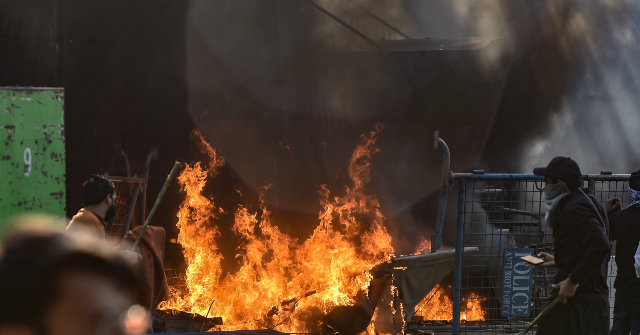
Pakistan imposed a three-day curfew on Monday morning following violent protests against the U.S.-Israeli attack on Iran, including an attack on U.S. consulates and the embassy in Islamabad. At least 22 people were reportedly killed in clashes with Pakistani security forces, and over 120 were injured.
The curfew was imposed in the northern cities of Gilgit and Skardu, where several deaths and dozens of injuries were reported on Sunday. Thousands of Shiite Muslims — adherents of the branch of Islam that Iran’s theocracy purports to lead — swarmed through the streets of these cities, vandalizing several buildings and setting fire to a police station.
In Skardu, the Shiite mob attempted to storm the offices of the U.N. Military Observer Group (UNMOGIP) and U.N. Development Program (UNDP). UNMOGIP is the agency that monitors the Kashmir region, which is disputed between Pakistan and India.
According to local media reports, the mob managed to set fires in several parts of the U.N. complex and surrounding public facilities. The Pakistani government deployed troops to stabilize Gilgit and Skardu, and both cities were placed under curfew, as the police urged residents to shelter indoors amid “deteriorating law and order conditions.”
In the port city of Karachi, the largest city in Pakistan, demonstrators attacked the U.S. Consulate on Sunday, smashing windows and attempting to set the facility on fire. An angry demonstration was also reported at the U.S. consulate in Lahore.
In the capital of Islamabad, riot police used tear gas and batons to hold Shiites back from the U.S. Embassy and the surrounding diplomatic enclave, known as the Red Zone. Thousands gathered to wave placards with the image of slain Iranian Supreme Leader Ayatollah Ali Khamenei and chant slogans such as “those who side with the U.S. are traitors” and “revenge against Israel.”
Another clash between demonstrators and security forces was reported from the northern city of Peshawar, again involving a mob moving on the U.S. consulate there. A large demonstration was held in the city of Multan in Punjab province, but this one was seemingly nonviolent.
Pakistani officials reported ten deaths in Karachi, eight in Skardu, and two in Islamabad, along with dozens of injuries.
Shiite Muslims only comprise about 20 percent of the Pakistani population, but since that population numbers over 250 million, Pakistan has one of the numerically largest Shiite communities in the world. Shiites are the majority in the region bordering Afghanistan, which is currently engaged in hostilities with Pakistan.
“Are we the enemy of the state? We were here to mourn the death of our leader, and we cannot even grieve here? They promised to let us be here and protest, but they violated their commitment?” a Shiite protester complained to Al Jazeera News, effectively answering his own question, since he referred to Iran’s Khamenei as his “leader.”
Contrary to the complaints of the Shiite demonstrators, the Pakistani government did denounce Operation Epic Fury.
Pakistani President Asif Ali Zardari expressed his “profound sorrow over the martyrdom of Khamenei” and said Pakistan “stands with the Iranian nation in this moment of grief, and shares in their loss.”
Prime Minister Shehbaz Sharif also expressed “grief and sorrow” over Khamenei’s death, and said his elimination by U.S. and Israeli air strikes was a “violation of the norms of international law.”
“We pray for the departed soul. May God Almighty grant patience and strength to the Iranian people to bear this irreparable loss,” Sharif said.
“Following the martyrdom of Ayatollah Khamenei, every citizen of Pakistan shares in the grief of the people of Iran,” said Interior Minister Mohsin Naqvi, describing Saturday as a “day of mourning for the Muslim Ummah, and for the people of both Iran and Pakistan.”
The Pakistani government would doubtless prefer not to be pulled into the Iran conflict, especially given its own clashes with the Taliban regime in Afghanistan, but it might not have a choice.
In September 2025, Pakistan signed a mutual defense pact with Saudi Arabia, seemingly to present a united front against Israel, which had just conducted an airstrike against Hamas leaders in Doha, Qatar. The defense pact theoretically committed Pakistan and Saudi Arabia to come to each other’s defense if either was targeted by an Israeli operation — but in reality, Saudi Arabia was attacked by Iran over the weekend. Also, at least one Pakistani national was reportedly killed by an Iranian strike against the United Arab Emirates over the weekend.