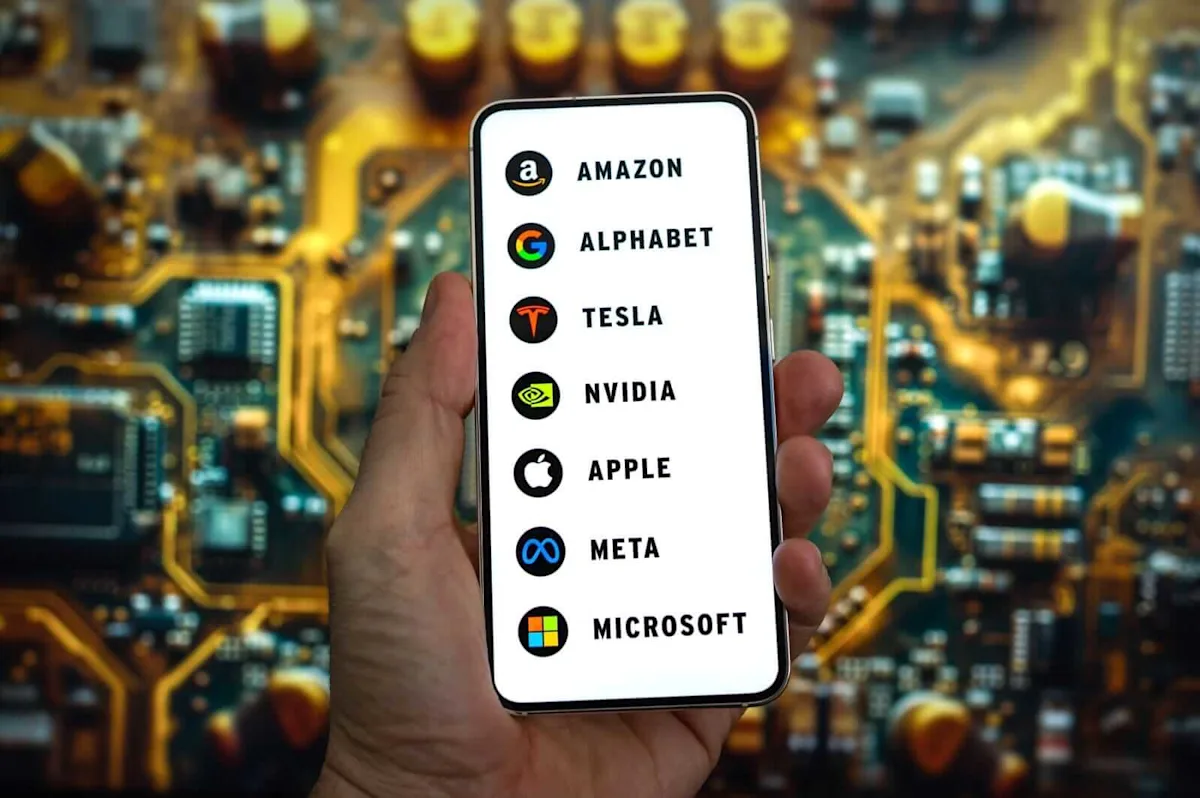
The “Magnificent Seven” stocks, the tech powerhouses that have fueled the U.S. stock market for years, are showing signs of fatigue early in 2026. After dominating the S&P 500 ($SPX) for years, a fresh debate has sparked among investors about whether the Magnificent Seven stock rally has finally peaked and whether one should buy, hold, or sell these mega-cap tech stocks.
Let’s find out what the right play is now.
The Magnificent Seven is a group of dominant large-cap tech companies that includes Microsoft (MSFT), Apple (AAPL), Amazon (AMZN), Alphabet (GOOG) (GOOGL), Meta Platforms (META), Nvidia (NVDA), and Tesla (TSLA). These stocks have powered through the AI-led bull run in recent years, accounting for a staggering portion of the S&P 500’s gains.
However, most of these names have had a difficult start to the year 2026. Here is how these stocks have fared so far this year.
Part of this sell-off is a 2026 market rotation away from AI stocks with lofty valuations toward previously overlooked areas such as storage, infrastructure, and other cyclical sectors. Investors may be pulling capital away from the Mag 7, but the core drivers behind these mega-cap techs (innovation, scale, and AI investment) haven’t disappeared.
Let me give you my three personal favorites from the Mag 7 group, which I believe will reward investors in the long run once the market rotates back.
Despite its 17% fall, Microsoft makes a compelling case for why it is still a must-own stock. In its recent Q2 of fiscal 2026, revenue surged 17% to $81.3 billion, while earnings per share (EPS) jumped 24%. AI is quickly emerging as a major growth engine, with Azure up 39% and cloud revenue reaching $50 billion for the first time. Despite massive AI investments, Microsoft’s operating margins expanded to 47%.
Despite spending $37.5 billion on capital expenditures, Microsoft generated $5.9 billion in free cash flow (FCF) in the quarter and returned $12.7 billion to shareholders through dividends and buybacks. No matter the market sentiment, with a solid backlog of $625 billion, aggressive AI expansion, and strong analyst backing, Microsoft appears more like a temporarily discounted long-term AI leader.