When we last left the Peaky Blinders crew — a dangerously close-knit family of flat cap-wearing, Birmingham-bred, brutal and yet oddly lovable gangsters — things had reached their dramatic apex. As various subplots chugged along toward their combustion point, top dog Tommy Shelby (Cillian Murphy) and his aggrieved nephew Michael (Finn Cole) had their final stand-off. The grand Shelby estate was rigged with dynamite and detonated, and Tommy, wrongly believing he was terminally ill, summoned the family for a last supper. In a final twist, as his own grave went up in flames (without him in it), Tommy galloped off into the horizon, his empire reduced to embers.

This made for a satisfyingly explosive conclusion, even if it left a few rather obvious loose ends. What would become of Tommy after he cantered vaguely off into the distance? And the fate of Tommy’s criminal corporation — and who would take over the reins — was also left unsealed. Series creator Steven Knight left ample room to build on a gamut of storylines. While Tommy and his few remaining kin survived, there would always be scope for more. Yet, although Knight and series one director Tom Harper’s propulsive follow-up, “Peaky Blinders: The Immortal Man,” still packs a punch, it too often feels like a rehashing of the show’s old material.
Picking up the pieces roughly five years after the events of the final episode, “The Immortal Man” opens as the Birmingham king has retreated from his reign. As the characters land on the cusp of World War II (the film is set in 1940, around real-life bombings of the city), the salt and pepper-haired mobster is still beleaguered by his post-traumatic stress from World War I. There is also his guilt over his hand in the deaths of copious family members, not least Arthur (Paul Anderson). He turns to memoir writing — “The Immortal Man” is also the name of his toiled-over manuscript in progress — as a form of therapy and otherwise mopes around his new country mansion.
Tommy’s total absence has left room for resentment to fester for his neglected heir, Duke, who was introduced in the show’s final season as something of a loose canon. Now all grown-up and recast as a brilliantly insecure, edgy, and tormented Barry Keoghan — practically a perfect fit to play Tommy’s son — he is causing havoc trying to outdo his dad, running reckless operations and pilfering ammunition from British soldiers. Disillusioned with his lot in life, he is even fraternizing with the enemy: Beckett (Tim Roth), a fascist conspirator who tries to wield a paternal power over Duke. With the threat of the extreme right rumbling across its six seasons, Knight finally brings the Peaky Blinders’ ultimate nemesis — the Nazis — within a hand grenade’s distance.
Those who remain standing (after the bloodbath of the show) reprise their roles: Tommy’s loyal right-hand man Johnny Dogs (Packy Lee), his sturdy uncle Charlie (Ned Dennehy), and his sister, the forever morally unimpeachable Ada (Sophie Rundle). She has sagely taken her brother’s advice to head into politics and make good in the city. But Knight’s script spends a lot of time self-consciously, apologetically fretting about those who are missing.
Often weighed down by this sense of all the characters lost along the way, the film tries to make up for it by unsubtly announcing which characters are whose substitutes. As an Alfie-esque criminal kingpin (Tom Hardy in the series), Stephen Graham makes a glancing appearance as the “king of Liverpool”; he’s right at home among the Peaky Blinders crowd, but Harper makes little use of him. Then, as Polly’s (Helen McRory) stand-in, Kaulo (Rebecca Ferguson), the mystical twin of Tommy’s long-dead Roma lover (and Duke’s mother), who has dubious intentions — and an equally iffy accent to match. Living up to the memory of these beloved characters is, after all, no easy feat.
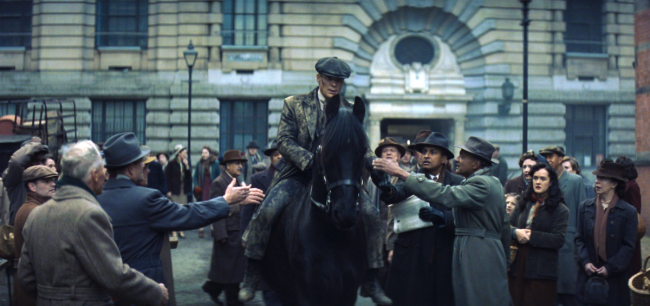
Despite the gaps in the Peaky Blinders lineup, the show’s iconic universe of tan-colored leather, suave tailoring, hard liquor, swill, and grime has been carefully restored. George Steel’s cinematography lends a newfound beauty to “The Immortal Man” and its bleak, wintry aesthetics on the big screen. The film is faithful to the franchise’s customary angst, with riotous needle drops (and an obligatory new Nick Cave track) courtesy of Antony Genn and Martin Slattery. And, for fans, there are instantly gratifying referential shots, such as Tommy riding horseback through a bombed-out Birmingham, spattered with pigsty mud.
Between Duke, Kaulo, and Beckett’s plotting, there are enough moving parts to drive the story toward a climactic, incendiary end. Inevitably, however, the result feels like the character evolutions, machinations, and plot pivots of an entire series of the show compressed desperately into 112 minutes. The payoff isn’t nearly as great. Yet Knight’s script is sharpest when, with a sprinkling of humor, he ventures into compelling thematic territory, exploring the monetization of grief as war rages.
This time round, though, an unfortunate silliness sometimes creeps in, where the film risks tipping over Shakespearean-size emotions into embarrassing bathos. Anchored by Murphy and Keoghan’s impeccable performances and father-son chemistry, it’s an unsteady trip down memory lane. Though imperfect, if it were the Peaky Blinders’ last hurrah, it’s certainly a spectacular way to go.
Grade: C
“Peaky Blinders: The Immortal Man” will release in select theaters on Friday, March 6, and on Netflix on Friday, March 20.
Want to stay up to date on IndieWire’s film reviews and critical thoughts? Subscribe here to our newly launched newsletter, In Review by David Ehrlich, in which our Chief Film Critic and Head Reviews Editor rounds up the best new reviews and streaming picks along with some exclusive musings — all only available to subscribers.