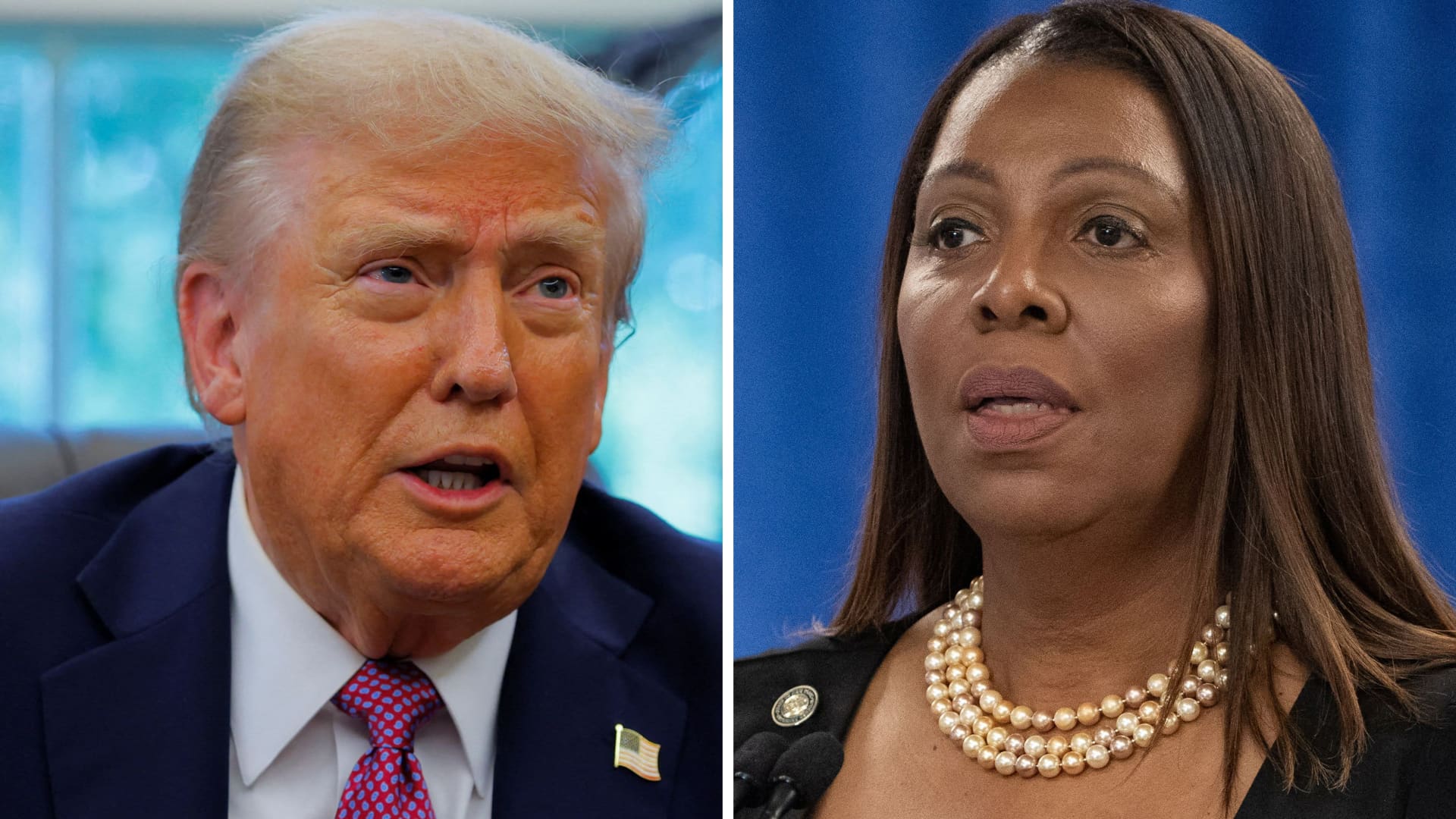
U.S. President Donald Trump and New York Attorney General Letitia James.
Brian Snyder | David Dee Delgado | Reuters
New York Attorney General Letitia James and the top prosecutors of 23 other states once again sued to block President Donald Trump‘s global tariff regime, just days after a landmark Supreme Court decision struck down his previous effort.
Their lawsuit, filed Thursday in the Court of International Trade, seeks to deem Trump’s latest tariffs illegal and order refunds to states.
Last month, the Supreme Court invalidated most of Trump’s sweeping “Liberation Day” tariffs implemented last year, saying that his use of the International Emergency Economic Powers Act to impose duties was improper.
But the president sought to keep his signature policy alive by immediately announcing a new wave of tariffs, these based on another law, Section 122 of the Trade Act of 1974. That global tariff rate is currently set at 10%, but the Trump administration has said it plans to raise it to 15%.
“After the Supreme Court rejected his first attempt to impose sweeping tariffs, the president is causing more economic chaos and expecting Americans to foot the bill,” James said in a statement provided to CNBC.
“President Trump is ignoring the law and the Constitution to effectively raise taxes on consumers and small businesses,” she said.
A White House spokesman did not immediately respond to a request for comment on the lawsuit.
The move from the coalition of state attorneys general — most of whom were part of the successful effort to block Trump’s original tariffs — adds to the ongoing international uncertainty created by the president’s tariff policies. On Wednesday, a federal court ruled that companies that paid tariffs struck down last month by the Supreme Court are due billions of dollars in refunds.
Misuse of law
In their lawsuit, James and the coalition argue that Trump is misusing Section 122 of the 1974 trade act, which they say was designed to address specific monetary imbalances possible when the U.S. was under the gold standard, rather than to combat trade imbalances.
The attorneys general also contend that the tariffs violate the Constitution’s separation-of-powers principle giving Congress the power to impose duties, and that Trump’s levies violate the 1974 trade act’s requirements that they be applied consistently across countries.
The effort is “a clear attempt to escape the Supreme Court’s ruling in the case against the tariffs imposed under IEEPA,” according to James.
Last year, James and 11 other states sued the Trump administration to halt his original round of tariffs. That effort was eventually combined with suits from small businesses affected by tariffs in the Supreme Court case that handed Trump one of the biggest legal setbacks of his second term.
Trump and James have had their own legal entanglements.
His administration’s Justice Department indicted James in October on two counts, bank fraud and making false statements to a financial institution.
James, however, faces no charges after a judge threw out her indictment and two grand juries separately declined to revive those efforts.
Correction: A previous version of this story misstated the timing of the lawsuit from James and other state attorneys general.