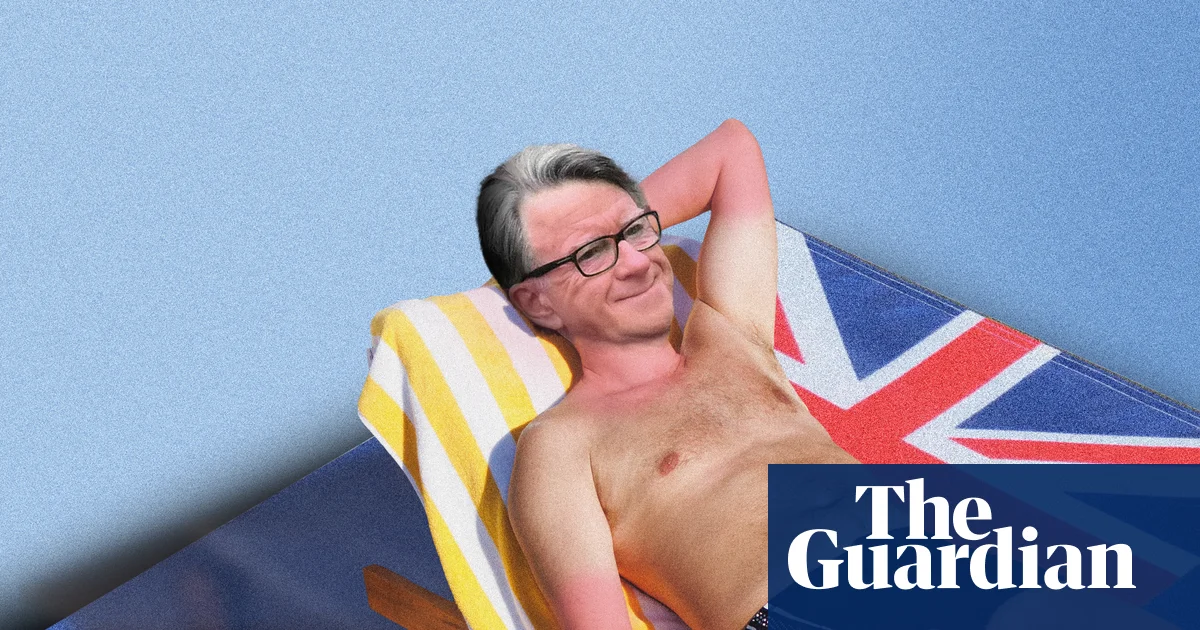
Is it really plausible that Peter Mandelson could have hatched a daring plot to escape to the British Virgin Islands? In the capital of Road Town for the last week or so, the question has been on many minds. And even if the UK’s Commons speaker, Lindsay Hoyle, came away with that possibility in mind from a recent visit, very few of them are convinced.
“It seemed strange to me,” said one bemused local official who had met Hoyle at a function a few days earlier, “that if you were going to flee, it would be to a British territory. From a logical point of view, you’re still more or less in the UK. It’s like fleeing to Southampton.”
Well, the beaches are nicer. The British Virgin Islands have long been a playground for the rich; exclusive private resorts, high-end villas and marinas frequented by celebrities with super-yachts. The Caribbean archipelago is better known for luxury sailing trips and offshore finance than Westminster intrigue.
But last week, the tranquil British overseas territory found itself at the centre of an improbable political mystery: was Mandelson, the disgraced former cabinet minister linked to the late convicted child sex offender Jeffrey Epstein, really planning to flee there? Did the Metropolitan police, based on a tip that Hoyle later said had come from him, thwart a potential escape to paradise? Or did someone, somewhere, get the wrong end of the stick?
On Friday, the Met released Mandelson from his bail conditions; his passport was returned after the police concluded he was not a flight risk. That might be interpreted as a tacit admission that detectives, and Hoyle, had got it horribly wrong. Mandelson’s lawyers issued a statement saying he “did not and does not” pose a flight risk and will continue to cooperate with the police investigation into whether he may have committed misconduct in public office.
In a bid to solve the puzzle, the Guardian travelled to the islands – population 35,000 – to ask around. And while few were keen to offer theories on the record, one speculative hypothesis kept coming up: a throwaway remark had taken flight and ended up with a sensational arrest more than 4,000 (6,500km) miles away.
Perhaps the islands’ political leadership might help clarify matters? The Guardian visited the office of the premier, Natalio Wheatley, near a marina where cruise ship passengers browsed colourful waterfront shops on a bright Monday morning. A parking space reserved for the premier was occupied, but a receptionist said he was away.
“Today is a very busy day,” Wheatley later said in a WhatsApp message, after rejecting a phone call. “Please send me your questions via this forum.” Could he speak the following day? “Very busy,” he replied. Asked by text if he knew where Hoyle’s tip had come from, and when and where Mandelson might have been heading, Wheatley offered a short answer: “I have no comment on the Mandelson matter.”
To recap the Mandelson matter: detectives arrested him on 23 February on suspicion of misconduct in public office, over claims he allegedly leaked sensitive government information to Epstein while serving as business secretary in Gordon Brown’s cabinet. Mandelson has denied any wrongdoing. It later emerged police had received a tip from Hoyle suggesting the former Labour grandee was preparing to move to the British Virgin Islands. The speaker had supposedly gathered this intelligence from someone during a four-day trip to the territory.
Mandelson, for his part, dismissed the claim as “fiction”, asking friends in a 4am text message: “The question is, who or what is behind this?”
If Mandelson had really intended to seek refuge there, it would have raised obvious questions. The BVI is not a remote jurisdiction beyond the long arm of the British law, but a UK territory with a longstanding extradition agreement.
And yet, on Tortola, the largest of the islands, Wheatley was not the only official to prove unavailable. The British-appointed governor, Daniel Pruce, was “off island for two weeks” and unable to meet or even speak briefly on the phone because of unspecified “diary constraints”, according to his policy and communications officer.
The acting police commissioner, Richard Ullger, was also said to be away for two weeks when the Guardian visited his Road Town office, which stands opposite a popular roti restaurant shaded by trees. Ullger later emailed to say he would be available to speak by phone, but failed to respond to further messages.
The search for answers continued nearby at the House of Assembly, past the offices of luxury real estate agents and international law firms on narrow streets where chickens roamed freely. Perhaps the House speaker, Corine George-Massicotte – who, alongside Wheatley, had invited Hoyle to the territory – might shed some light. Instead, the Guardian was informed that George-Massicotte was unavailable to answer questions because she was having lunch. Further attempts at contact proved fruitless.
The Guardian contacted more than a dozen other officials who had reportedly met Hoyle during his trip to mark the 75th anniversary of the islands’ assembly. Each in turn professed complete ignorance or declined to discuss the matter.
“I have no knowledge of what you’re talking about. Zero. Like zero knowledge of that,” said Ronald Smith-Berkeley, a permanent secretary who met the speaker in an official capacity. Lorna Smith, a junior minister and former deputy premier, added: “I really have no comment to make on Sir Lindsay’s visit, any aspect of it.”
Even away from Tortola, the topic proved delicate. A ferry ride across glittering waters leads to Virgin Gorda, where yachts cluster in the harbour and visitors gather to watch the sunset. At a food festival where officials and islanders mingled in colourful dress and sipped cocktails, the Mandelson affair remained off the menu.
Vincent Wheatley, the minister for health and social development, apologised for being unable to help, before recommending some local attractions. One Foreign Office official appeared visibly alarmed when asked about Mandelson and quickly walked away.
Clive McCoy, the director of the BVI Tourist Board, offered a clue on why so many were unwilling to discuss the subject. The islands reled heavily on tourism and the financial services industry, he said, and “having good PR”. “It’s annoying when things come up about the British Virgin Islands that are sordid or that don’t paint us in a good light,” he added.
The BVI, which were devastated by Hurricane Irma in 2017, have made headlines in recent years for their links to the Panama Papers and Russian money, and its former premier being convicted of cocaine trafficking and money-laundering conspiracies in the US.
It is perhaps understandable that local people would not want the islands to become synonymous with someone tied to Epstein, whose private island Little St James is easily accessible by ferry and water taxi.
Martin Kenney, a Canadian lawyer who has lived in the BVI for two decades, said he attended a lunch with the speaker where public policy issues, including regulation of the territory’s financial services sector, were discussed. At no point, he said, was there any mention that Mandelson might have been planning to head to the Caribbean.
“I have no awareness or knowledge of who the source [of this rumour] would be, or why on earth they would suggest that Mr Mandelson would want to come to the BVI to avoid interviewing by the police,” Kenney said from his Road Town office. “The British Virgin Islands is a territory of the United Kingdom. Why would you flee to another part of the United Kingdom if you’re going to flee? You might want to go to a country with no extradition treaty with Britain, but why would you go to a part of Britain? So, self-evidently, I think the story lacks some credibility.”
He also rejected speculation that Mandelson could have been offered refuge by a wealthy supporter. “It doesn’t make sense because the British Virgin Islands follows the English common law,” he said. “This is a rule of law-based jurisdiction, not a haven for people to flee to from justice.”
Among local journalists, another theory has quietly circulated: that the whole episode might have stemmed from a misunderstanding. Freeman Rogers, the editor of the BVI Beacon, said it had been suggested that Hoyle might simply have misinterpreted a joke during his visit. “That did cross our mind,” Rogers said. “It seemed very strange to us … This idea of him [Mandelson] just up and deciding to move here and disappear or something.”
Nor, Rogers added, did the notion that the islands could serve as a staging post for a further escape seem plausible. “I don’t think this is the kind of place, in this day and age, where he could come and then get smuggled away in somebody’s private jet. I don’t think that anybody here with a private jet would think it was a good idea to do that. So no, I don’t think that makes sense at all.”
In a brief statement to the Commons last Wednesday, Hoyle went public with the fact that he was the source of the tipoff, saying: “To prevent any inaccurate speculation, I’d like to confirm that, upon receipt of information, I felt it was relevant I pass this on to the Metropolitan police in good faith, as is my duty and responsibility.”
And on Friday, while defending his tipoff to the police, a spokesperson for the speaker’s office did not offer a view on the underlying truth of the claim: “As Mr Speaker told MPs, he was given a relevant piece of information regarding Lord Mandelson during an official visit to the British Virgin Islands,” she said. “He passed this information to the Metropolitan police in good faith and in confidence. It was for the police to decide how to respond to that information.”
For now, the source of Hoyle’s tip remains a mystery. But the sun is shining, the cruise ships, yachts and private jets keep turning up, and the marinas are bustling. And the Mandelson affair seems very far from people’s thoughts.