The war in the Middle East seems to be settling into a gruelling stalemate. The outcome will now be decided by who has the stomach to carry on like this and who asks for a ceasefire first.
The war in the Middle East has formally landed on Pakistan’s shores.
The government’s announcement of an emergency Rs55 per litre oil price adjustment on Friday night could well be the first of more to come. More so, the sheer availability of fuel is now an open question, despite the 28 days of stocks that we were assured the country maintains.
Dawn spoke to oil industry executives who say oil markets are now roiled with an uncertainty never seen before. The closure of the Strait of Hormuz has taken an estimated 20 million barrels per day (mbd) cumulative off global oil markets in what is being called “the largest oil supply disruption in history”. There is no precedent in the past when a quantity of this magnitude was suddenly removed from the market, not even in the oil embargo of 1973.
The impact, according to a note by Goldman Sachs circulated on Friday, is that “oil prices, especially for refined products, would exceed the 2008 and 2022 peaks, if Strait of Hormuz flows were to remain depressed throughout March”.
This is no minor warning. 2008 was the year oil prices hit a historic high of $147 per barrel, driven mostly on speculative buying. And 2022 was the oil and gas price shock when Russia, one of the world’s largest oil producers, invaded Ukraine, one of the world’s largest gas exporters and transit routes. That war drove oil prices above $120 per barrel. If the ongoing closure of the Strait of Hormuz persists, both these peaks could be surpassed.
Unfortunately, Pakistan’s economy does not handle energy price shocks very well. Since 2008, the country’s oil sector has seen at least four separate crises, during which either the supply chain broke down, creating aggravated fuel shortages, or attempts by the state to restrain prices at the pump, despite spiralling international prices, ended up aggravating inflation and fueling macroeconomic instability.
Pakistan’s recurring oil crises
Some of these crises were brought on by sharply rising prices, others by sharply falling prices. The so-called “petrol crisis” of 2015 was blamed by the then government on a sudden spike in demand due to a steep fall in the price of oil that brought two million motorists suddenly onto petrol and away from CNG.
Meanwhile, the fuel crisis of June 2020 was blamed by the then government on the sudden collapse of demand when the Covid-19 lockdowns hit, followed by an equally sudden spike in demand once they were lifted, while the price of oil had also dropped, and the government imposed an import ban a month earlier.
And finally, there was the fuel price spike in February 2022 with the onset of the Ukraine war, which the then government tried, in a vain attempt, to hold back from the consumer, but ended up driving up the subsidy bill and delaying the newly started International Monetary Fund program for a second time. That summer, the country was on the brink of default.
Two lessons emerge from these episodes: first, Pakistan’s oil supply chain breaks down when price shocks fail to travel through it smoothly. And second, attempts by the state to manage the price shock only end up creating an even bigger shock that not only fuels inflation, but also destabilises the overall macroeconomy.
In 2007 and 2008, the intercorporate circular debt in the oil sector shot up to nearly $2.5 billion (at prevailing exchange rate) because the beleaguered regime of General Musharraf, keen to shore up its sagging political fortunes, refused to pass on the spiralling cost of oil in international markets to consumers at home. The incoming government after the elections of 2008 eventually settled this circular debt, the only way they could: by printing the money.
The settlement reached in the last quarter of FY2008 to both repay the oil companies and hike fuel prices, propelled inflation to record highs in the months that followed, forced a large and disorderly exchange rate devaluation, and widened the fiscal deficit to 7.4 per cent of GDP from the budgetary target of 4pc. An attempt to try and shield consumers from fuel price hikes ended up subjecting the same consumers to an inflationary spiral — the likes of which they had never seen before.
The same story repeated itself in February 2022, but with slightly different contours. Once again, a beleaguered government keen to shore up its political fortunes rolled out fuel subsidies to shield consumers from an oil price spiral that was roiling international markets following the start of the Ukraine war. The result was a subsidy bill that shot past $1.0bn in three months only.
Once again, the settlement of that subsidy bill, coupled with the sudden adjustment of prices that followed, sent inflation skyrocketing to surpass all previous records in the months that followed, and forced a disorderly devaluation as well. The State Bank of Pakistan (SBP) noted that this “unplanned fiscal expansion” was a major factor in the re-emergence of macroeconomic imbalances during the FY2021–22, and contributed to the widening of the fiscal deficit to 7.9pc of GDP.
Over a decade ago, meanwhile, the story was slightly different. In January 2015, the petrol supply chain broke down due to what the government claimed was a supply-driven shock following the closure of one refinery and a steep downward adjustment in the price of petrol, leading almost two million motorists to shift from CNG to petrol suddenly. The sudden spike in demand and the simultaneous constriction of supply, according to the government, created a temporary shock that the supply chain could not withstand.
But others blamed growing Pakistan State Oil receivables from the government for the fiasco since such a large unpaid amount made it impossible for the state-owned oil company to open letters of intent for future imports. Regardless, the three days of the so-called “petrol crisis” that year saw all vehicular traffic in Punjab grind to a near halt, including emergency services, and much produce rotted on the farms for want of transport to urban markets. Had it continued for longer, food supplies in the cities of Punjab would have started to run short.
Then again, during Covid-19, the supply chain broke down one more time in the summer of 2020, following a collapse of demand due to the lockdowns, coupled with the collapse of prices in international markets. The government of the time was keen to pass the price fall in international markets quickly to consumers, while trying to protect refiners from the sudden drop in international prices. It banned imports in April 2020 to force oil companies to buy their stock from local refiners first, then it adjusted prices at the pump down to pass on the benefits of falling international oil prices to consumers.
The combined jolts from these decisions caused the supply chain to break once again, and pumps ran dry as the government accused oil companies of hoarding and launched law enforcement actions against them. Then on June 26, in a sudden move, the government hiked the price of petrol once more by Rs25 per litre, and within hours the fuel started to flow once again, lending credence to the government’s claim that there was hoarding going on, but at the level of the dealers. This fiasco, and the ensuing law enforcement action against its executives, fed into Shell’s decision to exit Pakistan’s market altogether.
The 55-rupee hike
When not handled properly, price and demand shocks in fuels have the potential to either break the oil supply chain and cripple vehicular movement across large swathes of the country or ignite record-high inflation that takes many months to bring under control. Driven by awareness, and perhaps freed from the compulsion to earn political points given no elections (or confidence votes) are on the horizon, the government acted with unusual decisiveness to pre-emptively adjust prices in the latest such shock to hit the oil sector.
In an extraordinary moment, they announced a mid-course upward revision of Rs55 per litre in the price of petrol and diesel, made effective immediately. In part, this decision was made to preempt hoarding by dealers, who could see the hike coming and would have had an incentive to wait till after the hike was notified on March 15 and then sell their stock. An early announcement ended the incentive to hoard.
But no sooner had the decision been announced than the backlash kicked in. Social media lit up with people reminding each other that the same government that found it so easy to burden the common citizenry with a record high hike in fuel prices has been buying luxury jets for its VIPs, doling lavish fuel allowances to its bureaucrats and furnishing them with large luxury vehicles as entitlements.
The optics could not be worse. On top of that, some commentators, like former finance minister Miftah Ismail, pointed out on social media platform X, that oil companies are making massive inventory gains from this price adjustment because they get to sell stock they bought at February prices at March’s inflated prices.
According to him, the price increase may have been necessary, but the manner in which the government did it was “just taking advantage of a crisis” to help oil marketing companies make excessive profits. “To stave off shortages, it [the government] should have either increased the petroleum levy for a week or done better monitoring of oil companies and petrol pumps,” he added.
Industry executives bristle at this argument. “Listen, the government requires me to maintain 20 days’ stock, which means for every litre I sell today, I have to buy another litre to maintain stock level,” explains one executive who spoke on condition of anonymity given the sensitivity of the situation.
“So yes, I make an inventory gain as soon as I sell one litre, but that inventory gain is gone the moment I order another litre to replace the one I have sold! And I am obligated by law to place the order for that next litre because the law requires me to maintain a minimum stock level.”
However, one critical point is lost in the ensuing debate. Whether the government followed the path it chose or the one outlined by Miftah, the end result would be the same: consumers would still be paying Rs55 per litre more for fuel at the pump. And this may not be the end of it.
The ‘real’ economic impact of war
On Friday, when the price hike was announced, the benchmark Brent oil price had closed at $92 per barrel, where it had shot to from $77 at the start of the week. Over the weekend, as we all digested the implications of an Rs55 per litre price hike, the war in the Middle East intensified. Iran launched further barrages of missile fire at Israel and the Gulf countries, while Israel and the United States broadened their targeting regime in Iran and hit oil storage facilities in Tehran.
Meanwhile, Iran’s Assembly of Experts announced the selection of Mojtaba Khamenei, the son of the assassinated Ayatollah Ali Khamenei, as the new Supreme Leader of the Republic and a known hardliner.
On Monday morning, oil markets opened to send Brent spiralling past $120 with no end in sight, Asia stock exchanges opened down, and the Pakistan Stock Exchange plummeted, triggering circuit breakers to suspend trading in the opening minutes. The real economic impact of the war is now set to land in the week that lies ahead. The price hike announced on Friday night now looks likely to be the first in a series of hikes that will become necessary in the days ahead.
The government moved decisively to secure the integrity of the oil supply chain above all other priorities. But this may just be the easy part. Sharply rising oil prices are going to cascade through Pakistan’s economy now, hiking up food prices, urban transport and electricity tariffs. How far this will go is difficult to say because it depends entirely on how long the Strait of Hormuz remains shut, and how intense the war becomes. What is not difficult to say, however, is that the week ahead will see more volatility than the preceding week.
Oil prices are just one part of the uncertainty Pakistan is facing from this war. More than half of the remittances that the country receives from its diaspora come from the countries impacted by the war – Saudi Arabia, the United Arab Emirates and other Gulf countries. For now, despite the war, reports from people living in these countries suggest day-to-day life has not been as adversely impacted. But given the intensification that is coming, there is no guarantee that this will continue.
Other countries that supply consumer durables to the countries in the Gulf, such as South Korea, for example, are seeing a spate of order cancellations from UAE clients, implying a rapid shrinkage in business volume in the Emirates. Gulf countries locked inside the strait are likely to be in the grip of an even more intense contraction, given the drying up of all oil and gas revenues and port throughput.
If the war drags on and its disruption of day-to-day life in the Gulf countries deepens, the fallout on Pakistan’s remittances from, and exports to, the Middle East could add up to significantly stress the external sector at a time when the growing trade deficit was already beginning to generate concerns. More stress on the external sector means more pressure on the exchange rate. Export proceeds in the July to January period of the ongoing fiscal year have already slowed by $1bn, while imports have surged by $3.3bn compared to the same period last year. If the government wants to be as decisive in handling the pressure on the external sector as it has been in dealing with pressure on the price of oil, it will have to devalue the currency.
On top of that, all of Pakistan’s west-bound exports transit through ports in the Gulf countries. In FY25, this amounted to almost two-thirds of Pakistan’s total export receipts, as per State Bank data. If commercial ports in these countries are impacted, Pakistan’s exports will suffer as well. Again, this impact is difficult to quantify, but it is easy to see how it will land directly on the country’s external sector, and from there mount pressure on the exchange rate.
If the war drags on, and its intensity does not abate, Pakistan could see petrol approach (and likely cross) Rs400 at the pump and the dollar blow well past Rs300 in the interbank. These are rough estimates, and on the conservative side (meaning the real volatility is likely to be more intense) and premised on the assumption that the war drags on and intensifies, for another week if not more.
Unforeseeable scale of volatility
A significant exposure for Pakistan is via its extensive reliance on bilateral deposits from Saudi Arabia and the UAE. The fate of a $2bn rollover from a maturing deposit in February is unknown, even as another IMF review has begun under the ongoing program. On top of that, Pakistan has already been asking Saudi Arabia for maturity extensions on $5bn worth of deposits the Kingdom has kept with the central bank to support reserves, as well as boosting the size of the oil facility. In return, the Kingdom has been pressing Pakistan to play a more active role in its defence against Iranian missile strikes, invoking the clauses of the Strategic Mutual Defence Agreement (SMDA).
Continued weakness in the external sector will provide the Kingdom with greater leverage in demanding that Pakistan enter the fray on the Kingdom’s side. With a front already open in Afghanistan, with its attendant foreign currency and fiscal requirements, it will take deft diplomatic handling for Pakistan to avoid getting pulled into the fray in Iran if the war continues and intensifies further. The United States’ ordering its diplomatic personnel out of the Kingdom on March 8 did not send a hopeful signal of an early de-escalation.
Meanwhile, what is keeping oil industry executives up at night is the search for diesel in global markets. “Almost all our diesel imports were normally sourced from producers inside the strait,” says one executive. “Our agreement with KPC is where we get a large share of our diesel,” he says, using the acronym for the Kuwait Petroleum Company with which Pakistan has a decades-long supply agreement. Some estimates say slightly less than half of Pakistan’s total diesel supply comes from KPC, while the rest is locally produced in Pakistan’s own refineries.
“We can’t find any diesel anywhere now,” he goes on. “The only bookings we can see are three months out into the future.” This matters because the wheat harvest is coming up, and that is the season for peak diesel demand in Pakistan. The harvest is set to begin as soon as Eid celebrations subside earlier in April, and if diesel consignments are not booked before then, the country could face a sharp shortage in those critical months.
A diesel shortage during the wheat harvest would send the price of wheat skyrocketing, which in turn would feed into food inflation, where wheat carries a large weight. “While the rest of the country is worried about the recent price hike, we are working around the clock to try and locate a diesel shipment from somewhere, anywhere, but the problem is that middle distillates like diesel are heavily produced in those countries that are locked behind the Strait of Hormuz.
The war in the Middle East seems to be settling into a gruelling stalemate. The outcome will now be decided by who has the stomach to carry on like this and who asks for a ceasefire first. If America tries to force open the strait by providing Naval escort to commercial shipping, it risks bringing its naval assets within firing range of Iranian armed suicide boats and anti-ship missiles, risking a direct hit. This would be a replay of the so-called “tanker wars” of the mid-1980s when Iraq and Iran targeted each other’s commercial shipping, prompting the Reagan administration to send in the US Navy to provide escort to some commercial shipping.
The US Navy took two hits during those operations, including one that had fatalities and a large number of injuries. And that was a much smaller operation as compared to what will be required today, since the strait actually remained open to shipping.
The longer this stalemate drags out, the greater the volatility that will engulf the global economy. Pakistan is relatively comfortable in its petroleum stock position for the month of March, and with the mitigation measures the government is working on, it might be able to stretch existing stocks a little longer. But if the war continues for even a couple of more weeks, the scale of the volatility it can unleash is difficult to foresee.
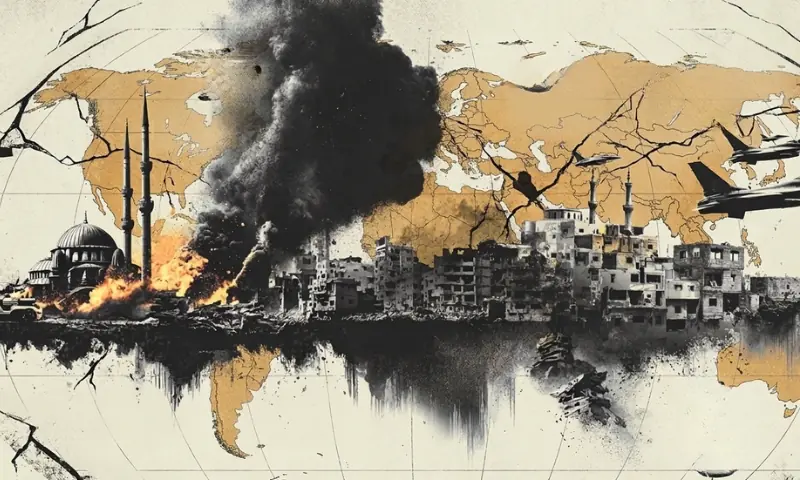
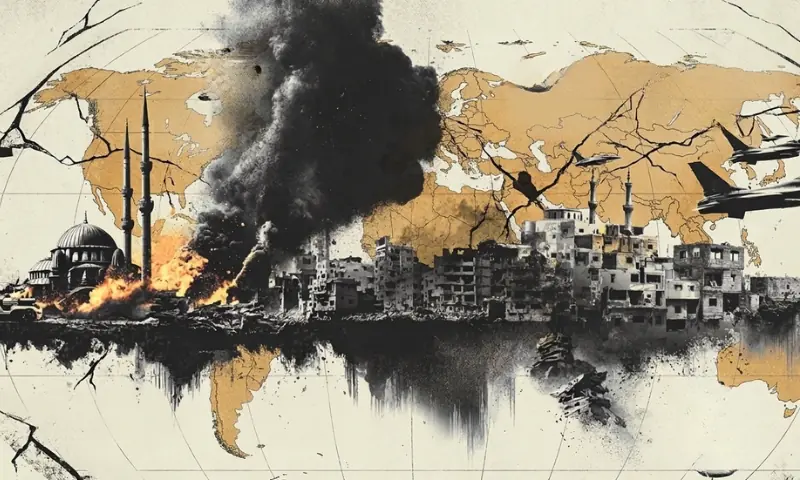
Header image created using generative AI