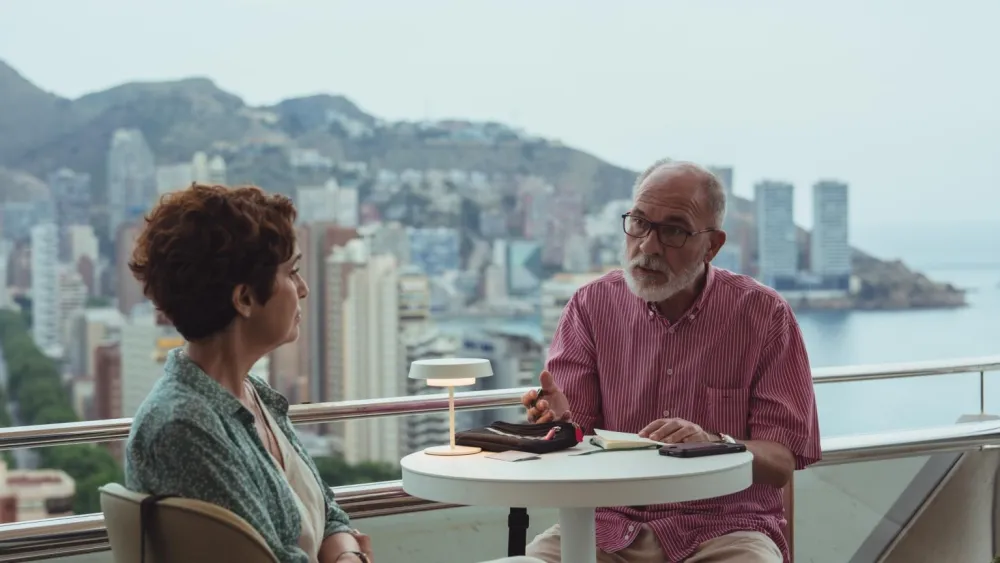
Madrid-based Latido Films has picked up international sales rights to crime-thriller/family drama “Blue Lights of Benidorm” (“Después de Kim”), the latest feature from two-time Goya winner Ángeles González-Sinde which is set to play in the Málaga Festival’s main competition.
A Spanish co-production between Gerardo Herrero and Mariela Besuievsky’s Tornasol Media and Pedro Pastor’s Voramar Films, “Blue Lights of Benidorm” world premiered March 8, at Málaga’s Teatro Cervantes. It will also be introduced to buyers on Tuesday at the Málaga Festival’s Spanish Screenings.
The film follows Gloria and Juan, divorced and estranged for 20 years, who are forced to reunite after learning their daughter has been murdered in Spain.
Traveling from Argentina to identify her body, they uncover a grandson they never knew existed — now missing — and begin a search that pushes them into a fragile alliance as buried resentments and unresolved guilt resurface.
Primarily shot in the Mediterranean resort city of Benidorm, the film plays its sunlit, tourist-facing iconography against a story driven by loss, responsibility and second chances.
González-Sinde adapts her own novel “Después de Kim” and anchors the film in its characters. On steering the story from a bruising starting point toward an ending that leaves the possibility of repair, she argues: “I always had the ending of the film very clear in my mind. I believe in human beings and in their capacity to rebuild by leaning on others.”
That conviction dovetails with her approach to writing: “I usually write with a very clear beginning in mind — a character with certain weaknesses, a conflict that puts them to the test, and an ending whose visual, moral and dialogue details I usually know.” The challenge is getting there: “The hard part is how to get to that ending — that’s the mystery of writing.”
González-Sinde has a dual track record as screenwriter and director, winning the 1998 Goya for best original screenplay for “La buena estrella” and the 2004 Goya for best new director for “La suerte dormida.” “Blue Lights of Benidorm” extends that adult audience targetig drive, using the crime thread to keep the narrative moving, while the character dynamics carry the film’s real weight.
The film toplines Goya-winning Adriana Ozores (“La suerte dormida,” “Los pequeños amores”) opposite acclaimed Argentine actor Darío Grandinetti (“Talk to Her,” “Rojo”), with Gloria March, Kevin Brand and Roger Aranda also in the cast, plus a special participation by musician Christina Rosenvinge.
González-Sinde said she avoided writing for specific names: “I never usually write with specific actors or actresses in mind. It often happens that they’re not available, and having to break out of that mold you have in your head becomes a drawback.”
What matters most is what performers bring: “Great actors can take the characters onto their own turf and make them theirs, and that, for me, enriches the result.” The commercial logic, she says, is a producer concern: “Producers are the ones who think about the commercial side of a name.”
“For me the main thing is the quality and depth of the work — especially for the kinds of stories I tend to tell, which are character-driven and carry a significant psychological weight.”
In this case, she added, the pairing gained an extra dimension: “It was a stroke of luck that Darío and Adriana also clicked in the way they approached the acting work. They didn’t know each other, and it’s the first time we’re seeing them together.”
For international buyers, González-Sinde points to Benidorm’s built-in recognizability — and the mythology that travels with it. “Benidorm as a setting sparks curiosity and interest,” she argued. “I’ve been coming to the city for decades, I have a home very nearby, and I know it’s a very recognizable name across Europe.
Beyond the name, the place already exists as an idea, she says. “There’s a myth around Benidorm, and people — whether they’ve been there or not — have their own idea of Benidorm.”
She also sees the film’s emotional dynamics as widely shared: “Many viewers can identify with these characters who go from being very distant to forming new ties, because our relationships as couples have been very different from those of earlier generations: divorces, separations.…” She added: “The relationship with children is also different; they often live in other countries that we know little or nothing about, as happens to the protagonists.”
“Blue Lights of Benidorm” is backed by Spanish public broadcasters RTVE and À Punt, as well as Spain’s ICAA and Valencia’s Institut Valencià de Cultura. Karma Films will release the film theatrically in Spain, with a planned bow on April 24.