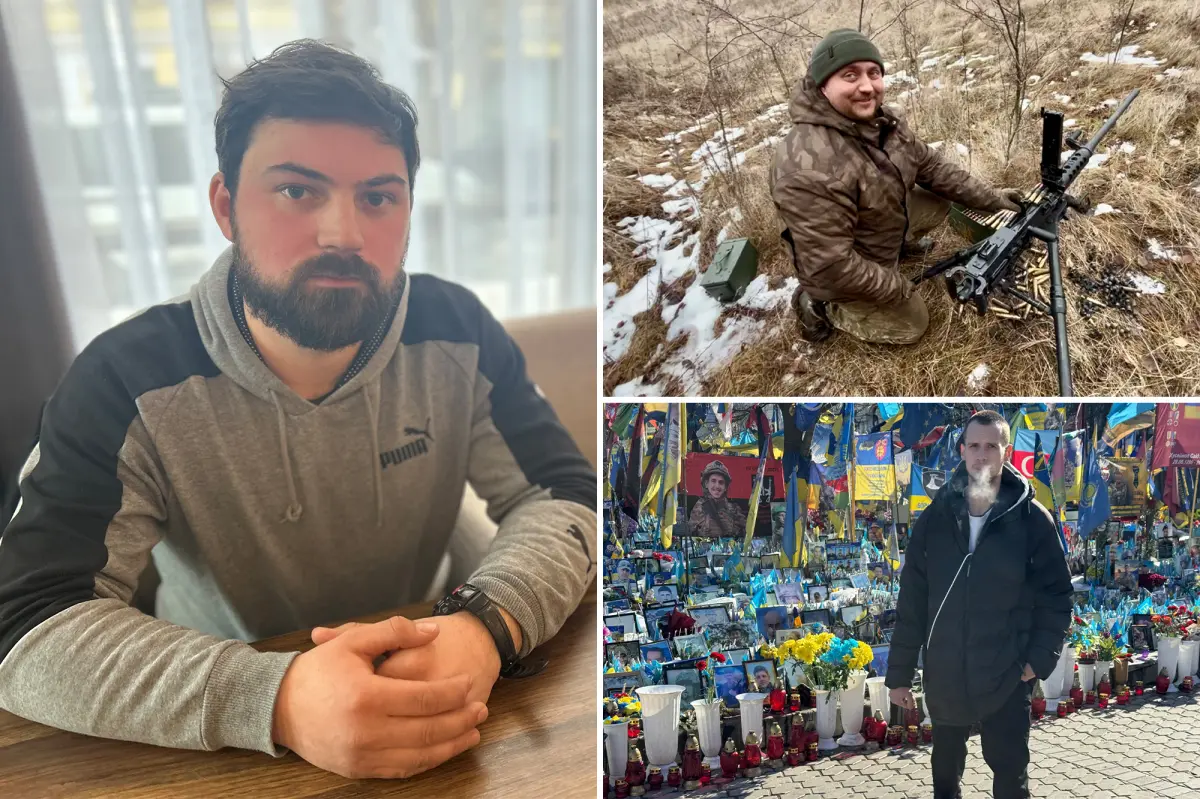
KYIV — Andrii Vovk is back from the front lines for the first time in nine months — and after a shower and a quick trip to the mechanic to fix a window shattered in a drone blast, he will soon return.
He is one of hundreds of thousands of Ukrainian troops still fighting in Russia’s war, now entering its fifth year.
There are no weekends in the military; no days off to rest or relax. Life becomes like the movie “Groundhog Day,” Vovk said, with one day of combat blending into the next.
Still, Vovk said he and many other Ukrainians who have been serving since the war’s start are not ready to give up the fight — unless peace actually lasts.
Asked about a floated peace deal that would see Kyiv freeze the conflict at the current battle lines, leaving Russia with the roughly 15-20% of Ukraine’s Donbas that it has been unable to fully occupy militarily, Vovk shook his head.
“I think, if Ukraine and Russia make peace now without hard guarantees, without huge losses for the Russian army, it will be the same scenario,” he said.
“It will be paused for maybe half a year, maybe a year, and after Russia builds up bigger stocks of drones, this will be the second war.”
But if Russia is unwilling to stop the war — neither is he.
“A real stop to the war will come when Russia is taking too many losses in troops, armored vehicles and planes,” he said.
It’s a sentiment US negotiator Special Envoy Steve Witkoff indicated in a recent address to Ukrainians on the fourth anniversary of Russia’s full-scale invasion on Feb. 24.
“There is no deal here unless Ukraine and its people can believe that they will be able to live in peace if, in fact, there is a diplomatic solution,” Witkoff said in a virtual address to the Yalta European Strategy conference. “That has to be the end result here — a reality that peace is there.”
If there was only a pause, Vovk said Russia would merely use the break to refill its weapons stockpile and reinvade again.
“I don’t believe that they have reached their target: the whole of Ukraine is their target, I’m sure of that,” he said. “They have no reason to stop now. They move slow with their advances, but they still move.”
The cost of war has been devastating.
The total number of casualties (killed, wounded, and missing) is at least 1.2 million Russians — which is the most of any major power since World War II, a late-January report by the Center for Strategic and International Studies found. In comparison, Ukrainian forces suffered somewhere between 500,000 and 600,000 casualties.
Combined Russian and Ukrainian casualties could reach 2 million total casualties by the spring of 2026, the report found.
Ukraine is still going on offense. In January and February, they eliminated thousands more Russian troops than the Kremlin was able to backfill, according to the Ukrainian Ministry of Defense. And over the past two weeks, Kyiv won back more land than they lost — a first since 2023.
Asked whether even a 10-year pause would be worth freezing the conflict, his answer was a hard no.
“For me, after 10 years my daughter would be old enough to join the army,” he said. “No, it’s better for me to fight.”
It’s a sentiment heard across the battlefield — fathers choosing the hell of war over letting a false peace hush the tired nation just long enough for Moscow to launch a new offensive to take the rest of the country.
One of those sons is Andriy Murzak, whose father Alexei “Chaus” Murzak was featured in reports by The Post from the front lines in 2024 and 2025, though by the pseudonym “Sergiy.”
“He always said the war wouldn’t end unless he was in it,” Murzak said in a café in Ukraine’s capital city.
Chaus died about four months ago. He had been a lawyer before the war, but traded his briefcase for a Browning M2 when Russia launched its full-scale invasion on Feb. 24, 2022.
He was a warrior, through and through, leading troops through some of the ugliest battles from Bakhmut in Ukraine in 2022-2023 to fighting in the incursion into Kursk, Russia in 2024-2025.
Despite witnessing the horrors of war repeatedly — telling The Post stories of Russian troops stacking their dead comrades to use as barricades in battle — he kept his gregarious nature, and commitment to the fight until his last breath.
He stepped on a landmine near the Donbas, but it was too dangerous to send a medical evacuation, his son said. He lost a leg and bled out in the field for 40 minutes, with one of his soldiers at his side.
But he was so beloved that once it was safe to bring troops back, his unit broke protocol to bring his body back first, ahead of another wounded soldier who was still alive, his son said.
Now Murzak, 21, is studying at a local university. His father wanted him to first pursue his education instead of joining the fight.
He has four years before he is old enough to be eligible for Ukraine’s draft, and hopes the war will be over by then — with a lasting peace.