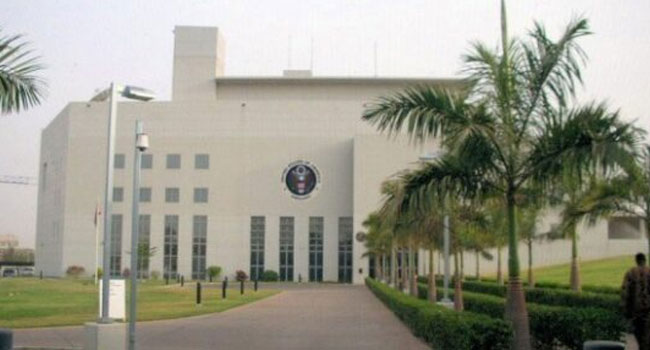
The United States Embassy in Nigeria has issued a security alert warning of a possible terrorist threat targeting US facilities and American-affiliated schools in the country.
In a notice released by the embassy in Abuja, US citizens were advised to take extra precautions when visiting American diplomatic premises and institutions linked to the United States.
The alert specifically mentioned the US Embassy Abuja and the US Consulate General Lagos, urging American nationals to remain vigilant and adopt additional security measures while travelling to these locations.
According to the embassy, citizens should vary their travel routes and times, avoid predictable routines, and remain alert to their surroundings to reduce potential risks.
“U.S. citizens should take additional precautions when travelling to the U.S. Embassy, the U.S. Consulate General in Lagos, and U.S.-affiliated schools,” the notice said.
Nigeria: The U.S. Embassy in Abuja informs U.S. citizens of a possible terrorist threat against U.S. facilities and U.S. affiliated schools in Nigeria. The Embassy recommends that U.S. citizens take additional precautions when traveling to the U.S. Embassy, the U.S. Consulate… pic.twitter.com/clVRMNhQu2
— TravelGov (@TravelGov) March 9, 2026
READ ALSO: Insecurity: We’ll Work Together To Take Back Our Communities, IGP Tells Kwara Residents
The advisory also encouraged individuals to keep a low profile in public places, avoid crowds and demonstrations, and review personal security plans with family members.
Other recommended precautions include ensuring mobile phones are charged in case of emergency and familiarising themselves with emergency exits when entering buildings.
Despite the alert, the consular sections of both the embassy in Abuja and the consulate in Lagos will remain open for services.
The embassy said US citizens in Nigeria should continue to monitor updates through its official website and follow security advisories issued by the US Department of State.
It also advised travellers to consult the Nigeria country information page on travel.state.gov for additional guidance on potential risks and security conditions in the country.
The security alert comes on the backdrop of the ongoing Israel-Iran War, which is an ongoing direct military conflict involving Israel and the United States against the Islamic Republic of Iran.
The war began on February 28, 2026, marking a major escalation in long-standing tensions between the countries.
As of today, March 10, 2026, the conflict has entered its 11th day. Early in the war, U.S.-Israeli strikes killed Iran’s Supreme Leader Ayatollah Ali Khamenei.
On Sunday, March 8, 2026, his son Mojtaba Khamenei was named as his successor, quickly assuming leadership during the ongoing conflict.
Military operations have included large-scale joint airstrikes by the United States and Israel targeting Iranian leadership, military infrastructure, and nuclear facilities.
For the first time, attacks have also hit civilian industrial infrastructure, including oil storage depots and refining facilities in Tehran. During the escalation, U.S. President Donald Trump called for Iran’s “unconditional surrender.”
Meanwhile, Iran has retaliated with waves of ballistic missile and drone attacks, known as Operation True Promise IV.
These strikes have targeted Israel as well as U.S. military assets in Kuwait, Qatar, Saudi Arabia, Bahrain, and the United Arab Emirates. Under the new leadership, Iran has also launched missile attacks on Israeli cities, including Tel Aviv and Haifa.
Casualties have risen across the region. Reports estimate more than 1,200 people killed in Iran, nearly 400 in Lebanon, and at least 13 in Israel. The United States has also confirmed at least eight soldier fatalities.
The war has had a major economic impact, particularly on global energy markets. Brent crude oil prices briefly surged to nearly $120 per barrel amid fears of supply disruptions and the effective closure of the Strait of Hormuz, a key global oil shipping route.
The conflict has also disrupted regional stability, global air travel, and energy infrastructure across the Gulf.
The 2026 conflict follows years of escalating tensions between Israel and Iran. In June 2025, the so-called Twelve-Day War ended in a U.S.-mediated ceasefire after Israeli and American strikes on Iranian nuclear facilities.