The Dose24:16What should people who’ve never smoked know about lung cancer?
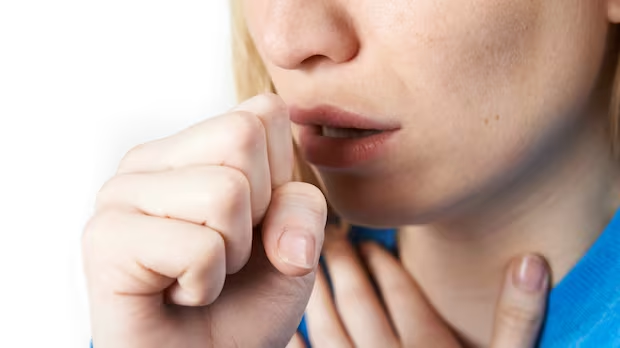
Toronto resident Winhan Wong’s lung cancer journey began in 2016, with a nagging cough that just wouldn’t go away.
A visit to his family doctor and a series of scans revealed the culprit: two litres of fluid in Wong’s right lung and a three-centimetre tumour.
Though his doctors assumed otherwise based on the test results, Wong had never once smoked a cigarette in his life.
“I was told that it was Stage 4,” Wong told White Coat, Black Art host Dr. Brian Goldman.
“There’s one doctor that said I might have six months, and then my oncologist said I had basically one to 10 years.”
Lung cancer is the deadliest cancer in Canada, representing about 22 per cent of all cancer deaths in 2025. But rates as a whole have been falling, largely due to decreased smoking, which is linked with the majority of cases in Canada. Still, research shows more non- and never-smokers are getting diagnosed with lung cancer at the late stage.
Besides smoking, risks include poor air quality caused by pollution and wildfire smoke, occupational exposures like those for firefighters and construction workers, as well as cancer-causing gases like radon, found in homes due to out-of-date building codes.
“It’s just heartbreaking,” said Dr. Christian Finley, a thoracic surgeon at McMaster University, because I think it’s that intersection of all their preconceived [notions that] this is a smoker’s disease.”
Lung cancer by the numbers
Definitions vary depending on the source, but the most recent Canadian Tobacco and Nicotine Survey, published in 2022, defines a never-smoker as someone who has never smoked a whole cigarette, or who hasn’t smoked in the past 30 days and also has had fewer than 100 cigarettes — roughly four packs — in their lifetime.
A former smoker — also called a non-smoker — is someone who hasn’t had a cigarette in the past 30 days but has smoked at least 100 in their lifetime.
Due to years of public health messaging, most Canadians are aware that inhaling cigarette smoke increases the risk of contracting lung cancer.
Perhaps because of this, McGill University assistant professor Dr. Nicole Ezer says she encounters many patients who are surprised to learn how susceptible non- and never-smokers are to the disease.
“[Never-smokers] may not be aware of all the risks associated with the development of lung cancer,” said Ezer, director of the McGill Health Centre’s lung cancer screening program.
Symptoms vary in intensity, but common signs include a persistent or worsening cough, shortness of breath, chest pains while breathing, difficulty swallowing and bloody mucus.

Environmental advocates say it’s time Health Canada updated its threshold on mitigating radioactive home radon levels. Data shows almost half of all detached homes in Canada have levels of potentially cancer-causing radon gas that exceed World Health Organization guidelines.
According to Finley, who is also co-chair of the Pan-Canadian Lung Cancer Action Plan, never-smokers tend to present lung cancer symptoms later than smokers, and may not consider that a persistent cough could be a symptom.
“They kick themselves or they are frustrated with the access to care, and so I find it a bit of a heartbreaking experience,” said Finley.

Dr. Kong Khoo, an oncologist with B.C. Cancer, was diagnosed with Stage 1 lung cancer in March 2020. Khoo’s cancer was caught early enough for successful treatment, and he remains convinced that long-term exposure to high radon levels in his home is what led it to develop in the first place.
Lung cancer doesn’t affect all demographics equally. The Canadian Cancer Society estimates slightly more women will develop the disease than men, because of “differences in tobacco use.”
The charity believes this is because men’s smoking rates began declining sooner than women’s. The rate of new lung cancer cases in men began declining in 1993, while for women it was in 2015.
Increased screening could improve outcomes
Stigma and misconceptions are part of why Finley is pushing for increased screening across Canada.
“Lung cancer screening reduces mortality by 20 per cent,” he said.
As it stands, Alberta, B.C. Nova Scotia, Ontario and Quebec are the only provinces with a formal lung cancer screening regime, while Newfoundland and Labrador has an ongoing pilot program.
“We have the tools at hand to reduce mortality; we’re just not doing it,” he said. “That impediment can only be explained by our stigma and to some extent, the whole question of equity.”

Dozens of cases were found in the program’s first two years. The CBC’s Carolyn has the story.
Additionally, routine screening typically isn’t aimed at people who have never smoked before.
In Ontario, for example, people only qualify for it if they’re 55 to 80 years old and have smoked cigarettes every day for at least 20 years.
In Alberta, people qualify for screening if they’re between 50 and 74 years old, and are also smokers or have quit after many years.
Ezer says part of the issue is that current scanning methods pose a risk of radiation for never-smokers.
“The risk is still too elevated to give an annual scan to really give them the overall benefit of being screened,” she said. “That may change with time as other tests are integrated.”
Since his diagnosis, Wong has become an advocate for improved lung cancer care in Canada.
White Coat Black Art26:30Lung cancer isn’t just for smokers
His cancer can be treated with targeted drugs, and he’s been able him to live a healthy life in remission, nine years beyond his initial diagnosis.
Wong also wants earlier screening programs.
“I’ve met people that have been in car accidents and they end up having to go to ER … and then they’re told that they have lung cancer,” he said.
“If you don’t have that background of being a smoker, then you’re not going to get that early screening done.”
Masks can also help
Experts agree that avoiding tobacco smoke is still the easiest way to prevent lung cancer, but never-smokers can take additional precautions to minimize lung inflammation, like avoiding cannabis smoke and vaping products.
Beyond not smoking, Ezer says regularly paying attention to air quality also helps.
Canadian air quality ranks poorly during wildfire season, potentially exacerbating existing conditions like asthma and increasing the likelihood of developing conditions like chronic obstructive pulmonary disease (COPD). Some research has found associations between poor air quality and mental health harms and heart disease.

Wildfire smoke doesn’t stay the same once it leaves the flames. As smoke drifts, chemical reactions can make it even more toxic. And as Johanna Wagstaffe reports, scientists are now working to pinpoint when and where health risks are the greatest — with the hope of eventually building that into smoke forecasts.
“You can consider getting air purifiers to improve the air quality in your home, in particular in times of year when we’re at highest risk in terms of air quality,” she said.
Additionally, people who are at a higher occupational risk, like construction workers, firefighters and miners, should wear proper protective equipment on the job.
Ezer adds that testing homes for radon is relatively inexpensive and can “reduce your exposure in your home.”
Health Canada considers radon to be the leading cause of cancer in non-smokers. Radon-induced lung cancer kills an estimated 3,200 Canadians every year.
The Dose27:52How does poor air quality affect my health?
The federal government also sells radon testing kits. Online resources like the Take Action on Radon initiative also provide interactive radon maps that show radon concentrations across Canada.
Experts say people with breathing conditions should also consider wearing face masks on particularly low quality days.
She adds that pregnant women, or people with heart disease can wear masks, as well, to reduce their exposure.