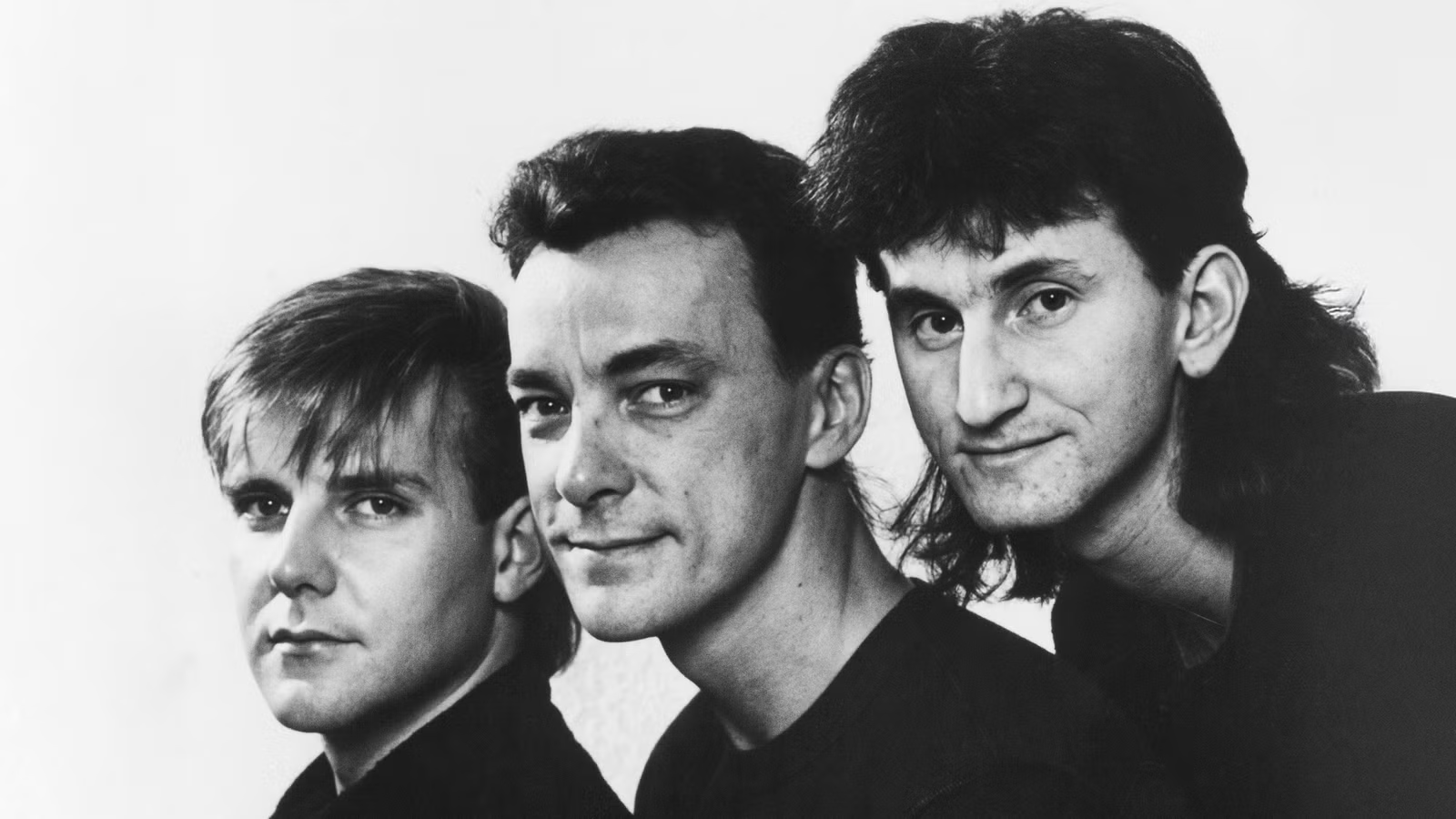
The 80s marked a decade of incredible growth and experimentation for Rush. The trio was coming off its best album to date, 1978’s Hemispheres, and they were hitting their stride as a band. The Canadian rockers spread their proverbial wings in the 80s, embracing technology, consolidating their riffs and musical ideas into slightly shorter lengths and drummer Neil Peart really came into his own as an indelible lyricist. The decade also saw Peart cement his legacy in music history with his use of complicated polyrhythms and powerfully hard-hitting yet smooth style of playing. He once explained his style behind the kit, by saying, “it’s like running a marathon while doing math equations.”
The band scored its career-defining hit with the ubiquitous “Tom Sawyer” off 1981’s Moving Pictures and never looked back. Through the decade, the band went through some growing pains, nearly abandoning their signature sound of a three-piece rock band for big-sounding 80s tracks with synthesizers, sequencers, orchestras, choirs and more bells and whistles. Rush scored unprecedented success in the decade but got a little lost in the excesses of technology along the way. Focusing on the 80s, here are Rush’s studio albums ranked by overall sound, influence and songwriting.
7
Presto (1989)
Presto saw the band go back to the basics of being a trio at the close of the decade. The album, produced by Rupert Hines, known for his work with The Fixx, Stevie Nicks, Peter Gabriel and Howard Jones, features fewer synthesizers and boasts more guitar-driven songs. Rupert worked intensely with Geddy Lee on his vocals, getting him to change some bad annunciation habits and ended up capturing some great takes on the album.
“Show Don’t Tell” is the perfect example of Rush getting back to how they started. A funky and driving rock song with big riffs that still has the 80s signature sound but driven by guitar with keyboards used as an enhancement. “The Pass” is one of the band’s most underrated songs. The beautiful Neil Peart-penned track addresses teenage suicide and how it can be romanticized. “No hero in your tragedy / No daring in your escape / No salutes for your surrender / Nothing noble in your fate / Christ, what have you done?” Presto was a stepping stone towards the sound the band refined in the 90s, with guitar-driven tunes, crushing riffs and sophisticated and evolving songwriting.
6
Power Windows (1985)
Fixed between Grace Under Pressure and Hold Your Fire, Power Windows was the first Rush album produced by Peter Collins after the tough Grace Under Pressure sessions with Peter Henderson. Collins had the band go back to the basic principles of songwriting, including using different keys, different tempos, breaking up verses and pulling instruments out of certain segments of the song to create special moments. Lee said:
“Thematically, Power Windows is another of our small seed concept albums. One that deals with power in various forms. The lyrics of ‘The Big Money’ for example, decry the cold, passionless use of the almighty dollar. But also acknowledge its power and sexy and irresistible allure.”
The band brought in many outside musicians for the album, which marked a big change in Rush’s sound. “The Big Money” is as 80s sounding as you can get, while the band also shows off a different side on “Mystic Rhythms,” “Territories,” and “Emotion Detector.” The band was in the midst of growing pains in the middle of the decade, not losing its identity, per se, but getting lost in the mire of production excess and adding more and more instrumentation to the songs to achieve that huge 80s sound. Power Windows also boasts the resounding classics “Marathon,” and “The Manhattan Project.” Lee said, “We have made as different a record as we possibly could, yet it was still true to us.”
5
Hold Your Fire (1987)
Hold Your Fire is 80s peak Rush. The album saw the band dig deeper into adding to its soundscapes. The effort was recorded in five different studios around the world and marks their second album with producer Peter Collins. Lee called the album “a highlight of my recording life,” as the band brought in a string section, an English brass band and a full gospel choir, which you can hear at the end of “Prime Mover.”
“Mission” is a beautifully deep song with brilliant lyrics penned by Neil Peart. It opens: “Hold your fire / Keep it burning bright / Hold the flame ’til the dream ignites / A spirit with a vision is a dream with a mission.” Rush scored a hit with “Time Stand Still,” which features vocalist Aimee Mann. Lee said Mann has “a voice that floated down from the heavens.” The grand effort features concert staple “Force Ten,” as well as “Turn the Page,” and some of the band’s lesser known tunes: Tai Shan,” “High Water,” and “Lock and Key.”
4
Signals (1982)
Signals is an underrated album, due to the massive success of the two previous albums, Permanent Waves and Moving Pictures. The effort ushered in a new era of success for the band as they embraced utilizing more synthesizers, samplers and new technology of the 80s. It was the last studio album helmed by longtime producer Terry Brown.
“Signals was a challenge to record with so much new material and so many new sounds and rhythms, we were experiencing major growing pains. Thinking more as a four-piece required some serious adjustment.”
“Subdivisions,” “New World Man,” and “Digital Man” encompass Rush’s new direction with enhanced instrumentation, utilizing new technology and a growing interest in bigger sounds. The group used more sequencers and samplers than in previous efforts. While the keys dominate, guitarist Alex Lifeson still found his spots to shine. Lee said, “There’s a blistering intensity all over those songs, especially in the wild soundscapes in the middle section of ‘The Weapon’ and his solo work on ‘Digital Man’.”
3
Grace Under Pressure (1984)
Grace Under Pressure was the first album Rush recorded without producer Terry Brown, who was behind the board since Fly By Night. The band tapped Peter Henderson, known for his work with Supertramp, Jeff Beck, Paul McCartney and Frank Zappa to helm the sessions. It was well-received, but it was a challenging record for the band. Geddy Lee said the sessions were full of “stressful confusion,” as they figured out how to work with their new producer.
“It was the start of a songwriting style that included big washes or pads of keyboard string sounds, sampled choirs and more. It has to be said not all of our fans were enthralled. Indeed, the dyed-in-the-wool ones were dismayed by the change of direction, but I was too driven and excited by the sheer newness of the compositions to care. As a band, we were terribly aware of the dangers of stagnation.”
Grace Under Pressure is Rush’s shortest and most concise album with classics like “Distant Early Warning,” Red Sector A,” and “The Body Electric.” The effort brought the synthesizers and samplers into the forefront of the band’s sound and writing style. The 1984 album also spawned the deep cuts “Kid Gloves,” “Afterimage” and “Between the Wheels.”
2
Permanent Waves (1980)
Permanent Waves saw Rush take a little bit of a left turn musically to focus on punchy songwriting and shorter songs that still had a proggy feel. In his book My Effin’ Life, Lee explains: “Our approach to Permanent Waves would be a total reaction to Hemispheres. Instead of composing side-long interconnecting pieces, we wanted to create songs no more than five to seven minutes long. We were still after big ideas and complexity, but thought we’d lend them more flexibility if we freed them from a strict overarching narrative. A small seed concept album, this time loosely tied together by a broad theme. We were determined to approach this album with a crisp, professional dispatch.” “The Spirit of Radio” was a radio hit and is a perfect example of the band finding a balance between clever songwriting and maintaining a progressive edge. It was musically designed to sound like someone switching between radio stations. The opening riff sounds like static and the song goes through many genres, including Punk, New Wave and the classic reggae bit at the end.
“It was shorter than most of our songs, but at five minutes, it’s still not your typical single. Even with a radio edit, it wouldn’t approach the three-minute mark expected of pop songs and could never be a true top 40 hit. But it brought new fans out to see us and excited the ones that we already had, which was good enough for us.”
“Freewill” is another hit peeled off the album, which features some wild time signature shifts and an insane guitar solo from Alex Lifeson in the five-minute radio staple. Permanent Waves also spawned the ominous deep cut “Jacob’s Ladder,” and the three-part masterpiece “Natural Science,” both fan favorites. The band recorded the album in rural Flesherton, Ontario and used the rural Canadian vibe to add to the album’s sound. Lee explained: “The studio’s isolated location allowed us to record outdoors with the added bonus of being able to bounce and amplified guitar across the lake and off the foothills for some truly natural echo, and we were able to create our own tidal pool sound effect in ‘Natural Science” by recording Neil and Alex gently paddling on the lake.” Permanent Waves is a Rush classic and a fantastic album front to back.
1
Moving Pictures (1981)
Moving Pictures was released on February 12, 1981. The album is the fastest-selling in their catalog, shifting over a million copies within two months of its release. The masterpiece spawned the band’s most popular song “Tom Sawyer,” as well as fan favorites “Red Barchetta,” “Limelight” and the instrumental “YYZ,” named after Toronto’s airport code, which uses its Morse code rhythm for the opening in a head-scratching 5/4 time. “YYZ” was nominated for a Grammy for Best Instrumental, but lost to The Police song “Behind My Camel.”
Peart dug deep into his lyrics for the album, tapping into his increasingly awkwardness with fame in “Limelight,” inspiration from an essay in Road and Track magazine and George Orwell for “Red Barchetta,” and “Tom Sawyer,” which Geddy Lee explains as “a wide-eyed tale of existential possibilities.” He also admitted that the tune did not come easy for the group.
“Almost everything to do with Tom Sawyer was a struggle… I became so negative about it that at one point I asked myself if we should leave it off the record entirely. Can you imagine? Rush’s all-time favorite song in the can?”
Moving Pictures is another iconic album from the trio and is their best album of the decade. It gave Rush a chance to take some musical risks on their ensuing albums later in the 80s.
Rush – A Show of Hands
- Release Date
-
January 1, 1989
- Runtime
-
90 minutes
- Director
-
Larry Jordan
Cast
-

Alex Lifeson
Himself – Guitars
-
Geddy Lee
Himself – Bass, Synthesizers
-
Neil Peart
Himself – Drums, Percussion