Ecuador’s Defense Ministry on Tuesday announced that, with the help of the United States, Ecuadorian Armed Forces officials seized 1.9 tons of presumptively U.S.-bound suspected drugs at sea.
The Ministry detailed in an official statement that the drug bust was carried out by Ecuadorian officials in collaboration with the U.S. Coast Guard and the support of naval intelligence, noting that the action was part of the South American country’s cooperation agreements to combat transnational crime at sea with allied nations such as the United States. The seized illicit cargo is valued at approximately $40 million at U.S. markets and $70 million in Europe, according to the Ministry.
Two Ecuadorian nationals identified as “Víctor V” and “Jonathan V.” were arrested in the operation. The individuals, the seized cargo, and other pieces of evidence will be delivered by the U.S. Coast Guard to an Ecuadorian Navy coast guard unit in Ecuadorian waters over the next few days, and will be kept under strict chain of custody.
“This intervention highlights the effectiveness of international cooperation and the firm and ongoing response of the Armed Forces, which are committed to the security and protection of national maritime areas, as well as to the well-being and peace of mind of Ecuadorian families,” the statement read.
The operation, the Ministry further detailed, was executed within the framework of the Ecuadorian government’s “Total Offensive,” a security initiative launched in January by the administration of President Daniel Noboa against criminal organizations and drug trafficking groups operating in Ecuador.
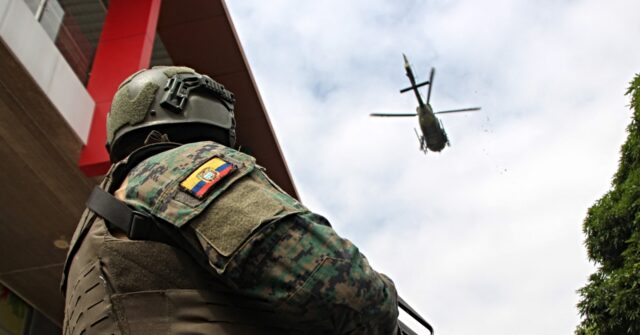
Tuesday’s announcement of the successful Ecuador-U.S. joint drug bust at sea comes roughly a week after the United States Southern Command (SOUTHCOM) announced the start of joint military operations in Ecuador against narco-terrorist groups, which SOUTHCOM described as a “powerful example of the commitment of partners in Latin America and the Caribbean to combat the scourge of narco-terrorism” while sharing unclassified footage of one such operation.
“Together, we are taking decisive action to confront narco-terrorists who have long inflicted terror, violence, and corruption on citizens throughout the hemisphere,” SOUTHCOM said in a statement last week.
“In March, we will conduct joint operations with our allies in the region, including the United States. The safety of Ecuadorians is our priority, and we will fight to bring peace to every corner of the country,” President Noboa said in a March 2 social media post.
Speaking at a security and anti-mafia forum in Quito hours after SOUTHCOM’s announcement last week, Henry Delgado, head of the Joint Command of the Armed Forces of Ecuador, stated that the joint U.S.-Ecuador military maneuvers will be carried out for an “indefinite period” in light of Ecuador’s long-standing security issues. The official reportedly urged Ecuadorian citizens to stay away from areas where criminal groups are carrying out illegal mining activities, and stressed, “It is preferable that [citizens] stay away because the Armed Forces will act decisively in each of these illegal sectors.”
President Daniel Noboa was among the 12 Latin American and Caribbean heads of state invited by President Donald Trump to form part of the “Shield of the Americas,” a regional security initiative led by the United States in the fight against drug cartels, illegal and mass migration, and stopping foreign malign influence throughout the region.
Noboa, describing the United States’s army as the most powerful in the world, told Univision on Tuesday that Ecuador’s Armed Forces want to work alongside U.S. forces, noting that it is not U.S. “interventionism” that American forces operate in the country, as it is a joint collaboration between both countries.
“We have reached an agreement, we are very clear on that, we have provided all the necessary facilities because we know we need them and because the threat is great, regional, but it is very clear and well established that they cannot work independently but only with the Armed Forces of Ecuador,” Noboa said.
Noboa reportedly questioned Mexico and Colombia’s absence from the Shield of the Americas initiative during the Univision interview, and claimed that both countries “do not want to resolve” the problem of drug trafficking in Latin America. The two countries were among those not invited by Trump to participate in the event. Noboa said that, unlike past attempts the Trump-led Summit represented the “first government in many years to show concern for the situation in the region.”
“They [Mexico and Colombia] don’t want to solve the problem for some reason. I’m not jumping to conclusions, nor am I going to give a specific reason, but I don’t see the point,” Noboa reportedly said.
On Monday, President Noboa detailed to Ecuador’s Radio Sucre that the Trump-led Summit addressed security subjects of concern for Ecuador such as drug trafficking, illegal mining, and money laundering. He emphasized that Shield of the Americas does not have an ideological nature attached to it, as it is a security alliance, unlike regional ideological groups such as the leftist Sao Paulo Forum.
“It is an alliance against drug trafficking, terrorism, illegal mining, and political corruption as well,” Noboa said.
Christian K. Caruzo is a Venezuelan writer and documents life under socialism. You can follow him on Twitter here.