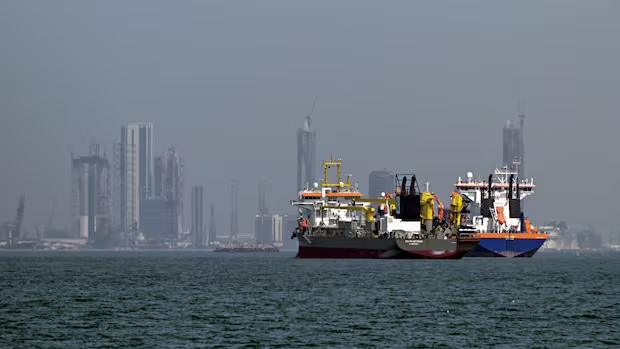
As the Mideast conflict escalates near the Strait of Hormuz, merchant ships and their workers have been caught in the crosshairs.
Thirteen vessels have been attacked in the strait since the U.S. and Israel began their war on Iran on Feb. 28, according to the U.K. Maritime Trade Operations Centre, and at least seven crew members have been killed.
“It’s the most dangerous place in the world at the moment,” said Phillip Belcher, marine director for Intertanko, an organization that represents about 200 owners of independent tankers worldwide. He says seafarers are on edge.
“They’re seeing the missiles going over their heads,” he said. “They don’t know if they’re going to be one of those being attacked in the next few minutes. They are unprotected sitting on those ships.”
The Strait of Hormuz is bordered by Iran, which has warned it would not allow any oil exports to pass through while it is at war. With merchant ships and their crew fearing for their safety, marine traffic has come to a standstill. UN Trade and Development estimates as many as 151 ships were transiting through daily in February. On Saturday, that was down to just four.
That’s effectively blocked a key shipping route that is the only sea passage from the Persian Gulf to the open ocean.
A Thai cargo ship was one of three vessels struck and damaged by ‘unknown projectiles’ in the Strait of Hormuz, Wednesday. Thailand says an explosion at the stern of the Mayuree Naree triggered an evacuation and that at least three crew members are missing.
There are reports some vessels are changing their tracking data to appear linked to China, hoping to reduce the risk of being targeted. Other ships may be turning off their automatic identification system transponder (AIS) to conceal their position.
But the huge tankers travel slowly, and Belcher says the strait is just 32 kilometres wide, with many Iranian spotters on the lookout.
“It’s almost impossible to pass through the strait undetected,” he said.
Hundreds of vessels stranded
For almost two weeks, hundreds of vessels have been stranded in the Persian Gulf, with about 20,000 seafarers impacted in the region, according to the International Maritime Organization.

And it’s not just oil tankers. There are also cargo ships that carry goods, food and chemicals. German shipping giant Hapag-Lloyd says it has six container vessels anchored in the Persian Gulf, to the west of the strait, and it would like to get them out.
“We look at the situation, I should say, hour by hour, so it’s very difficult to plan,” said Nils Haupt, the company’s senior director of communications. Even then, he says it’s too high of a risk to take for workers on unarmed civilian ships. “You would not dare to go through the Strait of Hormuz at the moment.”
Companies are also having to negotiate new insurance policies, with rates spiking because of the huge risks of crossing the strait.
“It’s a new chapter in shipping … commercial shipping has never been attacked and has never been part of a war,” Haupt said.

Sea mines a potential new threat
U.S. President Donald Trump last week said the U.S. navy could escort vessels safely across the strait, but so far that protection hasn’t materialized.
Belcher is skeptical of that plan, saying: “It’s too dangerous for naval ships to go in there. The conditions are not right or set yet for a naval ship to go there. If they did go in, they’d be missile targets.”
A new element to consider: American intelligence sources report that Iran has a plan to lay sea mines, which it last deployed during its conflict with Iraq in the 1980s.
British maritime officials say there remains no confirmed evidence of mine deployment or detonation in regional shipping lanes. Though Naveen Das, senior oil analyst at global trade intelligence company Kpler, says if it does come to pass, it would be a huge threat to maritime trade.
“It leaves that danger lingering in the market for much longer, which essentially means a longer-term disruption, even if there were to be some sort of de-escalation,” said Das.
Toll on workers
Many experts suggest the only realistic solution for resuming normal shipping operations is an end to the hostilities.
It’s all taking a toll on the workers aboard the vessels, who are often at sea for months at a time and now trapped in the Persian Gulf.

“They’re scared, they’re feeling very vulnerable, they want to go home,” said Jacqueline Smith, maritime co-ordinator for the International Transport Workers’ Federation (ITF), which represents seafarers around the world.
She says the ITF believes some seafarers are being put in harm’s way by shipowners that are forcing some vessels to attempt to cross the strait. “There are companies that are seeing that this is an opportunity for them to increase their profit in a very short period of time,” she said.
Smith says many seafarers are from developing countries, and have left home to build a better life for themselves.
“They shouldn’t be collateral damage for doing their job. Every worker has the right to come home when they finish their work.”