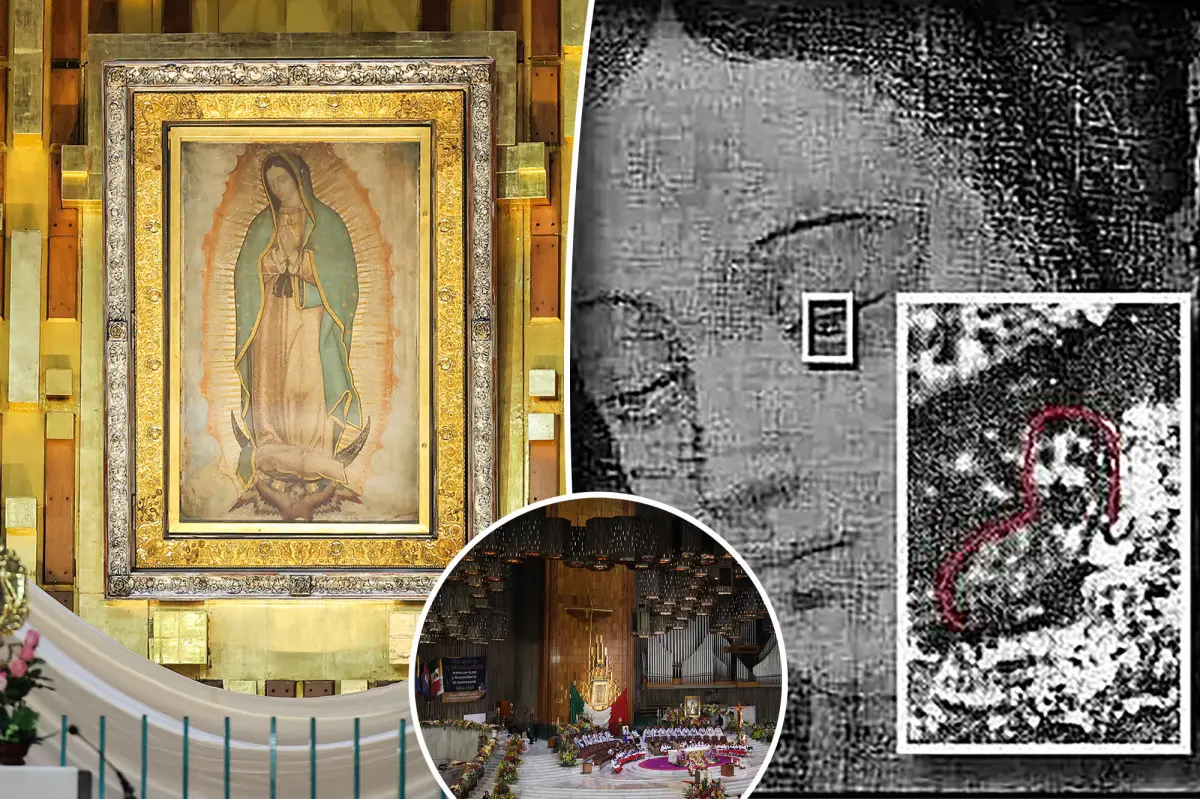
Scientists studying one of the world’s most famous religious images said a mysterious detail hidden inside might defy a traditional explanation.
When examining the Tilma of Guadalupe, a cactus-fiber cloak that many Christians believe bears a miraculous image of the Virgin Mary, researchers claimed they discovered at least 13 tiny human figures embedded in the eyes.
The reflections are so small that they can only be seen when the image is digitally enlarged, according to a report titled “Miraculous Image of Our Lady of Guadalupe” published by the St. Michael the Archangel Catholic Church in Texas.
According to the group, the figures look like witnesses who were present when the artifact was first revealed in the 16th century.
“The image of Our Lady of Guadalupe has been the subject of numerous technical studies since 1751 and extensive scientific investigations in recent years,” the researchers wrote, according to the Daily Mail.
However, despite the large-scale investigations, none of the findings offered any sound scientific explanation, which to this day “defies science and all human reasoning as it continues to baffle scientists and even skeptics.”
According to folklore, the image suddenly appeared on his cloak when he presented it to the bishop Juan de Zumárraga, which shocked witnesses and turned the object into one of the most esteemed religious objects in the Americas.
The cloak is made from coarse fibers of maguey cactus, which normally decays within a few decades, but the tilma has survived for nearly five centuries with little deterioration — despite exposure to candle smoke, humidity, dust and handling by pilgrims.
Historical records reveal that the tilma seems to be unusually resistant to insects and dust, noting that the colors have stayed bright even without a protective covering.
It measures about five feet by three feet and consists of two pieces of fabric sewn together with a simple seam running through the center of the image.
This echoed the findings from the researchers that said sections of the face, hands, robe and mantle of the digitally processed high-resolution images appear to have been applied in a single step — no sketches, corrections or visible brush strokes.
With all of this information, the scientists concluded that the technique used to create the image couldn’t be easily explained with known 16th-century painting methods.