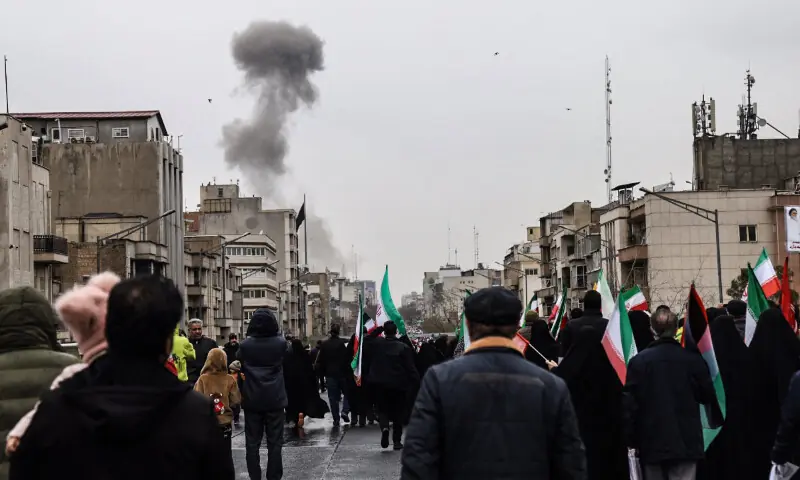
Deadly explosions rocked Tehran close to a pro-government rally attended by top officials on Friday, as Israel and Iran unleashed fresh strikes in a war that has ignited the Middle East and threatens to torpedo the world economy.
Since erupting on February 28 with US-Israeli attacks on Iran, the war has cascaded throughout the region, drawn in global powers, and sparked a major oil shock.
AFP journalists in Tehran reported loud blasts over the city skies, as Israel’s military said it had hit more than 200 targets in western and central Iran in the past day.
Iran’s state media said at least one woman was killed when blasts hit an area near a demonstration, where large crowds had gathered waving flags and brandishing banners reading “Death to America” and “Death to Israel”.
“These attacks are out of fear, out of desperation,” said Ali Larijani, secretary of the Supreme National Security Council, who attended the rally to mark Quds Day.
“One who is strong wouldn’t bomb demonstrations at all. It’s clear that it (the enemy) has failed,” said Larijani in a speech broadcast on state TV.
President Masoud Pezeshkian and Foreign Minister Abbas Araghchi also attended the rally, while images on Iranian media showed the head of the judiciary being interviewed just as a blast occurred.
Foreign ministry spokesman Esmaeil Baqaei vowed Iran’s military would teach the US and Israel “an unforgettable lesson”.
Shortly afterwards, state television said Iran had launched a fresh salvo of missiles at Israel.
Bread rationed
Iran’s Revolutionary Guards warned on Friday that any new anti-government protests would be met with a stronger response than in January, when several thousand people were killed.
Iranians speaking to AFP under cover of anonymity have painted a grim picture of life under the bombs, with cities in ruins and cash running short.
“People are desperately trying to withdraw their savings from the banks, as trust in them has vanished,” one 30-year-old woman in Kermanshah, western Iran, told AFP.
“Bread is now rationed. The population is extremely tense and outraged.”
The United Nations refugee agency has estimated that up to 3.2 million people have been displaced inside Iran since the war started.
Iran’s health ministry said on March 8 that more than 1,200 people have been killed.
US Defence Secretary Pete Hegseth said the US and Israel had struck more than 15,000 targets since the war started, warning that Friday would mark the most intensive bombing yet.
‘We won’t leave’
Iran has launched waves of drone and missile strikes against neighbouring states hosting US military assets throughout the region.
Saudi Arabia’s defence ministry said on Friday its forces had intercepted dozens of drones, including one targeting its capital’s Diplomatic Quarter.
AFP images showed black smoke hanging over the iconic skyline of Dubai after an attack on what was once considered a haven in a chaotic region.
Two people died from drone debris in Oman, according to state media there, while sirens rang out early Friday at Turkey’s Incirlik airbase, a key Nato facility housing US troops.
Later on Friday, Turkiye’s defence ministry said Nato defences had intercepted a ballistic missile from Iran in Turkish airspace, the third such incident in just over a week.
In another sign of the war’s spread, French President Emmanuel Macron announced the death of France’s first soldier in an attack in the Erbil region of Iraq.
Arnaud Frion, 42, was hit by an Iranian drone as the French military took part in counter-terrorism training, his commanding officer said Friday.
Elsewhere in Iraq, a US refuelling aircraft crashed, killing four crew members, though the military said it was “not due to hostile fire or friendly fire”.
In Israel, a strike on the town of Zarzir injured around 60 people, according to police, with AFP images showing burned-out vehicles and craters in the ground.
The conflict has also battered Lebanon, with authorities reporting at least 687 people killed by Israeli attacks.
AFP images from central Beirut showed buildings reduced to husks of rubble and burned-out shells of overturned vehicles as small fires flickered from the aftermath of strikes.
Israeli planes dropping propaganda leaflets over Beirut caused a number of loud booms in the sky, terrifying residents.