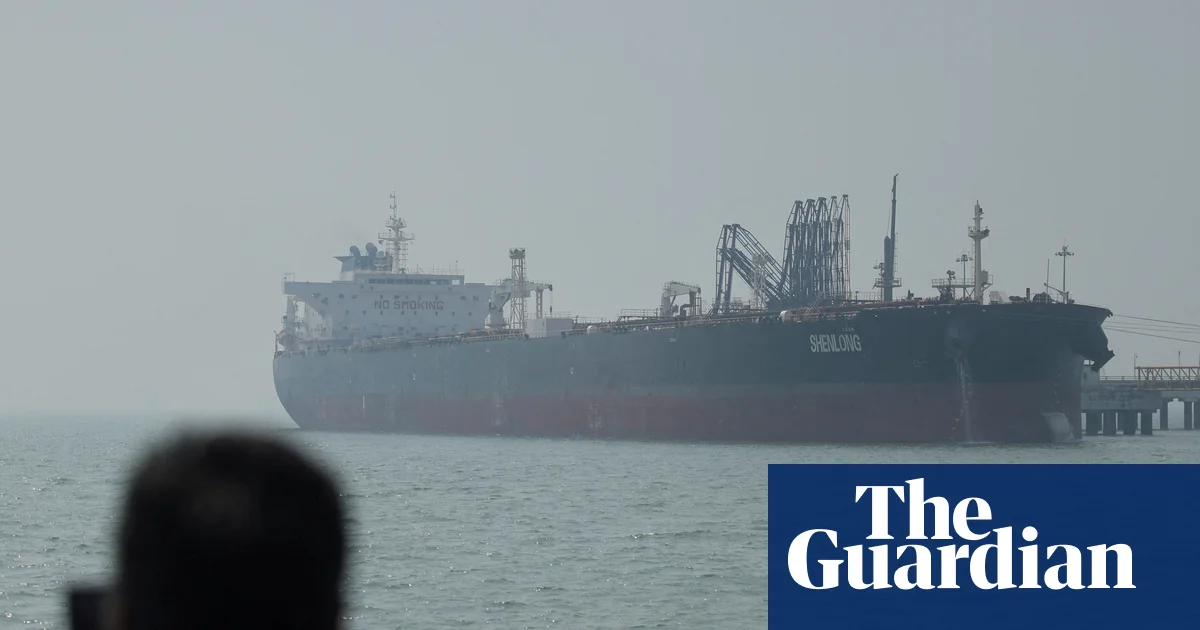
More than 1,000 cargo ships, mainly oil and gas tankers, have been blocked from transiting the strait of Hormuz by the Israeli-US war against Iran after Tehran closed the key maritime passage.
Officials in the Trump administration have suggested ways to get ships moving again, but amid continued Iranian strikes on tankers, and reports that Iran has started mining the narrow waterway, the proposed naval escorts have failed to materialise – even as energy prices have soared.
What is the strait of Hormuz?
The strait is the only maritime passage between the Gulf and the Gulf of Oman and the route for about a quarter of the world’s liquefied natural gas and seaborne trade from Gulf countries to reach the global market. Shipping in the chokepoint is confined to a pair of two-mile-wide lanes, one for outbound traffic and one for incoming, separated by a two-mile-wide meridian.
At its narrowest the strait is just 21 nautical miles wide (24 miles), with the deepest channel constrained on one side by the coast of Iran and on the other by the Musandam peninsula in Oman.
As a global trade route in a politically complex region, the strait has been targeted for leverage – including during the “tanker war” in the Iran-Iraq conflict in the 1980s. In response to that threat the US navy initiated Operation Earnest Will in 1987, the largest convoy operation since the second world war.
What is Iran doing?
As part of its policy to widen the geographic scope of the war and increase the global costs associated with it, Iran has attacked ships and reportedly started to lay mines in the strait, in effect closing it to marine traffic.
That has pushed up insurance premiums for cargo operators also concerned about the safety of their crews, although insurances policies continue to be written.
Surely this would have been anticipated by Washington when it decided to attack Iran?
US military planners have long warned that Iran could try to close the strait in the event of a conflict, but the Trump administration appears to have failed to anticipate such a response.
While some analysts had bet Iran would keep the strait open to ensure export of its own oil, the existential threat to Tehran’s clerical regime has triggered a far harsher response. That in turn has caught Washington out, including the energy secretary, Chris Wright, who said on Thursday that the US navy was not yet ready to carry out a naval escort operation.
“It’ll happen relatively soon, but it can’t happen now,” Wright said – after earlier wrongly suggesting that an escort had already taken place. “We’re simply not ready.” He added that “all of our military assets right now are focused on destroying” Iran’s military resources.
Why is the US navy not able to provide escorts?
It has long been understood by US military planners that countering an Iranian move to close the strait would be highly complex, reinforced by the experience of shipping being targeted by the Houthis in Yemen.
While the US has been targeting Iran’s larger naval forces, the country also has small, fast boats, which the US says have been used for mine laying in recent days.
The proximity of the Iranian coast to launch missiles and drones against shipping creates its own issues, in particular with Iran being able to “swarm” targets, making it more difficult to counter.
With transit lanes in places only 3 to 4 miles from the Iranian shoreline at the nearest, flight times for drones and missiles are very short, giving ships less than two minutes to react.
Last week Iran used a remote-controlled boat laden with explosives to damage a crude oil tanker anchored in Iraqi waters.
While the US has one of the world’s largest and most powerful navies, that does not mean it has enough assets required for escort duties. In the past, such operations relied on an international coalition.
“Neither France, the United States, an international coalition or anybody is in a position to secure the strait of Hormuz,” said Adel Bakawan, the director of the European Institute for Studies on the Middle East and North Africa, earlier this week.
Any US naval ships would themselves become a target – requiring air cover in addition to their own air defence systems.
What about sea mines?
Iran has a variety of powerful sea mines available, some more crude than others, which can be deployed just below the surface or anchored to the seabed and be set off as deep as 164ft below the surface. The country has conventional mine-laying vessels but it can also use fishing boats and other small craft.
While naval mines are a potent threat with a long history of damaging shipping, Iran is probably more interested in the psychological threat and increasing the complexity of any convoy missions. Among the mines in its arsenal is the Maham-3, which has magnetic and acoustic sensors, rather than being triggered by physical contact with a ship.
Can the US counter Iranian shore batteries?
Some analysts have suggested the size of the area involved and the availability of cheap and effective drones that can adopt a variety of tactics against shipping would require a ground operation to secure the coast along the strait, which in itself would probably be complicated.
“Strategic priorities, like opening the strait of Hormuz and securing what remains of Iran’s nuclear stockpile, will likely require some ground troops if no diplomatic options are pursued,” Brian Katulis, a senior fellow at the Middle East Institute, told the Wall Street Journal. “What we are looking at is potentially a very messy situation.”
“On the strait of Hormuz, they had NO PLAN,” the US Democratic senator Chris Murphy wrote in a post on X. “I can’t go into more detail about how Iran gums up the Strait, but suffice it say, right now, they don’t know how to get it safely back open.”